
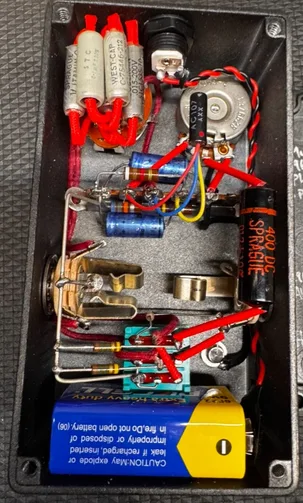
As with Germanium-transistor Fuzz Face inspired circuits that are all unique with different personalities, it goes with Germanium-transistor treble booster circuits. We imagine that there are no fewer than 30 makers of such circuits offered these days, and a quick search on Reverb substantiated that thought, with 286 listings for "Treble Booster" and 350 for "Treble Boost." When filtered for "used only" and sorted high to low, the Baldwin Burns Treble Boost from 1965, with an asking price of $4,851.53, stands in first place. The last original 1960s Dallas Rangemaster sold on Reverb for roughly $3,100. If the aesthetic and exactness of the original Rangemaster is your thing, Chris does make an amp-top version, as does the British Pedal Company out of London.
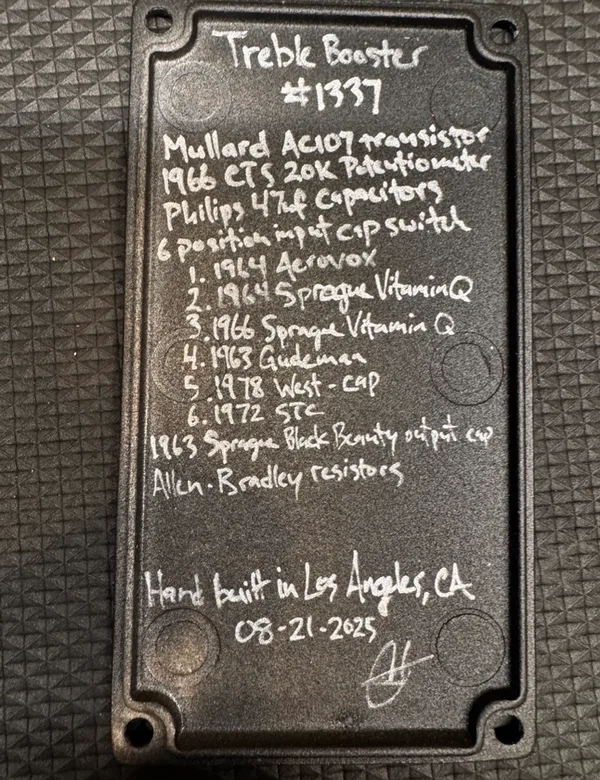
For now, we turn our attention to a much more flexible version of treble boost and a daily "go-to" for us: the R2R Two Knob Treble Booster outfitted with all-NOS parts. The Germanium transistor in this case is a Mullard AC107, and the photo of the build details the rest. How cool that Chris writes it all out on the inside of the back plate, with signature and build date. His take on this simple circuit expands upon what the traditional single-capacitor Rangemaster can do by adding an additional five-capacitor set. Each of the six positions, starting with the default Rangemaster capacitor size and increasing from there, extends the frequency range being boosted in a fairly dramatic way. And using older caps and the linear potentiometer from 1966 does introduce a different feel, compared to modern takes. It just has that older amp vibe and breakup.
To understand why Brian May felt the need for a Rangemaster Treble Booster, check out the YouTube video titled Brian May Star Licks Guitar Tutorial 1983. Just prior to the 4-minute mark, you'll hear his core AC30 cranked-up tone and then with the Rangemaster kicked on. The core tone is very dark and wooly, and treble boosters work exceedingly well with that starting point. Perhaps our favorites among all the amps and guitars we tried with the R2R were both the 1987 lead and 1986 bass circuits of the Marshall Plexi era — in this case, 50-watt Germinos with tweaks to the EQ on the amp and pedal tailored to both the Yaron LP and Nash Tele. We also had great success with the Park 18-watt that Mitch Colby built. Fender black-panel amps can get along with treble boosters, too, but to our ears, more as a Hendrix, rolled-off, cleaned-up, sustaining fashion. For those who have not modified their Princeton, Deluxe, or Vibrolux Reverb with a mid pot, the R2R can enhance the lower and upper mid frequencies, in order to fatten things up with your Strat or Tele, and depending upon which cap you select, that range can be dialed in for humbuckers, too. Endless sustain and bloom? Yes, push your British circuits and prepare for the launch. All in all, Chris described it best when he suggested that this circuit is basically a non-master-volume boost/preamp with plenty of gain. It excels as an always-on pedal, and when you turn it off, it doesn't take long to change your mind. As the inevitable reality of NOS part scarcity comes to fruition, perhaps now is the time to make the move on your own R2R Two Knob Treble Booster. TQ—Scott Ulrichs

R2Relectric.com
IG: djlavalamp