
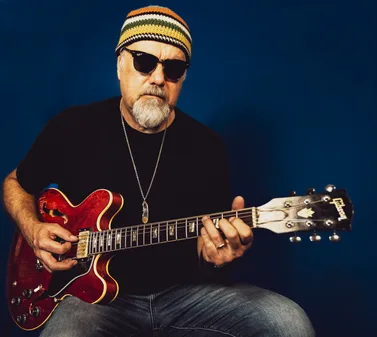
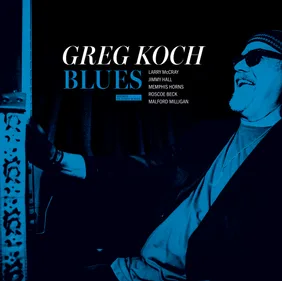
The master of gristle returns with a blues album that will blow your mind. On Blues, Greg Koch travels to the outskirts of infinity to unleash an album that showcases wicked guitar played over some of the most popular songs in the blues-rock songbook. Flying V blues master Larry McCray drops by with Jimmy Hall, Malford Milligan, and the Memphis Horns, and the result is passionate guitar playing with soul and fretboard fireworks. Koch talks about his musical influences, gigging, gear, and the death of 60-cycle hum.
TQ: How did this album come about?
I did something with the Allman Betts Band about three years ago. I'd known Devon Allman from online stuff. He'd seen some of my videos. He reached out to me on Instagram, and we were talking. Then, I had him on the podcast.
He announced dates for the Allman Betts Band and that they were going to have special guests. So, I sent him a text saying something crazy like, "I see that you're going on the road again. If you need a Viking gristle infusion into your event, please keep King Gristle in mind."
He texted me back saying, "Just for that text alone, you're in!" [Laughs.] That's how this whole thing started. It went really well, sitting in with those guys, and Devon and I hit it off. Then we were going through St. Louis with my trio, where he lives. He came out and sat in. He said, "Dude, we need to get you to a larger audience." I said, "Well, please do." [Laughs.]
So, we started brainstorming ways to help facilitate that. So, it's basically a partnership I have with this record deal with him. It's with the goal of helping me get in front of as many people as possible. Maybe I don't have to work quite as hard. [Laughs.] Rest assured, the more things happen, the harder you have to work.
He had an idea of doing a compilation record to raise money for a higher-budget record with special guests, which could have a theme, which may or may not include Hendrix. So, we decided to do a compilation because I have 20-plus records. My stuff is all over the map, but when people come to the merch table at my shows, they always ask, "What's the bluesiest record you have?" So, we culled all the blues tunes from my back catalog. I also found some unreleased Muddy Waters tunes I recorded. I had "Can't Be Satisfied" in the can.
We brought in Larry McCray as a guest, who recorded in Michigan. We constructed a duet where we switched off verses, adding his guitar and vocals. It turned out awesome. I also had "Can't Lose What You Never Had." It was a very cool arrangement, but I didn't like my vocals. They said, "Why don't you have Jimmy Hall sing on it, and the Memphis Horns play on it?" I said, "That sounds great!" The Memphis Horns kicked ass! So, the album is a retrospective but also includes a couple of new tracks. We also had an additional live track called "Don't Change Horses," with Malford Milligan singing. We released that on the CD version, which has more tunes than the vinyl version.
So that's the story. People have been grooving on it, and it's going well, but when I did the Rick Beato podcast, it blew up. It went crazy. [Laughs.] It's been a lot of fun, but some of those tunes are 30 years old. People don't make that correlation. They think it's new stuff, but they're digging it.
TQ: You can't tell it's older material. It's recorded and produced very well.
"Red House" goes back to 1995 or '96 in this club in beautiful Oconomowoc, Wisconsin. Originally, it was on a record called Double The Gristle. It was half live, half studio, double CD, that I did back in the day. "Steppin' Out" was from that collection. It's weird listening to that stuff after all these years. Every time I record something new, you're so hyper-focused on getting that thing done and that you hear every mistake. You wish you would have gone back and fixed it. Then you never want to hear it again, but by the time it comes out, that's when you really have to go to work to promote it.
As soon as I'm done with a recording, I've moved on. I can't even listen to it anymore. Then I hear it by accident and think, "Hey, that's kind of cool. What is that?" Then I start hearing all the mistakes I made. [Laughs.] When I listen to it now, in retrospect, I'm not as perfection-oriented. Most of the stuff I like to listen to has all the warts. I like mistakes because you realize it's that human element that happens in the moment. I listen back to my stuff now and say, "Yeah, that's you." [Laughs.]
TQ: Does listening to those recordings give you gear flashbacks?
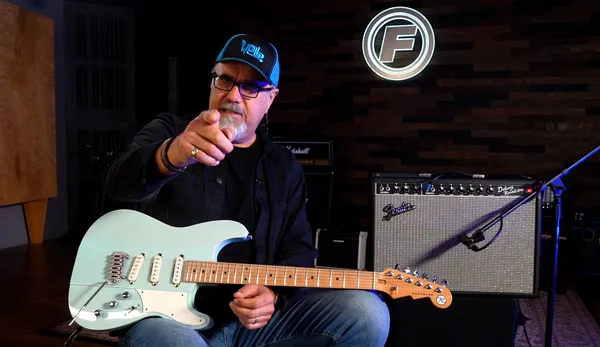
When I listen to "Red House" and "Steppin' Out," I remember back then I was using a Deluxe Reverb and a Vibrolux Custom Reverb, which is the one that came out in '95. When we started mixing it, we got rid of the Deluxe Reverb channel because it didn't sound right. So, it's basically the Vibrolux. I was also using a Fulltone Fulldrive 2. This was the one with the silver casing with the sticker on it. That's how old it was.
I was also using my Fender Custom Shop Strat, which had Lace Sensor pickups. That guitar was so bright. It had an ash body and a big old fat maple neck, so it was a very bright guitar. Those pickups worked well for that guitar because it tamed the brightness. So, when I listen back to that, I think, "That was some good tone!" [Laughs.]
TQ: Are you hard on yourself as a player listening back?
When a guitar player has chops, people think it means they can play fast. It doesn't matter how slow, soulful, or cool your phrasing or vibrato is; if someone is offended by your technique, they're going to say, "Oh, he's just a fast chops guy." I remember back in the day, in my little microcosm of the Milwaukee area, I used to hear, "He always plays too much." When I listen back to that "Red House," compared to what passes for blues nowadays, which is sort of a blues shred thing, that was not too much! [Laughs.] It wasn't too much then, and it's not too much now!" [Laughs.]
TQ: Regardless of what gear you're using, your personality is always the dominant force.
I've tried to make that happen! [Laughs.]
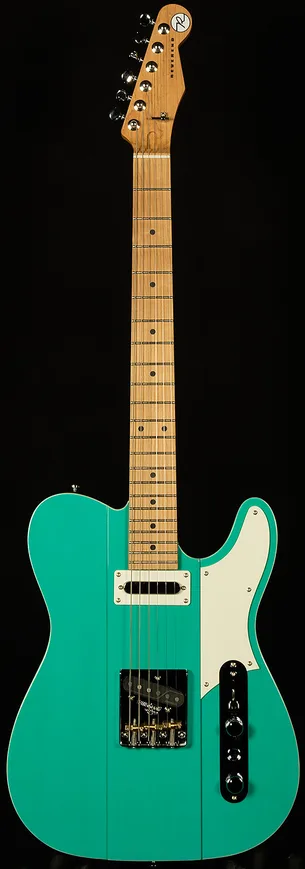
TQ: Your Greg Koch Signature Gristlemaster guitar by Reverend sounds like a blank canvas. Whoever plays it will get back exactly what they put into it.
Absolutely. That guitar puts it all in your hands. When I first got that, I plugged straight into an amp. When I was playing with my trio and a B-3, I didn't feel the need to have additional gadgetry because that whole palette was being taken care of on the other side of the stage. I just wanted a pure guitar tone. I liked the idea of having pristine cleans, a slightly meatier clean, and then off to gristle land. That's what I aim for with all these signature guitars.
I wanted a guitar where you can go straight into an amp, turn it up, and everything is in your grubby little mitts. Or you can flavor it with different pedals. All that stuff was created within the mindset of having it be as much in control with your hands with just a cord and a guitar amp. Anything on top of that is good times.
TQ: How much back and forth went on between you and Fishman in regard to the pickups?
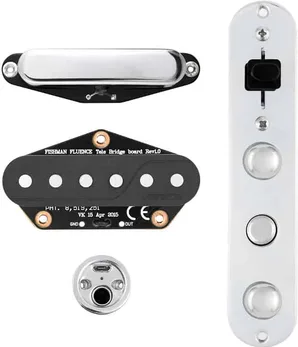
I was involved with the voicing on the first Fluence pickup. We did the Strat pickups and then the humbuckers. I knew the process and how it would work. We voiced them in real time. It's not modeling. There's a preamp onboard, but the coil functions as a regular coil with magnets. It's just that the coil, instead of being wound, is stacked on circuit boards with the coil printed on the circuit board. That in itself is truly a blank canvas, but you can voice it through a clean amp and manipulate it to be whatever you want it to be. It can also have multiple voices.
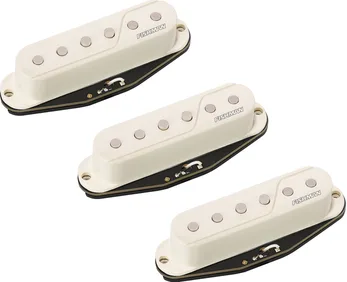
When I voiced my pickups, I sent them a few of my guitars. They did a sweep of my pickups using a program so they could get a basic structure of how they react every which way from Tuesday. When it came time to voice the pickups, we had a guitar that allowed us to unplug the Fluence prototypes and then plug in the conventional wound pickups to listen to them and make adjustments on the spot. By the time we were done voicing the pickups, I preferred the Fishman versions over the gold-standard ones that we were aiming for. It only took a day.
The next time I heard them, they sent me a prototype, and I was like, "Shit! We nailed it! This thing is happening." The P90s were a little more difficult because this was right during COVID, so we voiced the pickups the weekend before the lockdown. I did one more voicing session after the lockdown because of some technical constraints on what we were trying to do. The process was a little more complicated, but I love how they turned out.
Of the two voices we picked, one has a slightly meatier version with a little more output. The important thing to remember about the Fluence pickups is that they don't add things to the first sound to get the second sound. It's an independent voice. It happens to be a little meatier with a little more output, but it's not constructed on the shoulders of the first.
TQ: And no 60-cycle hum!
Exactly! That's why I was interested in doing these pickups with them, to begin with. You have the guitar that you really like the sound of with regular pickups in it, and then you have the noiseless guitar that you know you have to use when you're in certain scenarios where you can't avoid the 60-cycle hum. It doesn't sound quite as good, but it gets rid of the noise. I wanted it to be the opposite. I wanted a guitar that I preferred the sound of—and it's noise-free. And doggone it, we did it!
TQ: Do you bring any other guitars on the road?
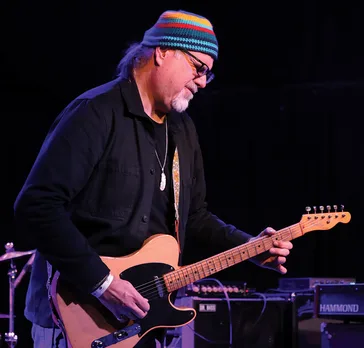
I brought my '53 Tele. I start off the night with it if I'm in a room that doesn't make noise. If there are rooms that make noise, I don't even bring it. If I have to bring one guitar, it's my signature model because it's sussed out so ergonomically that in any situation I run into, I know I'm going to be able to handle it. But there's something fun about playing the '53 because you have to overcome all the things that are happening on it. You play to that, and that in and of itself is the cool thing. You can't reconstruct those weird idiosyncratic things that happen with those old guitars. There is a cool thing about playing those old guitars, but if I'm in a scenario where I have to bring one that has to do it all, I'm bringing my signature model. It's got everything I need on it.
TQ: What amps are working well for you on the road?
I'm using Tone King amps. They sent me a Royalist, and I realized that's where I needed to live. [Laughs.] I played Fender amps, but whenever I played through Marshalls, I always felt I was set free. All my idols played Marshalls. The Royalist is basically like a mini-Marshall that's built to annihilate. It's got an attenuator, and I use it like a JTM 45 with the 1964 setting. I've messed around with the attenuator, but when I'm live on the road, I've been using it with the attenuator off and adjust the volume where I need it and push it over the edge with my pedals.
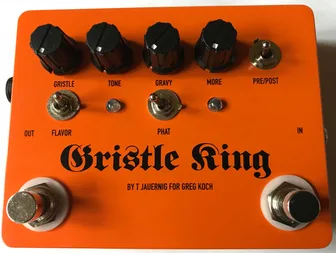
Sometimes, I use the single 12" speaker combo with the 1x12 extension cabinet, and it sounds... awesome. The cleans have a little bit of sass, and when I hit the second voice on my pickups or add the clean boost on my Gristle King, it fattens up in a way that is very organic. When I hit my Gristle King lead sound, it sings like a banshee in heat. It's been great on the road, and I haven't had any problems. I use the Tone King Imperial for smaller gigs. I played across Europe with these things, and they're built like a brick shit house. They're ready for battle. [Laughs.]
TQ: What's on your pedalboard?
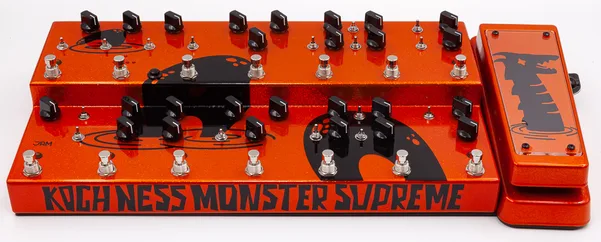
JAM pedals from Greece made me the Koch Ness Monster multi-effects pedal. The Koch Ness Monster Supreme is the one I use at gigs. It's the only one that has a version of my Gristle King on it. On the Koch Ness Monster Supreme, there is an arsenal of great JAM pedals on it. The WaterFall Chorus is my favorite. I wasn't a huge fan of chorus over the years, but I use it as my Leslie effect. I set the rate high, so it sounds like a Leslie. I love how it cuts through. It also has the Harmonious Monk on it, which is a harmonic tremolo. Then there is an analog delay on there that we call the Delay Llama. I use that as a slapback. I have that on all the time.
Then there's the Delay Llama Extreme, which has presets. I use that for the longer delays and the crazier shit. Their UniVibe, which is the RetroVibe, is really awesome. I use that all the time. Then there's the Gristle King and then a fuzz, which is very usable. It's called the Eureka! It's a combination of a Fuzz Face and a Big Muff. After that is the LucyDreamer, which is their take on a Tube Screamer. It's got a mix control and a preset boost. Then there is a thing they have called the Boomster, which is a clean boost—kinda like a treble booster. Lastly, there's a wah pedal. I go to gigs, I plug this thing in, it takes me two seconds to set up, and away we go. It's a clean-sounding unit.
TQ: What's next?
I'm having a blast doing what I'm doing. I'm gonna keep on recording and releasing music. This particular band aggregation is an incendiary unit. It's the best vehicle I have ever had to do my stuff. Now, I have the infrastructure to go out and tour and perform. I want to get out and turn as many people as possible on to what I'm doing. It's fun to travel around and play the music you've always wanted to play. So, we're just going to keep on doing that. TQ—Oscar Jordan
gregkoch.comreverendguitars.com
fishman.com