
TQR: Hey now, what’s happening over there in Illinois, not getting electrocuted and staying grounded with your life? How in the world did all this start for you? A guitarist in the family or a siren of a singer?
So good to catch up! GREAT question. Yes, my family was always involved with music. My mom was a singer, not professional, but sang for weddings and things like that, and so did her two sisters. There was always a piano in our house. There was always music in the house, and I have been a huge electronics hobbyist from the age of about ten, building Heath Kits, Knight Kits, a signal tracer, a car engine analyzer, a capacitor analyzer. I built lots of DIY projects from my favorite magazine, Popular Electronics. All of this was in the early 1960s to late 1970s. I took electronics classes in college and during that time I was repairing televisions on the side. There was a furniture store/RCA television dealer and repair shop in the little town of Hinckley, Illinois where I grew up. I worked for the repair guy and made many rural house calls to repair color TVs. I played guitar in high school but ended up moving onto solely concentrating on keyboard.
TQR: Cool! We remember driving in a van to a gig at the University of Northern Illinois and it seemed to pop up in the middle of a cornfield. We brought along a pair of 100-watt Marshall stacks. The neighborhood loved us. Was Edgar Winter an influence?
Ahaha, yes! My favorite groups were the Doors, Deep Purple, and Santana. All bands where a Hammond B3 played a prominent role. I’m not a guitar player. I had a Farfisa combo organ that was my instrument and a black panel Fender Bassman. I loved that setup! Speaking of Northern, I went there for grad school for a year. I am still really into music and was in a garage band up until about five years ago that played bars and parades. I still have a Hammond 103 that I restored in my family room, and I have a separate room for my other keyboards and vinyl setup. It is powered by a stereo amp that I built from scratch using a pair of 6550s for each. It rocks! My kids and grandkids love singing Christmas carols with me, now as a grandpa.
TQR: From there to building the Amp Maniac…how does that happen?
All this started because I had a friend who plays guitar, named Larry Beck. He lives in south Florida and he’s a big Telecaster fan. He has a few of them. We got to talking about running these vintage amps, because his voltage down there was like 125. At that time, I was restoring a Dynaco ST-70, which is an early stereo amplifier kit that used a pair of EL34s as power tubes for the left and right channel. Larry and I discussed the over voltage problem. The power transformer on my Dynaco ST-70 was so hot you could fry an egg on it. I discovered some circuitry in the ARRL manual, A ham radio handbook that showed how to take A 12-volt filament transformer with a center tap and lower or raise the voltage 6 or 12 volts. From there, Larry encouraged me to build one so he could try it out. I built a handful of them. I sent one to him and tried one on the Dynaco and had a few left over so I put them on eBay to see what happened.
TQR: How was the trial-and-error process for those first builds? Did you nail it or were there a few iterations?
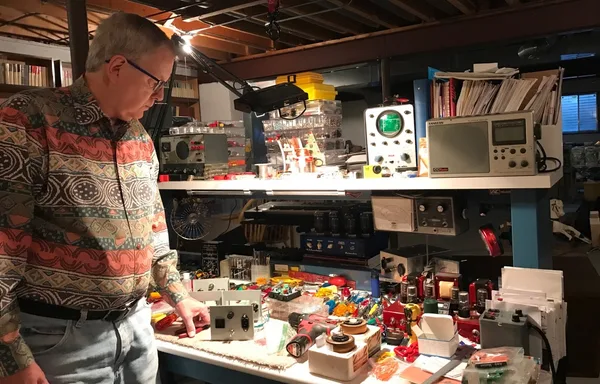
Oh, yeah, it was fairly logical to me. I used the schematic since I knew how to read them well from all of the television repairs and built the first one and it was easy after that. They were early versions of what I build today but they worked great. So, the three that were left I listed on eBay to see if anyone else was interested. From there, I was contacted by a fellow named John Peden, who bought one and contacted me. He said he was a good friend of David Wilson, the ToneQuest Publisher, and told me David would like to talk to you. I said, sure, absolutely. I sent one to David and then he called me up, and we did an article on them that came out in July of 2009. When that issue of ToneQuest hit, I got orders for forty of them the first day, and I only had ten made! John Peden also purchased one for G. E. Smith. He loved it. The photo is on my website. That’s how the Tone Preserver was born.
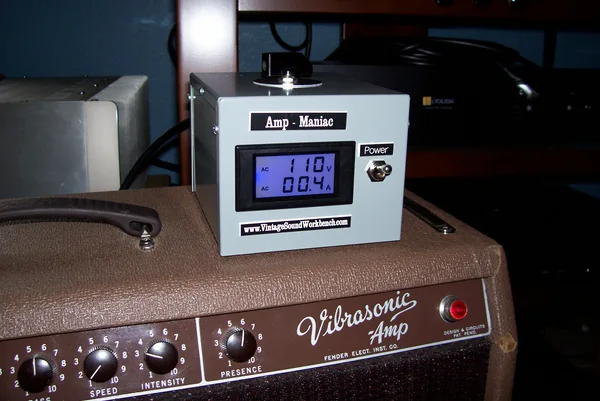
In my own mind I was never happy with just the two-switch situation, only allowing the voltage to be adjusted by 6 or 12. I wanted to be able to dial to the sweet spot for each application perfectly, to make each amp sound its best. That’s when I started to use the variable transformers. Back in the day I had bought twenty-five of them and thought that would be plenty. When David heard that’s all I had, he said, you better ramp it up, buddy! Those are going to fly. So that’s how the Amp Maniac was born.
I started to get feedback from players that the analog meter was hard to read, especially in a dimly lit bar gig. Soon after that, self-powered digital meters became available. The early digital meters had to have a separate 6 or 9-volt power supply and there was no way I could fit that in the box and keep them a decent size along with the plug-in cord, switches, etc. Then I was able to get digital meters that were backlit, and sales increased due to that, and then ultimately meters were able to display both voltage and current, which was even a better, because if you can see how much current your amp is drawing on a regular basis, if something starts to go haywire you can evaluate the amp to see if it is a cap going bad, a rectifier, etc. I switched to that meter. When I first was using rectangular meters, I had a hand punch, called a nibbling tool which only took off a bite of metal at a time. That was a real pain and tough to get correct, and I’m very fussy about how things look. At that time, I was in a band and our bass player worked as a CNC programmer at an aluminum manufacturer. He made me a punch that exactly fits these rectangular meters and I still use it to this day. Things progressed from there. I use 14-gauge silver-plated stranded wire in them with crimped and soldered connectors. I use the best quality components I can find. I build them to last like a small appliance, not some low-cost transistor radio. The highest quality makes a difference, and everything matters. I guarantee them for life.
TQR: The pandemic was a strange ride for your business?
Oh! Sales were okay but supplies were tough! Things got really bad. Meters were out of stock and I had a backlog of fifty to make. I found some meters that were equivalent bit different sized, so my punch no longer worked. It was back to the nibbling tool. Things took so much time. Fortunately, the meters came back around, and I got rolling steady again. I have had supplier issues with components but that’s easy enough to deal with. The price may be a bit different but that’s fine as long as the quality meets my standards. Finding the variable transformers is a continual issue, even to this day. I’ve learned to manage things, look ahead, and keep supplies rolling in.
TQR: Well, what a unique business and niche, as a one-man show. Can you tell us the positive reason why a player would want to utilize an Amp Maniac and your thoughts on vintage Fender amps?
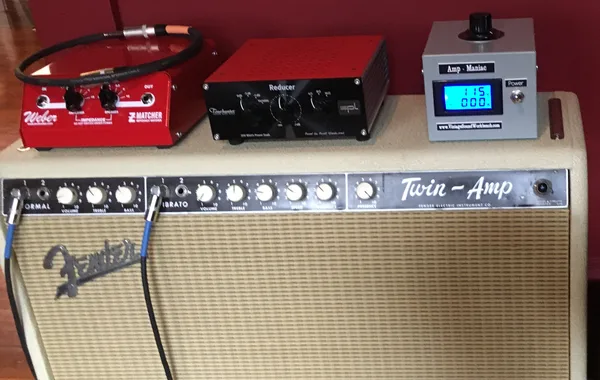
There are two primary reasons to use them. One is from an electrical standpoint, the other is from a sonic or acoustic standpoint. The Fenders from the ‘50s and ‘60s were usually made to run on 115 or 117. The voltage today depending on the time of day and where you live, ranges between 120 and 125 volts. That is significant. You are basically running a power transformer that was made for 117 volts and it is being overpowered by 8-volts. The effect is that it raises the filament voltage, the B+ voltage, changes the bias on your output tubes, so everything is off, and in some cases significantly off.
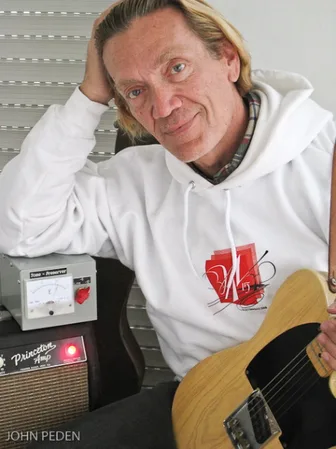
These Fender amps do not have voltage regulators in them, and the transformers and tubes run much hotter. We all know there is a finite supply of great vintage tubes, whether we want to admit it or not. High voltages can wear them out much quicker. From a sonic standpoint, it lets the amp breath, gives it some openness, removes the harshness, and I could go on and on with what everyone tells me after they get one.
TQR: Yes. The amps are so much happier with the Amp Maniac and voltage smoothed out. There is a sweet top end and fidelity, creamy roundness and harmonically beautiful sound, as well as a feel in your hands and fingers that makes things so much more inspiring and organically sweet. Our Texas power grid here is something else, we don’t even have words for it some days, but thank goodness for the Amp Maniac. We fire it up religiously with everything and it is stellar, let alone for safety reasons. Tonally, it is a magic box. Most players will hear and feel the difference and find it fascinating to shape their tone with. Any last words of wisdom and what is ahead for you?
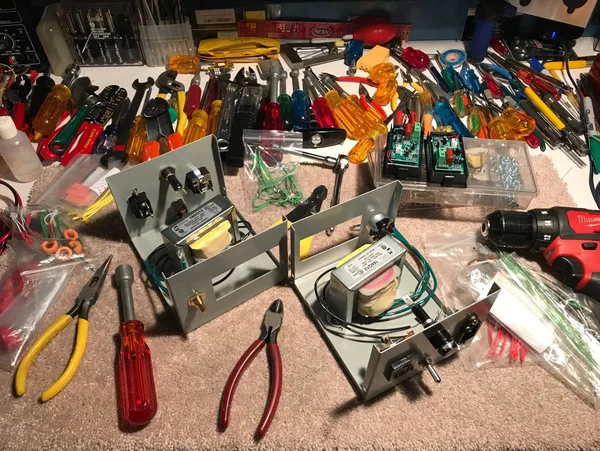
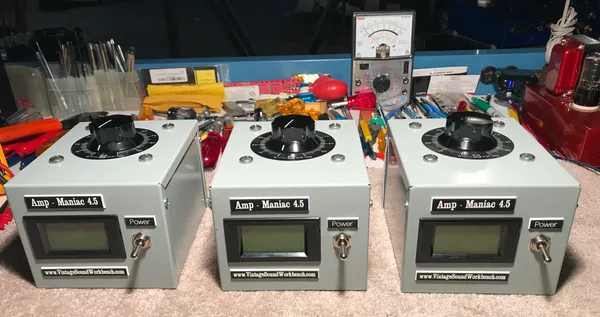
Aha, you nailed it! One of the things I’ve sometimes run up against is that the Maniac is rated at 2.5 amps of current. It will handle a Marshall 100-watt stack. Some guys want to run a pair of amps with it. Like a Bassman and a Showman. They worry about blowing a fuse. I’ve done custom orders where I make a 4.5-amp version, on a limited basis, because finding that transformer is very difficult. If someone wants one, we can discuss that. You can find YouTube videos where the Amp Maniac is demonstrated by my friend Stan Miller. Stan has a channel called Millstap, where you can see the Tone Preserver and an Amp Maniac tested and reviewed. Stan does an in-depth analysis of how the voltage changes within the amp that readers might find fascinating. Stan purchased one of the original Tone Preservers after he saw the review in ToneQuest back in 2009, so things have a way of running full circle. I recently saw a Facebook photo by Joe Bonamassa where he was taking delivery of a long sought after Dumble amp. What do you think was sitting on the floor next to the amp? An Amp Maniac! I usually build six to eight Amp Maniacs at a time, and I have a technologically savvy twelve-year-old grandson and hopefully I can eventually turn this over to him. Quest forth… TQ—Riverhorse
www.vintagesoundworkbench.com