
We weren't the least bit surprised when John Grammatico shared with us that David Wilson was the only one who was open to hearing his work in the early days. Many great builders made their way into these pages once it was realized they walk the walk, have something special for readers, and John is no different. We have always been believers in his amps. Many of our TQ readers own them and remind us of that often. When John began conversations with us this past year over a few months, about his power cables and how they affect sound, we were all about it. We have learned that everything matters. Even down to getting a solder joint right. His path to all this is a rowdy one, filled with a few twists and turns that have been a heck of a ride. And no, it is not easy making a living as a one-man show in this field, for the guitar world is a crazy one, flavors of the month abound, and they disappear faster than imaginable, but John has not. He's still finding his way to creating magical gear, and that will never change.
Here is John, sharing beyond candidly everything he has gone through to get to this absurdly stellar moment with his art.
A pivotal moment in my life was when I was 14. I went to a hi-fi store with my cousin, who was looking to buy a stereo system. Fortuitously, the Linn rep from Glasgow, Scotland, happened to be there demoing their renowned turntable against a CD. I was so moved after hearing it, I had to have it. I saved up and bought a Linn turntable and speakers and a Naim amplifier, and I've been on the journey pursuing great sound ever since.
I grew up on rock and hardcore and then later got into blues, jazz, classical, Baroque, opera, and Indian classical music. It was my obsession with Stevie Ray Vaughan and his guitar tone that inspired me to get into building amps and to do this right, I felt I had to breathe the same air as he did, so I moved to Austin, Texas.
This did not go so well. I thought guitar players in Austin would also be obsessed over guitar tone. What I encountered was people saying your amps are cool, but I like my Blues Jr. It seemed that the requirement was that the amp had to say Fender. To pay my rent, I was doing amp repairs. One guy couldn't pay his bill, so he gave me a non-working Fender reissue tweed Bassman. I thought, what am I going to do with this? I decided to gut it and make it as close to a vintage tweed Bassman as I could. When people heard it, they said, "You need to build this." I said, "Nah, I don't want to be known as a clone guy. I've developed my own designs." Then I questioned whether I'd even be able to sell any of my own amps, so I thought, well, I can buy Bassman cabinets, chassis, and transformers one amp at a time, so it wouldn't take a huge investment. I knew selling in Austin would be tough.
Coming from the hi-fi world, I knew magazine reviews would be key. I reached out to all the magazines, and they all blew me off, except for ToneQuest. David called me and we had a nice chat. He said, "Obviously, I've never heard of you, but you sound like you know what you're talking about. If you want, you can send me the amp and if I like it, I'll review it. If I don't, I'll send it back to you with a polite explanation, and all you'll be out is the shipping." Totally fair, so I sent it. He called me and said, "Okay. What's going on here? I've been doing this for a long time and when I get an amp, I open it up and I already know how it's going to sound, but I opened yours up and saw things I've never seen before, and it sounds like this?" In his review, he said, short of buying a pristine and well-maintained original Bassman, this is the best you could do. This immediately got me a bunch of sales and gave me a boost of confidence, so I decided to take an amp to a blues jam at Maggie May's on 6th Street in downtown Austin. They were nice enough to let me put it onstage, and the guy running the jam called up the manager of Music Makers on South Lamar and said, "Hey, man, you need to come hear this amp. His name is Luke Cutchen and he is now a guitar player in the band Midland. He said, "Your amp sounds great. I want to put it in my store." So now it looked like I might actually sell amps in Austin, and they did sell a few, but still I was mainly shipping amps out.
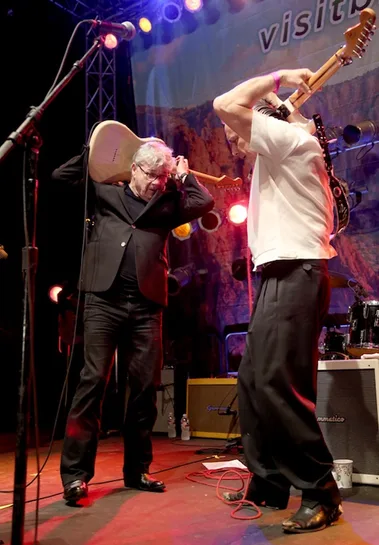
Jimmie Vaughan would go into the store from time to time, and Luke would ask him to try out my amp, and he'd politely decline each time. One day he finally agreed to. Luke called me up after just having sold an amp, and he said, "Do you have an amp ready? Jimmie Vaughan wants to try your amp." I said I have one built and playable, it's just not aesthetically completed. Okay, bring it here at 2PM. I'm meeting Stevie's brother and I'm nervous AF. Luke says, "Tell him about your amp." I said, "Or he could just plug into it..." Jimmie is about to plug into my amp and turns to me and says, "I'll tell you right now, I'll try your amp, but I'm happy with my Fender deal." I don't care; Jimmie Vaughan is about to play my amp! He proceeds to plug into the bright channel, cranks the volume between 9 and 10, cranks the treble, cranks the mids, cranks the presence, and turns off the bass. WTF?! I've only ever tweaked the amp in the Normal channel with everything at noon. I'm going to walk out of here with my tail between my legs humiliated. Somehow it sounds incredible.
This was before smartphones, but people must have been texting because the room started to fill up, and after two hours of Jimmie playing, there must have been 50 people in there. He was playing all these examples of old music, saying, "and this is how they did this," etc. And at the end, he turns to me, in front of everyone and says, "Will you take a check?" I had just been baptized by the blues godfather of Austin and the word spread fast. Two weeks later he called me up and said, "How would you like to take a drive out to my place?" He showed me his guitars and classic cars and said, "If you can build me exactly what I want for the big stage, I'll play your amps."
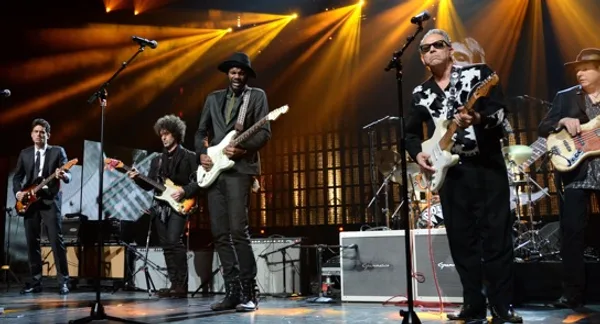
We got together a bunch of times, and I'd bring over my soldering iron and boxes full of components. We tweaked the circuit until he was happy. Then he brought up the look, saying he loves tweed. I said I do too, but I feel Leo owns that look, and he agreed. So, he said, "What about matching my guitar?" I liked the sound of that and said I'd get on it. Once I found the Tolex that matched, I called him. He was getting on a plane in California but answered the phone. He said, "You know what? Order two." I ordered two cabinets in this new look and built this new circuit now called the Kingsville amp, and he went on tour with them. The sales came in immediately, and all the magazines that had blown me off called me up and said they'd love to review my amp and here's a free subscription. This led to my amps being onstage at the Royal Albert Hall, Carnegie Hall... Experience Hendrix Tour used by Doyle Bramhall II, and Buddy Guy—Kennedy Center honors inducting Buddy Guy and Led Zeppelin; the Austin City Limits Hall of Fame induction of Stevie Ray Vaughan and Willie Nelson, and the induction of Stevie Ray Vaughan into the Rock and Roll Hall of Fame.
After building lots of Fender-style amps, I was ready for a new flavor. I bought this Fender shirt in green online. The shade of green in person didn't match the online pic, and I didn't really like it. I only wore it out once, and this was to go to Lifetime Fitness. On this day, some dude comes up to me and said, "Hey, man, you play? I said no. He said, "But you're wearing a Fender shirt." I really didn't want to get into a conversation with this guy, so I reluctantly said, "I build amps." He said, "What kind of amps?" I said, "Tube amps." He said, "Yeah, I figured that, but what style?" I said, "Fender, mostly tweed." He said "Cool, I have a bunch of vintage Fender amps and a Dumble." I said, "Wait, did you say you have a Dumble?" He said yes. I said, "You mean a kit...or a clone?" He said, "No, it's a real Dumble." "You have a real Dumble?" "Yes, it was owned by Jackson Browne. It was used on Running On Empty." "Alright, who the heck are you?" He asked if I wanted to exchange numbers and we went back to working out. Shortly after, he texted me and said, "What are you up to?" I said I've got a couple guitar players coming over. You're welcome to come hang. He said, "Do you want me to bring the Dumble?" Uh, yeah!
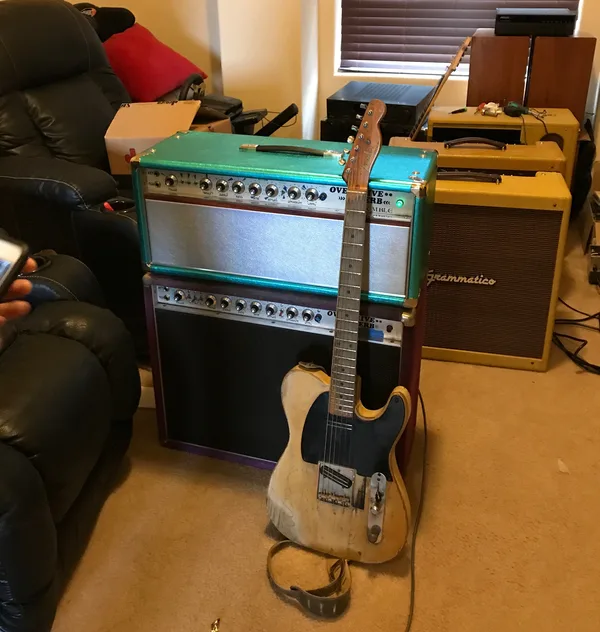
So, an hour after meeting this guy, I have Jackson Browne's Dumble at my place, and he also brought Danny Gatton's Tele, signed by Willie Nelson and Roger Miller, and a clone of this amp that he claimed was built by a guy that Dumble trained. However, it did not sound anything like the real Dumble. I had heard 10 Dumbles in person, some better than others, but none of them blew me away. This one, however, had the magic that spoke to every part of my being. The range of colors, textures and harmonics was incredible. There was this stretchy chewiness that made note bending so expressive...and the way it would lock onto a note and soar away with it with an unreal sustain. The frequency response was very wide and smooth that had an EQ shape like the horizon on the ocean. This was so much more sophisticated and complex than anything I'd ever heard before. I became consumed with learning what exactly he did just like I learned about Fender, Marshall, and Trainwreck. Well, the deeper I dug, the more I discovered small nuances that were not a part of the formula of those other amps.
One day, I watched an amazing video by Vertasium about the impossible blue LED. Like most people, I assumed the blue color came from the coloring in the plastic. This video changed the way I viewed my approach and realized I had to change my approach to a much more Japanese sense of subtlety, with attention to the tiniest details at a molecular level with substantially much more precision. I don't play guitar, so I found I could make accurate assessments of subtle changes to a power cord in my hi-fi systems. Eventually, I was getting results that had something special going on. Musicians thought the same thing, so I thought I should take some examples to a true hi-fi store here in Nashville that has state-of-the-art stereo equipment. His conclusion was mine was better than his $2,500 reference cable, and he bought four from me and said he would use his network of dealers to help me get them to market. I was gearing up to do this. In the meantime, I had made some miniature versions for a friend to try out in his studio. The results translated to everything in the recording chain, as well, especially on the analog-to-digital converter.
He was recording a band, and one of the guitar players was into vintage gear. I had repaired several pieces for him, so he was familiar with my work. He had suggested the other guitar player try my cable that the studio owner had labeled "Sauce." This was a "holy shit!" moment for everyone in the room, and it was reported back to me. Once I heard just for myself how much of an impact the cable made on the entire sound and how it unleashed the tone of each pedal, I knew this was something that had to be explored further. I continued to refine a cable specifically for pedalboard power supplies, which turned out to be quite different from the hi-fi version, as I was looking to enhance guitar-specific tones. I realized one cable wouldn't cover all the possibilities and needed to refine more tone-specific cables, which turned into four uniquely flavored cables covering the span of my favorite tones, from the '50s Fenders to the late-'90s Dumbles. Here is what I can tell you about each of them.
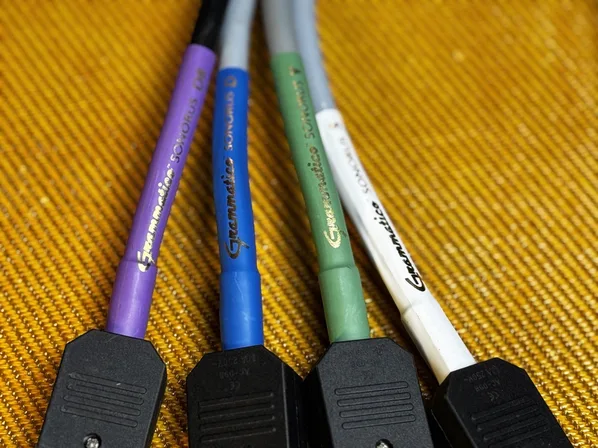
The V: Covers the sonic range from the '50s to the mid '70s of classic Fenders and Marshalls. It gives the round, bouncy bottom end with throaty mids, bell tones and chirpy, sweet, slightly raspy highs. The tone flavor is smoky, earthy, leathery, barky and woody. The breakup is a medium to slightly looser grit with a raw primality.
The S: Keeps some of the vintage Fender flavors of V intact but incorporates a little bit of fidelity I hear in the Dumble tone, bringing in a little more speed and precision. It gives more compression, sustain, bloom and spread, making it more effortless to play.
The D8: My interpretation of what I hear from the earlier Dumble tones from the late '70s and through the '80s. The highs have a weighty, wide shape, slightly blunt with a mildly rounded front of note, just enough to take the edge off, but keeping the precision. I describe the shape as a Portobello mushroom. The flavor of the highs is cooler and more metallic than the Fender tone. I would not say the mids are scooped like a Silverface, but there is a slight waist that helps it swing and bounce. The lows extend deeper than a Fender, with more articulation and definition with some bloom, but never boomy. The EQ is more extended in both directions, and the highs are now reaching the air and atmosphere frequencies, helping to create a vibe in the room. Not as warm as V or S, in that respect; it suits the era.
The D: My interpretation of the Dumble tones from the '90s on. It's the most compressed, and where the highs of D8 gracefully start to roll off, D continues up into the stratosphere, where the angels live. It excels at fast playing with the most speed of all four and seamlessly blends reverb and delay to create a vast soundscape. With distortion, it's the smoothest of all, with the finest texture. The D needs to be used with a speaker that will go up to 8kHz, like many 10" speakers...JBLs and EVs. Most speakers today roll off at 4.5kHz. It's that extra octave above where D is designed to live. It's a frequency spectrum shift while keeping the upper notes dense.
—John Grammatico
The Grammatico Sonorus Series Power Cables Review
We love Princeton Reverbs, and as you now know, our 50-watt Italian Brunetti is here to stay for amazing Hendrix, ZZ, AC/DC, Zep, and even early Eddie Van Halen tones. These would be the two main amps we use for hearing everything. As John has shared, these power cables thrive when going into pedalboards as well, which often hold digital pedals, and they somehow make the entire sound spectrum seem analog. Since our pedals are all hardwired, like our vintage Echoplexes, Uni-Vibes, and big box Deluxe Memory Man pedals, plus our fuzzes use actual batteries, our revered friend Matt McCulloch is taking the reins for that part of the review, as well as adding his own thoughts about his experiences with the cables overall. Matt is a tone connoisseur and player who is on the phone here weekly discussing things we are delving into, and a go-to of ours for a second set of ears. Even though we played these cables and wrote notes for weeks, we did have Jonn Richardson stop by for a day, fresh from a West Coast tour, so he could play while we swapped cables, amps, and guitars, and we stood at the back of the room to write notes and take it all in.
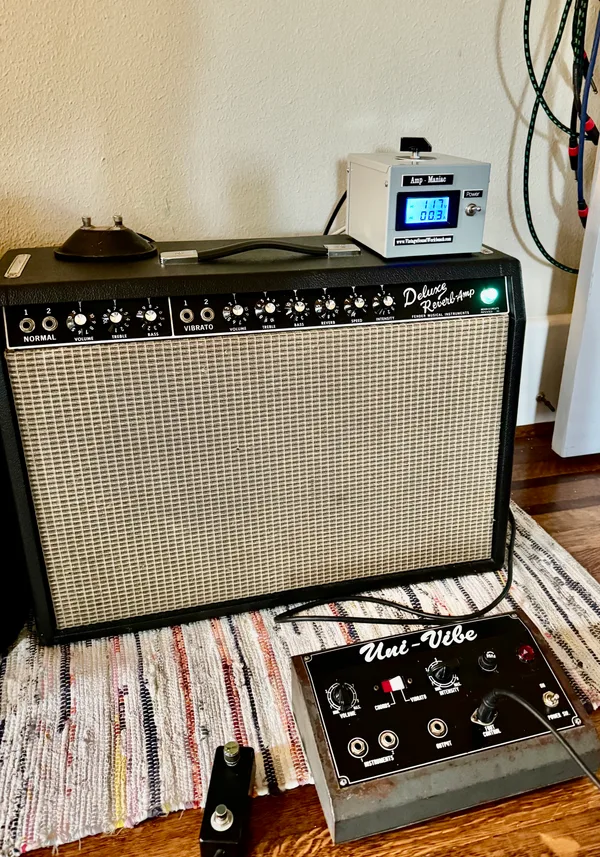
The cables are mesmerizing. We ran them against a stock Fender IEC cord, which we didn't mind, and they made it sound weak, thin, sharp, bright, and small-hearted. That was fascinating. We will keep our final notes here for you tight and to the point. There is no need to mess around—just tell it like it is.
The V was our immediate favorite for clean amps. It was smooth, full-bodied, warm, earthy, woody, and old-school sweet, with seemingly pure analog vibes. It did not push the amps or overgain them. It simply made everything smooth and lovely. The V does not have a lot of bloom, presence, or top-end chime, though.
The S is far more out front, chimey, alive, vocal, and it has a jump to it we love, compared to the V. It seems to add just a bit of signal or gain and is more in-your-face, open, and awake. With the Brunetti, S did a great version of early AC/DC, with true open, clear punch and kick.
The D8 is also warm and smooth, but for gain, it roared to life, and these classic Plexi tones just poured from the amp in ways that were to a "T," perfectly nailing '60s and '70s rock and roll for us. Any old classic vinyl, the D8 was delivering the goods in spades. We were thrilled. Oh, yes. lively!
The D was smooth like the D8, but with even better top-end clarity. It has no spike on the top end, though. It has some serious rumble and attitude, electrical firepower and drive, and we just loved it with a vintage Princeton Reverb cranked to 6, both Strats and a gold top, and using a 1962 Jensen C10N speaker.
And just so you know, in comparison, the typical stock cable that comes with Fender reissues, Voxes, and Marshalls sounded thin, bright, shimmery, and without full body or lows, compared to these. We are guessing you have a couple or more that you use. Well, it's time to move on—get a serious power cable. 'Nuff said.
After all the smoke had settled, and a couple weeks of cranking, we called John and bought four of them, sent the cash, and were thrilled. They ran us $250 each, which may sound like a good chunk of green, but think how many pedals you have bought through the years, for more than that. We bet you got rid of most of those. These cables will stay with you, we are sure. The difference between cheap stock cables is night and day, let alone what they do for the sound. If you have vintage amps, you simply buy a couple male-to-female cable adapters, which are eight bucks for two on Amazon, so you can take your favorite vintage Deluxe Reverb, or whatever, plug into the adapter, and then bring the power in from the wall with the Grammatico to connect them, and never look back. Is this high-grade next-level terra firma? Yes, but this is precisely why you are here. TQ—Riverhorse
EM: [email protected]