
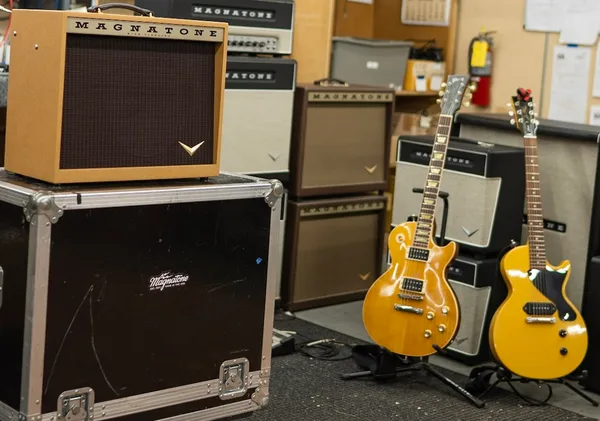
Thanks for the kind words, Ted, and while it needs no clarification, David Wilson didn't do anyone a solid unless he was all-in on what he was hearing and feeling. With that spirit, we are all-in on the Kingston. Obeid and Larry have some great ears and the technical chops to understand how to get this 1x12, 12-watt combo very right. With Ted's leadership and vision, you have a winning formula in today's Magnatone. Power tube distortion on display in a finely crafted instrument like the Kingston is just so damn pleasing.
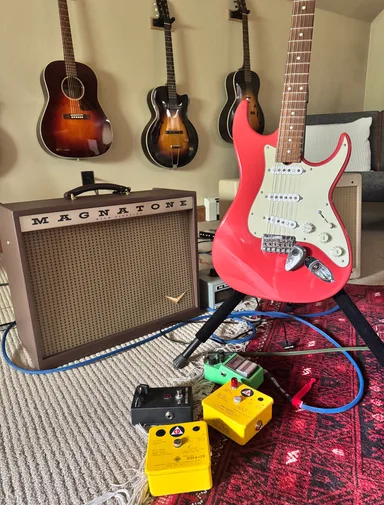
Billed as the Princeton killer — we imagine for marketing and promotional reasons — we decided to see for ourselves. Riverhorse buys up all of the Princeton Reverbs from '64 and '65, and owns 100 of them, so we could only go and borrow a reissue from our buddy Paul Decker, owner of Music Villa.
For us, there was no comparison. The Princeton Reverb looks and feels cheaply made. The knobs on the pots pale in comparison to the smooth-like-buttah Kingston. It's not a terrible amp, in terms of tone, and we were okay with some of the classic black-panel Fender tones we were able to mine with its cutting highs and a breakup quality that is unique to that style of amp, but the Kingston is an entirely different animal. Big, round, warm, harmonically rich, and to us sounds like a Magnatone. It made the Princeton Reverb sound a bit thin and anemic. The Kingston has its own thing going and the billing sells itself short. A stout 12 watts, it comes up to a pretty decent volume early in the sweep of the volume knob, but the taper is really smooth and consistent, with no abhorrent spikes.
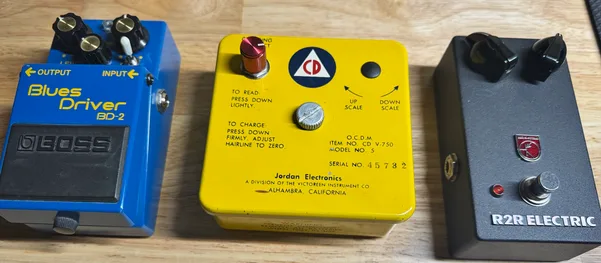
The fun starts around 9 o'clock on the volume and has many flavors of pushed tones up to about 3 o'clock. It just keeps going up to full blast with more distortion, but it's pleasing and best described as having a really rich tone. The amp holds together well, but fully gassed it will get so thick with a Les Paul that it will have you reaching for the EQ to run up the treble and the bass down. We really love the number 2 input for humbuckers because it allows you to take the volume up a bit more while maintaining more headroom for cleaner passages. Nothing is spiky, and we imagine that the speaker choice plays a role, too, in keeping the high end rolled off a bit. With an old Junior full up, the Kingston just roars and sparkles like a finely polished emerald with the guitar volume rolled back a bit. While some amps seem to prefer one type of pickup to another, like a lead circuit late '60s Plexi or JCM 800 that marry well with humbuckers, the Kingston was simply beautiful with everything we tried. Pedals in front? Yes! It loves both Hooks Projector Preamp pedals, one with a volume pot that allows us to find a different and complementary balance between the amplifier volume and the pedal volume. The R2R Treble Booster adds some nice bite when guitar volume is up a bit, and glassy beauty tone when rolled back. Our 2001 Keeley Phat mod Blues Driver dialed up with just a titch of more grain to the hair adds some spice in the upper frequencies, too. That said, we like it best with no pedals at all.
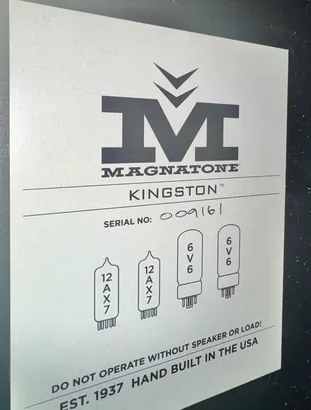
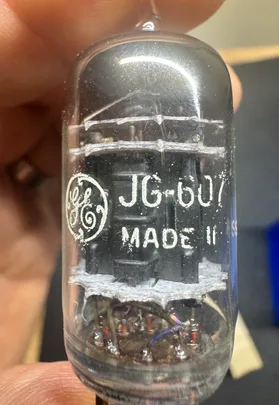
Certainly, because of the team's time spent conducting speaker trials, the custom WGS ceramic speaker matches up really well, but as you know, we like to try a few different flavors. The 30-watt Celestion 100 alnico kills with this amp if you want a bit more aggression and high-end bark. The 50-watt Jupiter alnico complements [via the speaker output] the stock WGS by widening the upper-frequency spectrum, and you know how we feel about the Fane A60. Auditioning preamp tubes in the V1 and Phase Inverter slots, which are stock JJ 12AX7s, is a must experiment, as it can alter the gain range, sweetness, and push of the amp. First, we tried a yellow-label Sylvania 12AY7 in V1, which is about 40% to 45% of the 12AX7. It was slightly microphonic and rattled a bit, so we pulled it. CW came by with a beautiful triple-mica black-plate GE 12AY7 [6072], and that, combined with a 5751 in the PI, was incredibly sweet. Because so much of the breakup with this amp is coming from the power tubes doing their thing, an AY7 with the volume at 3 o'clock is still just perceivably about as loud as the stock AX7; it just has a bit more clarity and woodiness further into the range on the volume so that you can push it up a little more.
The green-label JAN GE 5751 [70% gain versus AX7] in both V1 and the PI was magical, again for those looking to fine tune. Lucky for us, the Kingston happens to be well designed for this type of manipulation because all of the tubes are easily accessible from the back. Of course, we had to throw in a pair of RCA black-plate 6V6s, as we've repeatedly mentioned how smoky and rich those are. However, we actually preferred the stock TADs as a better fit, comparatively, given the warm and full-bodied nature of the Kingston — the black plates introduced just a bit too much more of that same thing the amp already does in its stock configuration. Compared to a couple other fantastic high-end favorites of ours in the 12 to 15-watt range, specifically the Benson Monarch Reverb+ and the Bartel Sugarland, the Kingston held its ground with no problem, since it has its own unique bloom to the attack, break-up character, and midrange voice that makes owning multiple amps of this size so much fun to bounce between. Do you eat the same breakfast and dinner every day? There's a nice round chirp to the attack across the entire volume range. It just gets more pronounced the more volume you have, and while some amps only sound good when really cranked, the Kingston is pleasing at all volumes.
Digital onboard reverb is brilliant, as it not only sounds great throughout the entire range, but there are no mechanical failure points or extra tubes required. The build is rock solid, the PCB really well done, and as so often not the case with cranked-up 1x12 combos, we didn't have to chase rattles and sympathetic resonances, and that is so important because it can drive you batshit crazy. Oh, and the Amish leather handle is about as nice as it gets. Covered in a brown material that at first looks like Tolex, we learned (as did you) that it's actually cotton and will weather and beat up in a nice fashion. If you don't have a small, relatively low-wattage combo with reverb, don't walk — run to get yourself a Kingston. It's just a joy to play! TQ—Scott Ulrichs
magnatoneusa.com