
My first introduction to John Grammatico came courtesy of Jimmie Vaughan. I'd seen Jimmie perform numerous times, typically through his Matchless rig or a reissue Fender Bassman. So, when Jimmie appeared one night in 2012 with two Kingsvilles onstage, my interest was piqued and from his first notes, my interest soared. I thought Jimmie sounded better than I'd ever heard him, and that's saying something.
David Wilson's TQR piece about the Kingsville hit shortly after, and about a month later I was in Austin visiting John to try one myself. Surrounded by dozens of transformers, speakers, reels of wire, tubes, and other electronics in John's work area, I knew I was in the presence of the real deal. John was testing endlessly, leaving no stone unturned. The Kingsville I brought home hasn't left my side in over a dozen years.
John and I share a fascination—an obsession, really—with hi-fi. That indescribable feeling you get when a recording plays back so convincingly that the performers seem to be in the room with you: It's goosebumps, it's transcendence, it's therapy some days. And in the daunting world of serious hi-fi, aftermarket power cords loom large. They've become an essential ingredient in a finely tuned system, allowing music to breathe and flow in ways a stock cable simply cannot.
It always baffled me that this same understanding hadn't fully migrated to the world of guitars and amplifiers. At its most elemental, the sound we're hearing and chasing starts as electricity from a wall outlet that's carried to our amplifiers and pedals by a cord. Shouldn't that cord be a priority?
When John told me he'd been designing a power cord specifically for guitar amplifiers and pedalboard power supplies, I knew his experience was the right blend. Who better to work through this than someone who has spent decades at the intersection of hi-fi and guitar amp design? Frankly, I had no idea just how right he would be. Everything a purpose-built power cord can do for a hi-fi system, John has brought over for our amps and pedals.
Riverhorse has told you what John's cords do for amps, and my experience on that front is identical: they're on my vintage Fenders (through an Amp Maniac), Two-Rocks, Marshalls, Hooks Spaceheaters, and Grammaticos, and there's no going back. But what about the power supply on a pedalboard? Could a cord there possibly matter? I'll admit I approached that question with genuine skepticism. I am now fully converted.

My go-to pedalboard is a mix of analog and digital: Tube Screamer TS9, Kingsley Page, Klon KTR, Strymon El Capistan, Strymon Flint, a Way Huge Blue Hippo for chorus and Leslie, and the remarkable Austen Hooks Preamp. All powered by a Cioks DC7, though my results held equally across a Strymon Zuma and a Voodoo Lab power supply.
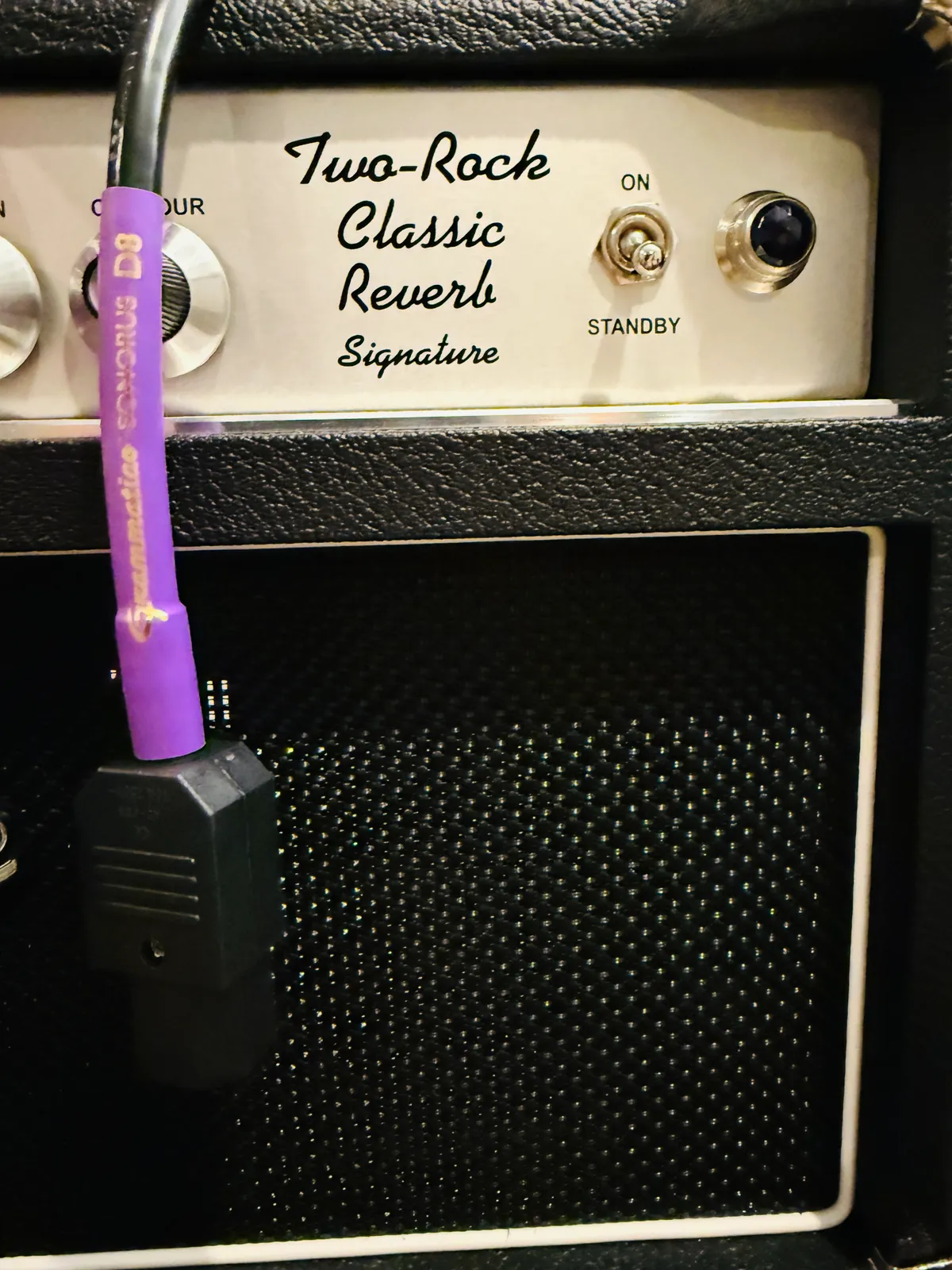
I ran the pedalboard through a Two-Rock Classic Reverb Signature 100/50—set clean and fairly neutral, on a stock power cord—into a Two-Rock 1x12 cabinet. The results were not subtle:
Sonorus D: Starting this journey by moving from a stock cord to the Sonorus D, the entire pedalboard seems transformed. Everything is playing in a round and bell-like way that makes the stock cord sound jagged and plastic by comparison. On overdrives, Sonorus D takes the blanket off, with highs emerging that are beautifully sculpted and presented without a hint of harshness. Equally amazing is what happens to modulation. The El Capistan, Flint tremolo, and Way Huge become totally coherent, three-dimensional, and liquid in an unmistakably analog way. With the stock cord, the El Cap's wow and flutter felt slightly disconnected, as if the effect were occurring behind the note rather than within it. With the Sonorus D, it's part and parcel of the note from the initial transient all the way through—an enveloping bloom takes over, like I'm playing in stereo.
Sonorus S: Energy! The S has a palpable, almost physical effect on how the guitar feels under my fingers. There's an immediacy to everything, an urgency that has notes popping and exploding off the fretboard in a dynamic yet controlled way when overdrives are engaged. The overall sound moves forward; the restraints are off. Your Strat with heavy strings and a rosewood board and probably a sunburst finish into a Tube Screamer—you're going to freak out.
Sonorus V: If V is for Vintage, it's equally for Vocal. V has a profound impact on the midrange, transforming overdrives into throaty, expressive instruments. Picking technique becomes the equivalent of having a wah or trumpet mute on board—notes open and close as if forming vowels, entirely under the player's command. Modulation effects also bloom and swell in the mids here, conjuring swirling Leslies. Speak!
Sonorus D8: There are colors in the overdrives now that I didn't know existed. D8 is voiced around Dumble sounds of the 1980s—that ODS gain structure and tone complexity that turns heads. Beautiful harmonic saturation emerges across each drive pedal with D8 onboard, making the stock cord sound mushy and one-dimensional by comparison. It's all palette and complexity; and as with D, there's a roundness and coherence on modulation effects that simply isn't there with a stock cord.
Sonorus P: Plexi or Party—take your pick. P is boisterous and fun. The overdrives growl. There's energy in the lower mids, highs that extend upward and outward with authority. Single notes cry out through the Tube Screamer. Chords through the Klon become multi-dimensional—that extra low-mid energy pushing through while the top end separates itself and sings. Modulation effects lift in frequency, riding and dancing on top of the mix rather than sitting underneath it. It's a party, and everyone's invited.

Each Sonorus cord has a distinct and coherent voicing, a genuine tone identity that's as audible and musically meaningful on your pedalboard power supply as on your amplifier. The moment you plug in a Sonorus, the stock cord we've all been using forever is instantly exposed. Veiled, flat, dynamically inert—it was the weakest link in the chain all along, and we never knew it. Swap it out and you don't go back. What about a Sonorus on both your amp and your board? The two cords work in concert—a system-level coherence that is genuinely difficult to describe and, I promise you, impossible to unhear. John Grammatico has always understood great tone. He's proven it again. TQ—Matt McCulloch