
Riverhorse called me up and pointed me to a 1965 Deluxe Reverb chassis he found listed on Reverb. Turns out, the seller had all the transformers, reverb tank, bag, and cables removed from the chassis and for sale separately. Man, you hate to see that, but be that as it may, we focused on the chassis itself first. It looked pretty straight with mostly original components, and the circuit board appeared to be very flat, which is a good sign that it has stayed in a dry environment and may not be conductive. Looking at the seller's other listings, he had the original reverb tank, bag, and cables, choke, and other parts, and we discussed what we think would be essential to have for the amp from the seller.
Riverhorse quickly worked a deal in less than one minute flat and called me back to talk about what cabinet and power and output transformers we could use. He had also contacted Bryan Sours at Soursound.com about his offerings for a vintage '60s Deluxe Reverb. I told him I've got a good original '60s output transformer here we could work with, and it would be interesting to compare both output transformers once the chassis is back in service.
Once the chassis, parts, and cabinet arrived, I could get a good in-hand look to see what she needed done. It had a poorly replaced and incorrect pilot lamp assembly and a replaced AC courtesy plug that was defective.
It also still had the original filter, bias, and bypass capacitors that needed to be replaced, and it needed fresh screengrid resistors. The cabinet is a very nice Mojo cab that Riverhorse found in Florida, and it has 1966 Super Reverb grille cloth on it. He had loaded it with an Eminence 12" SC-59 Alnico speaker before sending it.
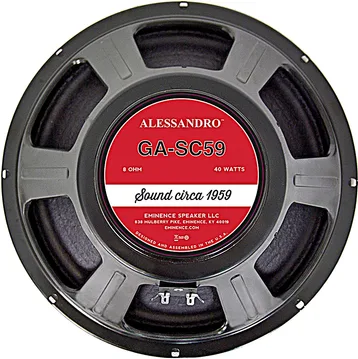
I had a chance to hook up my Princeton Reverb into the cabinet with the Eminence SC-59, and it is just shockingly good. Now I know why Riverhorse has three of them; it sounds fantastic with a Fender Reverb amp, in my opinion, and I see one in my future.
F+T 22uf/500V filter caps were used, as were high-quality bypass and bias capacitors, plus a few resistors were out of spec and were replaced with vintage-correct carbon composition. The screen grid and B+ power supply resistors were replaced with 3-watt metal oxide. The pilot lamp assembly and AC courtesy plug were replaced with old-stock vintage-correct parts, and a nice 12' 3-prong grounded AC cord was installed.
We installed a 50k reverse audio-taper pot with a switch that disengages the ground reference of the tremolo circuit when turned off, giving the amp a healthy clean boost while disabling the tremolo, and when turned up, the switch is closed and the tremolo works as stock. We both thought that installing an old stock '70s Fender 250k ohm audio Treble pot with a push/pull switch to engage or disengage the bright switch would be useful, as well, and a 25k midrange pot was installed in the extension speaker jack as per Riverhorse's request. Riverhorse disagrees with most people out there and feels the bright cap, at certain volumes, is deeply critical as a tool for beautiful and shimmering cleans that are pure Fender. So, he wanted the option for both with the simple in/out switch. Brilliant.
I cleaned all the pots and jacks and tightened and cleaned all pin holders in all tube sockets.
I also verified all grounds, removed the ground-reference capacitor, and replaced a defective On/Off power switch. Then, we installed the Soursound power transformer and the original output transformer I had in stock, as well as a set of preamp tubes I like to use in my Fender Reverb amps, plus an excellent Mullard 5ar4/GZ34 rectifier and a set of matched Westinghouse 6V6GTA tubes that are very robust and can easily handle the voltage in a Deluxe Reverb. Riverhorse had sent most of these. I plugged her into my bench test speaker, brought the amp up to 120VAC, checked all the voltages, and biased the output tubes to an average of 20mA, and things were looking good. She idles very quietly. The original Gibbs reverb tank is sounding very nice, both channels sounding very good indeed. The tremolo is working great, too, so we can keep the original LDR [light-dependent resistor] unit, but we did slow down the tremolo speed just a bit with a mod on the oscillator circuit, per another request by Riverhorse, who loves huge, throbbing, slow, thumping tremolo for many of his rhythms and chordal textures and songs.
The Soursound power transformer voltages are spot-on, too, not an overvoltage secondary like many Fender replacement aftermarket "vintage-style" transformers you find out there. It is obvious that Bryan at Soursound has given thought to this overvoltage secondary winding issue and got it right. Plugging into the Mojo cabinet with the SC-59, this amp really sounds great. It is deep, strong, and beautiful. I played the amp on and off for a couple days, just to hear how the output transformer performs and to make sure no minor issues developed. It sounded like you couldn't ask for more, and the Mid control seems to work better than I thought it might in a 22-watt amp. So, I said to myself, let's try the Soursound SST-125A1A output transformer now that we have a good baseline for the stock output transformer.
The SST-125A1A is an open-frame-construction output transformer that is made for replacement in tweed Deluxe, brown Deluxe, black-panel Deluxe, and Deluxe Reverb amps. Once it was installed and I fired up the amp, it was obvious that the transformer is an immediate upgrade, I didn't think the amp could sound much better, but it does! It now has a tighter, warmer, and deeper usable low end with a more efficient transfer of signal and harmonic content in all frequencies to the speaker. This Deluxe Reverb is the best-sounding one I've ever had in my shop in all 50 years I've worked on them, and I don't say that lightly.
I wasn't sure how the output transformer would sound initially because the spec sheet for the SST-125A1A states "it's worth mentioning that the break-in period for this design is about 30 hours, due to the original interwinding insulation used." It sounds very good right out of the box and, yes, I did notice it got even better as time went on. I put almost half of the 30 hours of playing time on it myself over a couple of days.
We got everything double-boxed and well-packed and sent it to Riverhorse for him to finish the break-in. It was hard to stop playing it—this one is special, absolutely world-class.
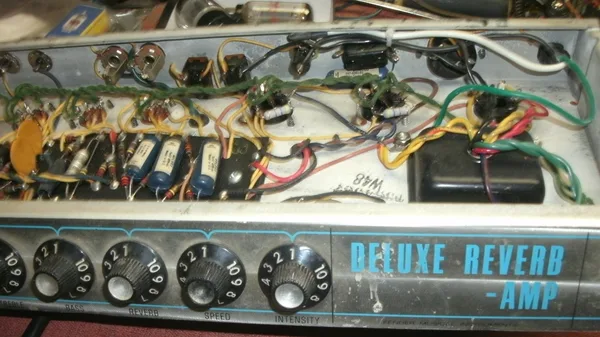
I do have a silver-panel early-'70s Deluxe Reverb that is a good amp, but after playing the 1965 Rebirth Deluxe Reverb, I felt the need to kick some tires and see what's out there. Turns out, there's not much at the usual places like eBay or Reverb, and most have issues or are priced sky high. I looked at the Guitar Center website and found a couple of interest, one listed as a 1967 and another listed as a 1968, both with the metal grille trim and with black-line silver control panels.
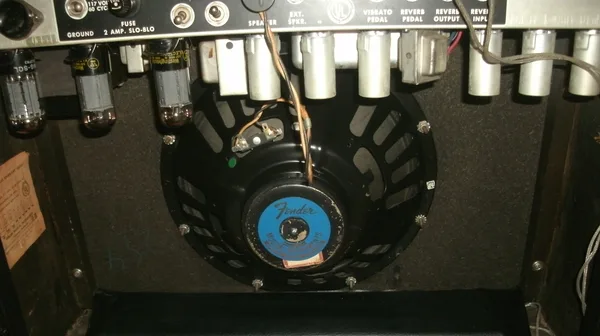
I called the California store with the 1967 listing, and I honestly thought the amp was more likely an early '68 but with only one grainy photo to go by, I needed more info and photos. The salesperson told me he could take more photos and send them to my email, which he did. All the transformers were original. The power and reverb driver transformers dated to mid-1967 and the output transformer and choke dated to mid-1966. She had the original Oxford 12" speaker and the original black footswitch, too. So far, so good. I really wanted to get a few photos of the inside of the chassis, but that would take time, he said, and they were closing in about an hour. I had seen enough already to believe this would be a very nice example from the last of the golden era of great Deluxe Reverb amps. Anything under the hood can be dealt with, but I was hopeful that it would be mostly stock inside. I really wasn't planning to find a very nice example at a reasonable price, either, but this one was listed at just under $2,500 and the seller told me if I wanted it, he would include free 3-day shipping.
In this day and age, it is becoming difficult to find reasonable prices on great vintage gear of any kind, and I could hear the bartender in the back of my mind yelling, "Last call!" This was also reminding me of how Riverhorse found the '65 DR chassis and parts, and how quickly it all came together into a great amplifier. He does not waste time or mess around, ever—just how he lives. So, it was time for me to pull the trigger on it.
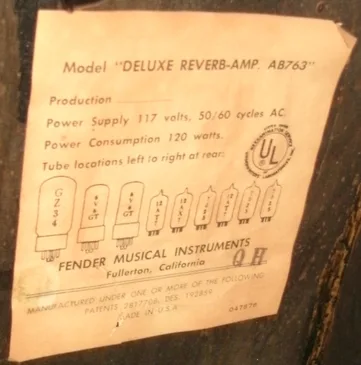
When it got here, it was well packed, and once the amp was unpacked, it had a few surprises, too. She had all the original tubes from the factory, including a nice Telefunken 12AX7, RCA 12AX7s, and a Mullard GZ34 and 12AT7. In the photos he had sent, it showed just a partial tube chart, and I was surprised to see the bottom of the chart had a date code with QH stamped on it: August of 1967.
So, this is the earliest silver-panel Fender Deluxe Reverb I've seen so far. Pulling the chassis revealed that all the original resistors, blue molded caps, bias, bypass, and filter caps were still there from the factory. Only a 3-prong AC cord had been changed, which was a good move.
We got her up to spec just like we did to Riverhorse's amp. The original Oxford speaker was kind of tired, so I for the time being, I installed a nice ceramic Jupiter 12" I had in stock while an SC-59 12" Alnico is in the works for this amp. She just sounds wonderful, open, clear, pure, all the Fender goodness, and I couldn't help but feel that some of Riverhorse's good Karma had rubbed off on me— yet another fine adventure we have shared over the years with now a pair of fine Fender Deluxe Reverbs from the golden era. Well, he has three now, haha! Gee, I wonder what his favorite amp is.
I've done five gigs with it already. And now, after speaking with Bryan Sours, he is sending along some excellent transformer upgrades I know I'll be needing soon. I have plans for another Deluxe Reverb build I can take from gig to gig myself without beating up this '67, and I'm sure those transformers are going to hit the mark.
Serendipity: The occurrence and development of events by chance in a happy or beneficial way.
It's still possible to find decent deals on great vintage gear out there, especially on amps that need love. Perhaps serendipity will ride with you, too, on your quest. The Deluxe life is, indeed, DEE-LUXE! Quest forth. TQ—Terry Dobbs a.k.a. Mr. Valco
Valcoamp.com