
Oh, boy, can we go down a rabbit hole in this realm, and let's be mindful as always that when a soldering iron is in our hands, a pick is not. Are you spending more time chasing what may stymie you in a blind test or working out that Steely Dan lead in "Rikki Don't Lose That Number" that you've been telling yourself you should learn after hearing Skunk Baxter talk to Rick Beato about what he was thinking when he laid it down? Alas, we do this because it's fun and the realizations we form and education we acquire along the way are simply part of why we're all here.

There will be detractors and folks who will lay out all kinds of commentary around what matters (or not) with the wire harness, the pots, the wafer material, the shaft material, the custom taper, the tolerance to spec, 450k ohms vs 500k vs 550k vs 600k, the material of the capacitors, the number of pickups in a guitar, the height of the pickup, the magnetic pull on the strings of the second pickup, and the corresponding height of the polepieces, if they're adjustable. This list only scratches the surface of the endless and interrelated variables that all play a role in what we perceive to impact the tones for which we fight so hard.
We occasionally stumble onto what initially captures us as a mind-blowing revelation, only to then settle down, check ourselves, and sit with what we think we heard for a bit before committing it to our world's reality, whatever reality means to you in 2025. In short, the RS Pre-Wired Vintage Electronics Upgrade kit for Les Paul works as advertised and our 290 has never sounded better. Yes, Ron's pickups are insanely good and a big part of that equation, and don't forget about how it all starts with good wood. It's somewhat of a fool's game to try to examine and compare the taper of pots and listen for what your capacitors are doing across different guitars, because they're not wired to the same pickups—but we do it anyway.
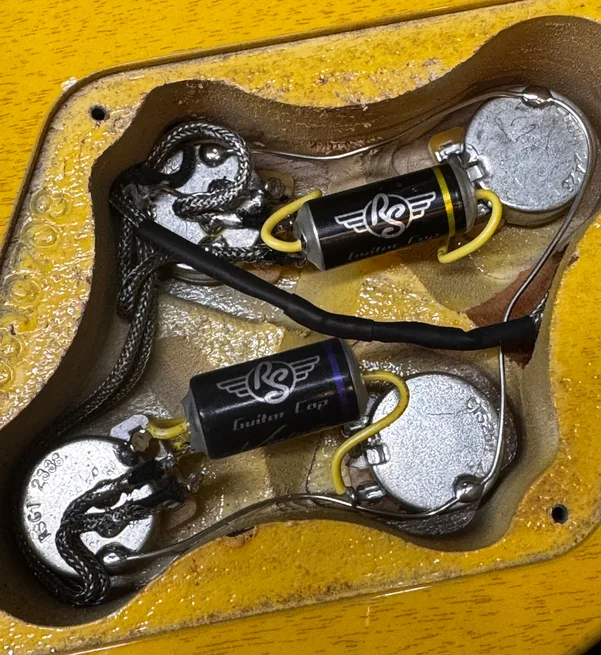
If you sit down and painstakingly work through what you're hearing as you start from 0 on your guitar's volume, with the corresponding tone pot at 10, record it, take notes, move the tone pot to 0, repeat with your analysis of what the volume pot does, move the tone pot to 5, and repeat again, you will start to conclude what you perceive the taper to be. And make sure to do this with a very loud, clean tone and then a very loud, distorted tone because we promise the experience will lead you to potentially second guess what you hoped were confident conclusions. With the RS setup in the Collings and starting with the neck pickup, we initially hear the pot kick on at around 1, with a nice gradual and even move from 1 to 2 to 3. From 3 to 5-plus, the perceived increase in volume is slightly tempered and best described as a flatter move, and then from 6 to 10 we again hear a nice, even move with zero spike from 9 to 10 as we've often experienced with other lesser pots.
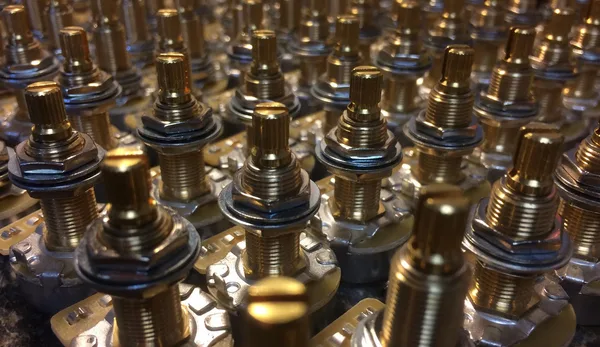
In a similar fashion, when we work through that same scenario with the tone pot on 0, the experience is comparable. When we moved to the bridge pickup and repeated the above scenario, we noticed that the volume came on just a little more gradually starting prior to 1, which we really liked, and the taper was very consistent with what we heard in the neck. We find the RS pots to be a perfect marriage of not too stiff or loose, and we imagine that they will wear in nicely and loosen over time, if that's your thing. The build on the pots is excellent and there is zero noise or scratch, as you'd expect. Now, running the other direction in order to hear what the tone pots and caps are doing is an inverted experience. With the volume at 10, rolling up the tone from 0 to 10 had us hearing a bigger move early from darker to brighter between 1 and 3 and a very nice, consistent, gradual and even taper across the remainder of the range. The caps do what they should: They're usable across the spectrum and in no way veil what we hear.
Having worked through this on your behalf, we couldn't help but smile to ourselves while succumbing to the reality that this form of tone manipulation and recorded behavior is in no way, shape, or form aligned with how we'd actually use these knobs when playing music live or jamming along at home. No. With our heads back and eyes closed, our muscle memory knows where the knobs are, and our intuition, having manipulated these things for decades, takes over and puts them where they need to be, never once looking down to see what "number" we're on. Can we get our guitars to sound and behave as we want with the RS harness? Oh, yes, and we're lucky to have such fantastic options to help make our guitars sound their best. If your instruments suffer from stock electronics that have your volume come on abruptly at 3 and stay relatively flat to 9, with a spike from there up to 10, that's no good. Drop what you're doing and go spend the $120 on a pre-wired kit from RS, which is about a third of that uber-cool pedal you just bought, plugged in, hyped to your buddies, used for a gig or two, and now sits in your pedal drawer, vying for inclusion in that pedal purge that never comes. An upgraded harness is one of the least expensive moves you can make and will be used every time you pick up that guitar. Highly recommended. TQ—Scott Ulrichs
rs-guitarworks.myshopify.com