
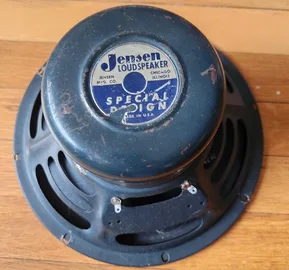
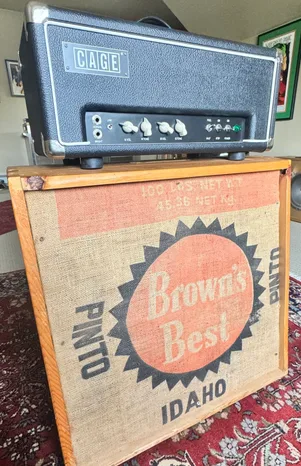
You've heard us mention our luck in acquiring a 100+ year-old recycled pine 4x10" cabinet that Larry Pogreba made from an old bar in Dry Creek, Montana. We weren't on the lookout for one, but when our good friend and local amp repairman, builder, and large NOS tube stash owner, CW saw the cover of the November 2025 Tonequest Report and remarked that the cabinet [Riverhorse's 1x15 with a most excellent 1959 Jensen P15N speaker] happened to look a lot like a Larry Pogreba cab, we confirmed that it was indeed the case. When he followed up with, "Well I have a 4x10 that Larry made sitting down at the Villa [Music Villa] for sale for 200 bucks," we jumped. This cab is outfitted with an old potato sack grille cloth with an ad for Brown's Best Pinto Beans, Idaho, and 1953 Jensen P10S speakers, capable of handling a whopping 9 watts each with their demure 1" voice coil and minuscule magnets. There was a note of caution from Larry in what appeared to be an old reverb tank cover stapled to the bottom of the back that suggested that we take it a bit easy on 'em if we didn't want them to blow.

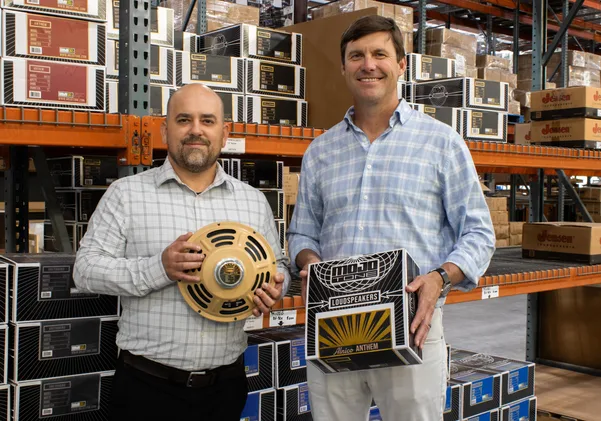
While it was a romantic notion to work with these older drivers that aesthetically looked the part, it became obvious that we wanted to rock this sucka with speakers that could handle significantly more gas, while still paying homage to Larry's initial vision of old Jensen Alnicos. After some online research time, we found what we thought would be an ideal fit and reached out to our friends at Mojotone. Having read up on their Anthem series of American-voiced alnico and ceramic 10" speakers rated at 93 and 96dB, respectively, we knew this would be something you all would want to know about. The 10" speaker for most players is not the first thought that crosses our minds, in favor of the ubiquitous 12". Why is that? Well, for some they need the lower lows and potentially the higher highs of the 12, but we love what 10s do. The punch, tightness, and musicality of the 10 should not be overlooked, and specifically these beautiful-sounding Mojo Anthems. Here is our conversation with Michael McWhorter, CEO, and Andrew Simmons, VP Sales and Marketing, on how these came to be.
TQ: Welcome, Michael and Andrew. Please take 30 seconds to describe what Mojotone does.
Michael: Sure, we sell parts for guitars and guitar amplifiers, which includes anything that goes in or on a guitar or guitar amplifier. We specialize in pre-1980 guitar amps, and we manufacture our own brands, as well as for other brands, whether guitar amps, amplifier cabinets, pickups, wiring harnesses, etc. Lots of stuff.
TQ: We watched your nine-plus-minute factory tour on YouTube from 2021. Is the speaker part of the business in a separate location? We didn't see any mention.
We may have just not gone into that room that day, but we do fulfill speakers from our factory location here in Burgaw, North Carolina. None of the speakers we sell are manufactured in-house. We have a warehouse full of boxed-up speakers ready to go.
TQ: With the Anthem series, what were you going for, in terms of voice and application?
Andrew: Our mission when we started developing that line was to design a speaker that did what famously made old school Jensens so great. We felt that the current production Jensens were not capturing the magic and beauty of the old alnico and ceramics of the '50s and '60s. Over the years, they seem to have changed the formulas with the vintage series C10R, C12N, and P12R. To our ears, they've gotten really scooped with the entire focus seemingly on the high and low ends of the frequency spectrum. Most of the musical and detailed midrange that the old ones possessed is just not there. During the time of our R&D, we spent time with old Oxfords and Utahs, and as we were going through comparisons, we noticed that the motor size didn't vary much from speaker to speaker back in those days. [Ed Note: A motor is the combination of the voice coil and magnet.] With the Anthem line, we are using a variety of motor sizes, as opposed to simply changing the basket and voice coil material. The result of that effort and likely what you're hearing in that Alnico 10 is that they sound right out of the box. We continuously focus on what we hear from the field, and what players are looking for in an American-voiced speaker is for the low and upper mids to be present with no harsh spikes. We took a deep dive with many of the variables. For example, we tried a variety of seams on the cones, whether curved, straight, or flat. What really moved the needle and made the most noticeable difference was simply trying out different motors.
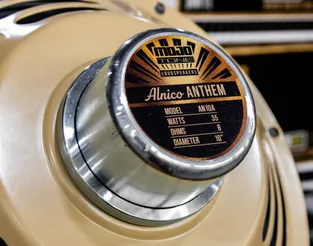
Michael: One thing we repeatedly heard from players over the years was that the Jensen vintage series were exceedingly bright out of the box, a challenge we worked to address with the Anthems. Sounding vintage as only a broken-in 60-year-old speaker can sound without entirely falling apart was the goal.
Andrew: You can really push these with not only American-voiced amplifiers, but British amps, too, like a 50-watt Plexi or Vox AC-30, if you're running either a 2x10 or 4x10 cab. The beauty is that you don't have to turn the amps up as loud to get that breakup that we all love. That's why we have the alnico 10 tuned at 93dB. With that early breakup, you can combat the sound guy who wants you to turn down, but as it's breaking up, it's not mushing out and losing definition. The low end is retained, it has a nice growl, and it won't get too raspy sounding, from which some lower-efficiency speakers can suffer. Overall, it's a really well-balanced speaker.
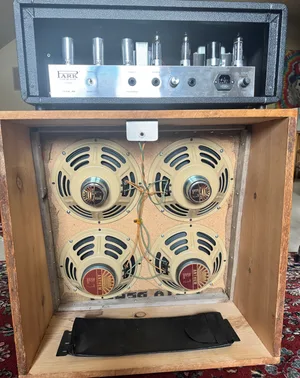
TQ: It is old-school ZZ-Top and Free all day with no cone cry, which can tend to happen with low-efficiency M-type magnets. With an old Junior and a Park 18-watt, it retained great sparkle to full-on extended harmonics and crunch with a twist of the volume control.
Andrew: We offer a 5F11 Vibrolux kit, and we've tested the 10" alnico through that amp, and it's a beautiful match. We also think it's a great marriage for your Princeton Reverb. It cuts through the mix really well.
TQ: How do you go about finding a manufacturer for the speaker in order to have them translate exactly what you want the speaker to do? Is it a series of back and forth with tweaks once you get close?
Michael: That's exactly how it goes. All the different ingredients of cone type, material, the paper, the voice coil material, and size. There are only so many parts of the speaker that can be different, but it's the nuance of differentiation that comes in the form of very slight adjustment and change that all add up.
Andrew: Fortunately for us we have a gentleman here by the name of Andy Turner, and he's our on-site mad scientist. He was able to build a device that allows us to measure all of these variables in order to translate what we're seeing with what we're hearing. It's a very controlled environment and we were able to spit out our own frequency response graphs based upon the samples as they came in. We would then mark up those graphs and send them back over with notes that may, for example, request a 2dB reduction with one particular frequency in a certain spot or range. That really helped speed things along and enabled us to capture the intention.
Michael: That really eliminated the subjectiveness of the conversation with the manufacturer. Rather than saying it's too bright or too dark or breaks up too early or late, we could simply show them.
TQ: In general, how would you describe the differences in what a 10" speaker will do, compared with a 12"? So many of us lock into 12s and never explore the beauty of what 10" speakers do.
Andrew: For me, and this is where we may get a little subjective, I think most guitar players share the opinion that a 10 will typically punch a bit more and they can often cut through with more focus. Maybe it's because they don't put out as much low end as a 12.
TQ: When you came out with the 10s, did you have a primary configuration in mind? Perhaps primarily marketed as an aftermarket fit for the very hot Princeton Reverb combo, a 2x10, 4x10 extension cabinet, or all of the above?
Michael: It had to work for all of the above. You do have to make some concessions because there's a big difference between a 1x10 combo and a tweed Bassman, so we did have to give and take to make it sound good by itself, as well as in combination with others.
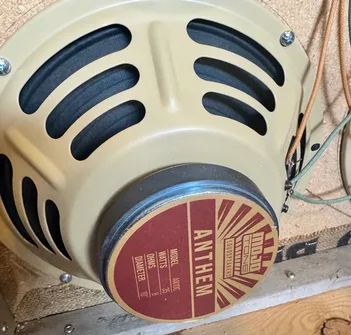
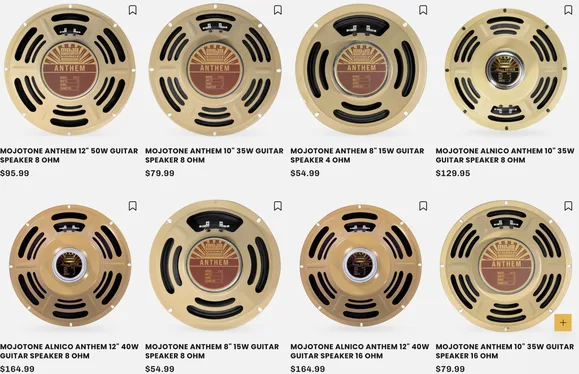
TQ: The aesthetics are really vibey—that somewhat tan-colored basket and the reddish magnet covers, not to mention the very badass-looking silver alnico cover. How did you arrive at the look?
Michael: It was really just a happy accident. We were originally going for more of a gold color, and that sample came back, which as you mentioned had a bit more of a light tan color. Everyone really liked it here, and as we were trying to go for more of a vintage feel, we didn't think a bright blue or bright red speaker in an old tweed brown- or black-panel Fender would have looked right. We were looking for something that would blend it and give folks a vintage vibe. I wish I could take credit for the color of the basket, but we did match up the red of the label to blend with the basket color.
TQ: Are you okay with talking about who manufactures these speakers for you?
Michael: We've been burned so many times with different speaker companies that we would rather keep that close to the vest. The company we found to do all of this for us does a great job of assembling the speakers, although we source the paper, as well as all of the soft parts that go into the final assembly, so that we can control some of the build.
TQ: Has the Anthem series been a big winner for you?
Andrew: Yes, they've been a great addition to the line. We have worldwide distribution, and our partners, Sweetwater, Guitar Center, and Musician's Friend, all move a ton of them, as do our partners in Europe, like the Thomann Group. We started recommending these speakers to our customers a couple of years ago and we've never had one come back because they didn't like it. It's always the opposite—they're thanking us for making this speaker. There was a thing that started to occur right towards the end of the pandemic, where you had many online influencers talking to their audience about how speaker changes are the most affordable, fastest, and tone-influencing elements that you can make to your amplifier. It's almost like it wasn't common knowledge. A few key videos, coupled with the supply shortages of the time, really helped us out. We had many players try the Anthems because we happened to be an available option for a good six months or so.
TQ: The speaker world is really pretty interesting. Like pedal and tube amplifier options, there doesn't seem like there was a time where we, as players, had more options than we do now. You've got your Celestions, Jensens, Tone Tubby, and Fane all making their own speakers. Then you have the companies that build their versions of those OEMs like Eminence, Weber, and Warehouse Guitar Speakers—and Mojo, too, is in that camp. Those same companies are also designing their own speakers, as well as building speakers for other designers like Amperian, Alessandro, and Jupiter. And then you have small-production, niche guys like Rawson Sparfield making their version of a Fane Crescendo and Tim Marcus [Milkman Sound] building spot-on JBL K-120s. Put distribution on top of all of that, and it's hard to get your head around it all. What are your thoughts on the industry in general?
Andrew: It's great and we love that there are so many options out there. Let's face it: The speaker is not one of the sexiest parts to an amp—you don't often even see it. But it's crazy because it's the last filter in your signal chain and impacts your tone in a big way. How your amp sounds will affect how you play and how you feel, and we've been very fortunate to make key decisions at the right moments that have allowed us to elevate our line of speakers and elevate the brand.
Michael: I agree with you that it is an exciting time for speakers, and we love geeking out on the details with those like you, who are into this element of tone. I truly believe that a rising tide floats all ships, so the more we get into this and do cool things, we all win and it's good for the whole industry.
TQ: We happen to think speakers are very sexy. It was Pete Cage who suggested back in 2002 that we experiment often with speakers because it contributes 50 percent to the overall sound and feel of an amp. Anything coming down the pike that you'd like to mention?
Andrew: We love Pete. We're still doing our best to get the word out on the Anthems, as we are still of the mind that it's a newish speaker for us. You will likely see some new 10" speakers coming out in the near future along with another new 12 out soon.
Michael: Yes, we're going to offer a new higher-power Alnico 12, which will hopefully be the next one out.
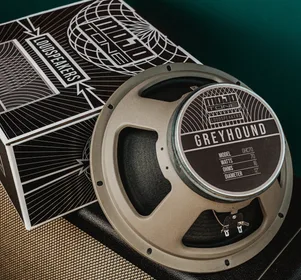
Andrew: We also should mention our Greyhound, a speaker we designed that combines what we love about both British- and American-voiced speakers. It's got all that power that we associate with British speakers, with more of an American-voiced product [Ed Note: Laur Joamets and Sturgill Simpson are using a 12" Greyhound.] We're working on a 10" version, which will be rated at 50 to 60 watts. TQ—Scott Ulrichs
mojotone.com
IG: Mojotone