
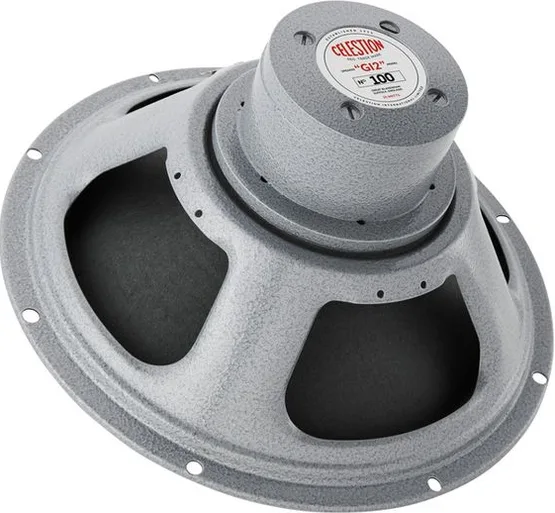
Simply the last in line. The final say with what is delivered to our ears and mics. Often spoken about as the contributor to 50% of the tone produced by any given amp. The speaker is that critical, and yet for many it's still an often-overlooked experiment in favor of a different amp or a guitar or pickup change.
Find yourself a way to do an A/B comparison of speakers and cabinets and you'll be enlightened by the experience. Discovering those magical amp/speaker combinations that work is like a quantum photon entanglement image, and when it's wrong you'll know.

How cool is it that we are excited by technology which first began to take shape in 1936 when the Rola G12 was brought to market to support the radio craze of the day. Twenty or so years later, Celestion engineers beefed up that G12 to align with the new Vox amplifiers that were able to deliver more volume. Today, not much has changed, as we see Celestions in the studios and on stages of all sizes, and there are likely not many guitar players on the planet who haven't toted a note through a Celestion. We continue here to celebrate their speakers, from the hallowed Alnico Blue to the Medium and Heavy magnet G12 Greenbacks, to the Vintage 30, G12H30 70th Anniversary, the higher power-handling Alnico Gold, and the smooth G12-65, often a favorite for 50- and 100-watt Marshalls, where a single 1x12 cab is all the stage space will allow. Check out what's in most Dumble-inspired amps, and you often find that same G12-65 as the stock offering. When it comes to the frequently heralded Pulsonic cone era (1962 to 1975), we stand up and take note that, yes, these are special. Fortune came our way when we were able to spend some time with the relatively new Celestion 100, a reverent aesthetic and sonic nod to the speakers from the late '50s and a time when players demanded more volume from their amps. The speakers had to hang. We caught up with Celestion's John Paice for a conversation and some enlightenment on the motivations behind the Celestion 100 and the beautiful accompanying book, A Century of Sound: The Story of Celestion.
TQR: Welcome back to The Tonequest Report, John. Congratulations on 100 years!
Thanks!

TQR: Let's start with the recently released Celestion 100 speaker. How do you describe what this speaker does, where it fits in the Celestion lineup, and what applications from your perspective are best for it?
The concept behind the 100 was to identify some of the common, desirable attributes of the very earliest alnico speakers that were used with guitar amps and replicate those as closely as we could. Then, make it look "age appropriate" so it looks as great—and as vintage—as it sounds. The additional goal was to have a speaker that would work effortlessly in the 20- to 30-watt power-handling bracket. That's a little bit higher-powered than the original alnicos, but it's a sweet spot and something that a lot of players are looking for.
TQR: Significant R&D went into that development. Tell us about the approach and some of the primary challenges and opportunities.
Tonally replicating a speaker from bygone days is always an immense challenge. We have a sizeable collection of alnico speakers from the late '50s and early '60s. We can listen to them, and we know what they sound like now, but we can only speculate what they might have sounded like when those speakers themselves were brand-new. So, there's always going to be an element of educated guesswork when it comes to developing something that is deliberately intended to be vintage. The development process tends to involve our using a small collection of what we deem as the best-sounding examples and using those as a tonal benchmark. Then the goal is to get as close as possible to what we believe are the most desirable attributes. The opportunity was that we got to give the speaker some extra power handling, using some more modern components. We were able to design that in while working on the tone.
TQR: Aesthetically, the speaker harkens back to 1959 and the B024, a G12-inspired alnico-magnet 12-watt speaker that was initially used in the Vox AC-15. Do we have that correct, and how would you describe the difference between the B024 and the original Alnico Blue, which came out soon thereafter?
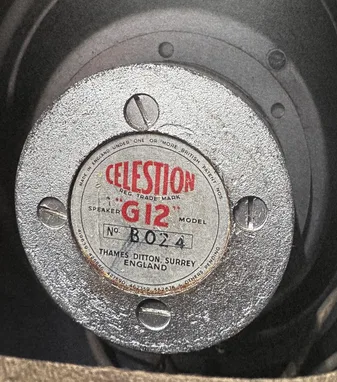
There were a variety of alnico speakers in the late '50s, including B024 and B025 and other G12 derivatives like the G44 and P44. They were often finished in silver or grey and sometimes done with a hammer finish, so we took our cue from these. B024 was indeed a 12-watt speaker, which wasn't beefy enough for the Vox amplifiers it was originally loaded into. So, I think it was Derek Underdown at Vox, who worked with Celestion's Chief Engineer at the time, Les Ward, to build something that was more robust. Ward used copper voice coil wire instead of aluminum, added doping to the outer edge of the cone, and reinforced the lead-out wires. The prototype was numbered CT3757, and there are a few examples of this model number out in the wild, but by January 1961 it had acquired a coat of azure blue paint—legend has it that blue was Vox owner Tom Jennings' favorite color—and it became the Vox Blue. Fundamentally, both speakers, B024 and the Vox Blue, sound like they come from the same family, but to my ears the Blue has a slightly different balance to it.

TQR: Pulsonic cones are revered to this day, but even the book highlights that much of the lore is clouded in mystery and uncertainty as to the formula for those cones and why so many feel as if today's speakers have not been able to re-create the performance. What influence did the old speakers play in the development of this new cone, and which speakers were used to help voice the 100?
Actually, if you look at the research online, most of those old alnico speakers are "pre-Pulsonic." The cones were often produced in-house at Celestion in Thames Ditton, which was the factory location at that time. Pulsonic cones, if you believe the legend, came along a little later in the 1960s after the G12 had taken off as a guitar speaker. It was really from listening to our benchmark speakers coupled with our long experience of how cones are made: we know what to tweak in the recipe in order to change their sound. That's how we developed the cone. We also added less dye into this particular cone, which gives it an authentic, faded appearance.


TQR: New materials for the voice coil allowed for a higher-rated speaker than the original 12-watt B024. From your perspective, how will a 12- or 15-watt-rated speaker perform in a 12-watt amp, versus a 30-watt speaker of the same type in that same 12-watt amp?
It depends on how you run the amp. If it's run full tilt, then the 12- or 15-watt speaker will be able to be close to its operational limit, so there's going to be a little bit of "on the edge" about the tone, which some people like. You get a little bit more leeway with the higher-rated speaker — it remains more "under control." You're also less likely to set it on fire!
TQR: To our ears, the speaker leans more dark and mid than bright, which is something we often seek and appreciate with brighter-voiced amps. Case in point: We had been running a G12H30 Anniversary in our Tungsten Crema Wheat 1x12 combo, which is a beautiful-sounding and responsive 20-watt Tweed Deluxe-inspired circuit. The Anni is excellent in that amp to hold the lows together, where Tweeds often mush up early. However, we rarely could get the tone control above 10 o'clock with single-coil pickups. With the new Celestion 100, it's quite the opposite, and the usable tone range is much more broad. We like the richness of the 100, and the response is a great match for that amp. What has the feedback been from customers, and to your ears what are the most accurate descriptions of their experience?
I can't really speak to the "accuracy" of anyone's descriptions, the simple fact being that, when it comes to speaker tone, everyone hears a little differently and all opinions are valid. However, your experience is certainly similar to my own thoughts: There is a remarkable richness and openness to the 100's tone, even more than the other alnicos in our range. To me there's a hair less treble than with the Blue and a shade more than with the Cream for anyone who's familiar with that model. Does it hark back more to those old models from the very early days? I think so. I genuinely believe we've been able to add that into the tonal blend and it adds a different dimension beyond what is currently available.
TQR: Is there anything else in particular that you would like to highlight about the 100?
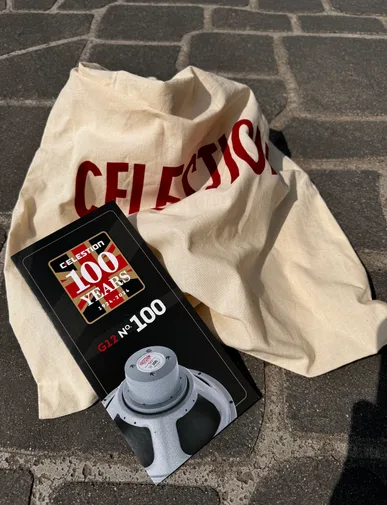
You've already covered the looks of the speaker, but I think it bears repeating. We wanted the 100 to really look the part, as well as sound great, so we've powder coated the chassis and magnet with a very age-appropriate hammer-grey finish and topped it off with a '50s-style label. The whole thing has been packaged in a cotton bag to protect against cosmetic damage, and we've tried to keep the packaging plastic-free. We found an old carton from that era and replicated the design of that, as well. The whole thing comes with an individual serial number and a little booklet on the history of the G12: it's just a lovely, collectable thing.
TQR: Turning to the book, it's beautiful and we loved the old pictures depicting the rich and turbulent history of the company. An old Radiophone sitting in someone's living room today would be an artistic statement of the highest order for musically minded folks like us and a shoutout to simpler times. What in particular about the history of Celestion stands out for you?

Taking the long view and looking at the history as a whole, what surprised me the most was just how varied it was, how much there was to talk about. You can actually see things being shaped by the events of the day. From the birth of wireless through World War II; the early days of rock and roll and the beat boom; the effect of stereo recording on home hi-fi popularity; the explosion of live music events and the resultant evolution of sound reinforcement; not to mention the effects of all manner of recessionary pressures and economic headwinds. And through it all, the loudspeaker — the transducer itself — in all its various forms, remained the constant.
TQR: Rola first introduced the G-12 in 1936 to be "the finest speaker available to the general public." It was designed as a permanent-magnet (alnico) speaker to be used in gramophones back then. Celestion made the speaker famous some 23 years later by making it more rugged with higher power ratings, to align with the valve amplifiers that were coming out. We are removed now 66 years later still, and so much of what we love about tube amps and speakers is that the state of the art was arguably established back then. Where does Celestion go from here, as far as new speaker designs go, and is there anything on the horizon that you'd like to mention?

As anyone who reads the book will realize, the G12 and the guitar speakers it generated were just one part of the Celestion story. The G12 speaker template also spawned the "Power" and "Heavy Power" production lines: speakers that were used in the fledgling sound-reinforcement industry. These days, much of Celestion's engineering efforts go into this side of the business, so-called Pro Audio. For example, we're looking at ways of developing large-format woofers that can take more power and last much longer when used in vast touring sound systems and line arrays.
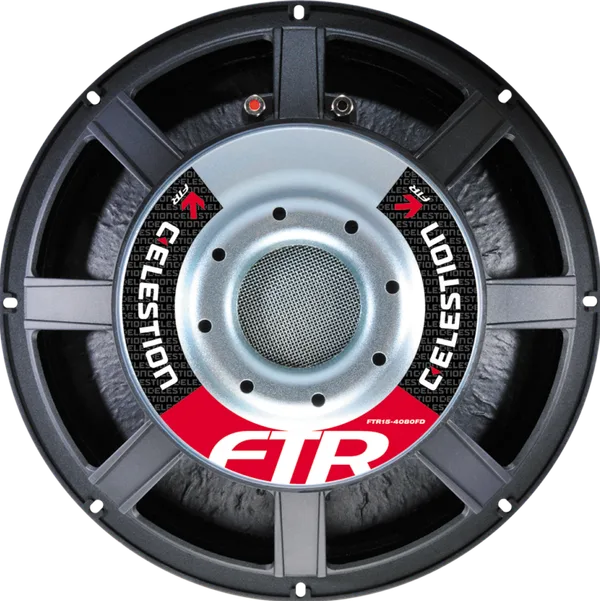
We've also been expanding products for guitar players who are seeking their tone in the digital domain. It might not be quite so popular for many readers of The ToneQuest Report, but the convenience and speed of the many digital solutions make them a game changer for many working guitarists. It's our goal to make Celestion tone more accessible in that format, while making it as realistic-sounding as possible. That said, we still firmly believe there will always be a place for the traditional guitar/amp/speaker setup, so we are constantly seeking new ways of bringing great tone in whatever package players are demanding. In the past few years, higher power and lower weight have been key determinants as smaller and lighter. We've been experimenting on something for a while that's been code named "The Quiet Speaker," and that will see the light of day soon. And of course, there will always be a demand to bring back "the old sound," so look out for more of that! TQ—Scott Ulrichs