
TQR: Hey there DryBell and Croatia! How did your journey with music and the guitar begin, was there someone in your family who played?
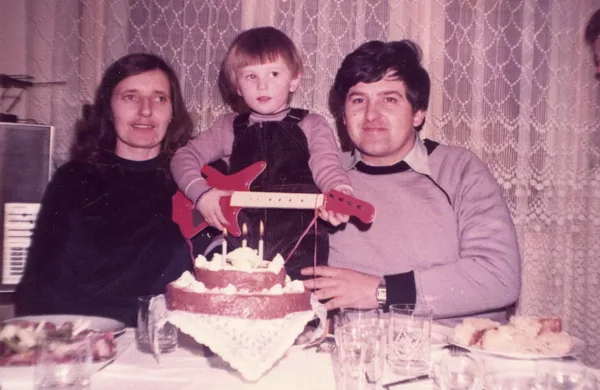
Here at DryBell, we are a very diverse group of individuals. I was born in 1979. When I was a child, no one in my close family played any instruments, but I became interested in music from an early age. My parents mostly listened to local radio stations in the mid-eighties and my grandparents had a turntable. I remember Elvis Presley and The Beatles records, but they mostly listened to regional performers. During the corn harvesting season, my grandparents' house would be filled with people coming together to clean corn and sing traditional songs. On those evenings, about ten people would sit in a large room and sing local traditional songs while cleaning the corn. I remember being impressed by the harmony combinations of male and female vocals.
At the end of the eighties, I received a toy piano for my birthday, and I can say that it was my first contact with an instrument. I was thrilled with it, but at some point, I took it apart because it broke. From an early age, I loved to disassemble technical things. Soon after that, although it was expensive by our standards, I managed to persuade my parents to buy me a keyboard. It was a small Bontempi ES 3200. My monophonic keyboard limited me to playing only one note at a time, which eventually became frustrating. Now, I believe that this limitation might be one of reasons why I did not pursue playing keyboard. In elementary school, I started playing tamburitza in the school orchestra and that's where I learned my first notes and experienced my first performances, including in front of a large audience in our former city hall. It was all very exciting for me. It wasn't until high school that I first encountered the guitar. My new neighbor lent me his acoustic guitar, which he never played and had been collecting dust. Since I already had experience playing stringed instruments, I made quick progress. In the mid-nineties, the internet was still not widespread in Croatia, so my classmate made me a copy of a book with guitar chords. A few years later, we played together in a band. After moving to a new location and meeting new people, I experienced significant progress in exploring and understanding music and encountered many new music genres that I had never heard before. In my new crew, we were listening to, copying, and exchanging albums of pop, rock, blues, and even grunge bands of the time. In the late nineties, playing guitar was a constant source of inspiration for me to discover and listen to new music, and we also started forming local bands.
TQR: Did you have some bands along the way? What was some of the first gear you used?
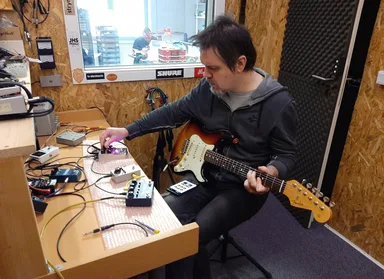
I played in several bands between 1997 and 2005. Currently, I spend most of my time playing to test the sound of pedals in development [laughs], but whenever there's a private party or birthday, my friends and I grab our instruments and play and sing for fun.
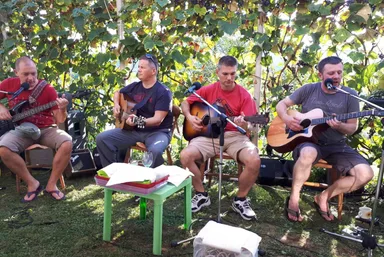
Fortunately, we've never stopped doing that. I also played the bass guitar (Fender Jazz Bass) in a band where we performed our own music, experimenting with a variety of genres, including punk, blues, grunge, and more. When I was twenty, I joined a new band where we played mostly rock and blues classics, but we also had some original songs of our own. Our popularity in the local area led me to meet my beloved wife Ivana and her sister Martina, with whom I now co-own the company. I played with that band from 2000 to 2005, and I haven't been actively playing in a band since then. I love to compose and express myself through my own songs, so I have some songs that I would like to record one day. Honestly, I would like to play in a band again, who knows what the future holds.
The amplifiers and pedals that I played through were mostly of my own making. In the very beginning, I recall connecting my electric guitar through a preamp that I had built myself. The preamp schematic was published in a Croatian magazine for DIY enthusiasts, and since I was already passionate about electronics at the time, there was no better project for me to work on. I used a HiFi power amplifier and a speaker box from which I removed the tweeter. On one occasion, I brought the entire setup to school and during the break, we cranked the amplifier so much that the overdriven sound reverberated throughout the school, until the teacher came to quiet us down. During that time, there wasn't much equipment available in our region, since Krapina is a small town. A friend from my other band played his dad's Fender Twin Reverb. Carrying that heavy amp to and from every rehearsal was quite a workout. At the beginning, I played an electric guitar that was handmade by an unknown craftsman and looked like a Fender Jaguar. Later, I switched to an Epiphone Les Paul Special.
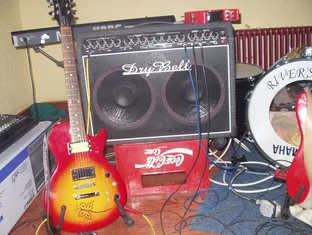
In 2000, I was already more deeply into electronics, so I made my own combo transistor amplifier with 3 channels, which I used until I left the band. Even back then, I had the DryBell logo on that amplifier. In the mid-2000s, I met Kruno and the rest of the crew from Zagreb, who were already professional players and had tried or owned a wide range of gear. That's when I really dug deep into exploring new sounds.
In 2007, Kruno launched the private forum Vault66, where a group of musicians and friends exchanged endless information about guitar sound, amplifiers, pedals, and rock and roll.
We spent every day on Vault66. On that forum, I described the complete process of developing the Vibe Machine V-1 pedal in detail, including all the initial challenges around photocells, bulbs, pedal construction, and successful or unsuccessful sound testing. The kind folks from that forum were the first buyers of the Vibe Machine V-1. Their incredible support and fellowship helped me kickstart my vision for DryBell.
TQR: Were you always interested in electronics or did you stumble into it? Were there any mentors who opened doors? How did that evolve and when did you start the company to chase your dreams?
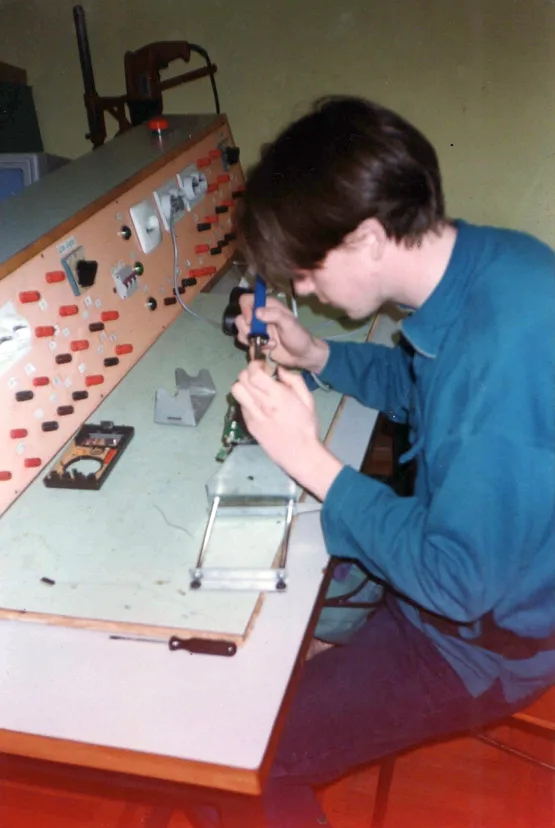
Although I play the guitar, I am far more of an electronics enthusiast than a musician. My father, now retired, worked as an auto mechanic. I have been learning about technical things ever since I was young, and my father played a big role in that. He used to own an auto mechanic and auto body shop. I spent a full decade working with him in his shop, starting from the end of elementary school up until the end of college. It was in the mid-eighties when my father first demonstrated and assembled an electrical circuit for me. That evening, I sat next to him as he worked on something unrelated, using his red analog "ISKRA automer 02." I recall asking him if he could hook up a bulb to make it light up. He was excited about my idea, and we stumbled upon a stack of old semi-dead batteries lying around the house. Using his instrument, my father measured them all and picked out a few batteries that still had some life in them. Afterwards, he connected them in series and fastened them to a wooden board about 40cm (16 inches) long to produce enough voltage to illuminate a 4.5V incandescent bulb. He included wires and a switch from an old car as he had various old parts in boxes in the basement, and he soldered the bulb straight onto the last battery. Suddenly, I was able to switch the light on and off by myself! I was just about six years old at the time, and it was really thrilling to me. This toy became my "illuminated ship."
My interest in electronics from that early period only grew. I started disassembling old radio receivers, car radios and TVs, exploring and learning how things were eventually made or mechanically constructed. Initially, it was just disassembling, but by the fourth grade of elementary school, I had built my own remote-controlled car, using motors and parts from various devices or broken toys. Batteries became a bigger problem for me because I used them a lot, and they were expensive, so I needed a different power source for my research. Even back then, I knew that a transformer could somehow lower the voltage. I still remember my fifth-grade design and technology teacher explaining to me how the Graetz Bridge rectifier worked. I took a small transformer out of a broken radio receiver, located four rectifier diodes on the printed circuit board, and in the end, I managed to get the DC voltage needed for my projects. It was such a joy. I no longer needed to use batteries or ask my parents for money for new batteries. Of course, electricity has shocked me more than once in my life, but luckily, I'm still alive to tell the tale. In elementary school, I got a small digital yellow multimeter, and that was the next important step in my progress. While other kids played, I spent my days working on my electronics projects and construction. And that's how I started. Later, I finished electrical engineering high school and University of Applied Sciences in Zagreb.
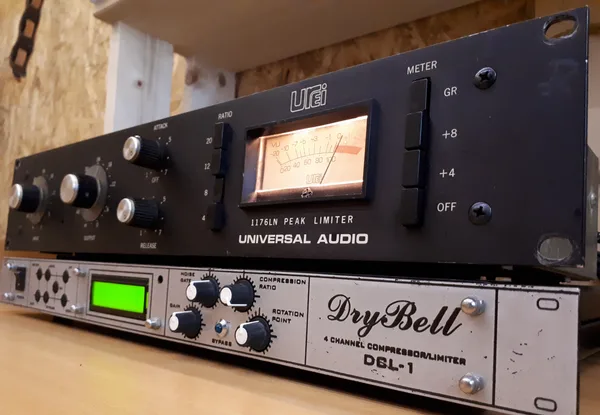
Starting to play the guitar in high school, it was natural for me to combine my passion for electronics with playing the guitar, making amplifiers and effects for the electric guitar. So, in the early 2000s, I became a respected electronics technician for repairing pedals in Zagreb and beyond, and suddenly people from all over Croatia were sending me pedals for repair or modification or bringing amplifiers home for service. Another major project that carried the DryBell logo was my final project at university, a 4-channel digitally controlled analog compressor-limiter rack unit. Finally, at the end of 2009, I decided to start producing pedals and selling them worldwide.
TQR: How has that journey been? How many people work with you? How has the company grown and where are you based?
After finishing college, I got a job as a young engineer in a company that designed safety remote control devices for Jet-Ski tourism. I worked under the guidance and mentorship of a top engineer. Around that time, Kruno, now an employee, asked me to rehouse his Danelectro Chicken Salad Vibe into a 1590BB metal enclosure.
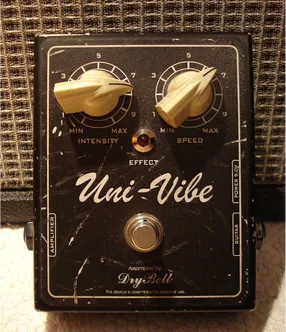
Since my hobby with pedals was at its peak, I happily took on this project. In 2007, I started working at a bigger company, KONĈAR, where I spent the next six years designing different types of PCBs for trains, power plants, and protection systems. Sometime in mid-2009, after rehousing another Chicken Salad pedal for another friend, Kruno expressed interest in replacing his old, rehoused Chicken Salad with a pedal that had a different throb character. At that time, he was experimenting a lot with different vibe pedals, so we agreed that I would make him a completely new Uni-Vibe clone.
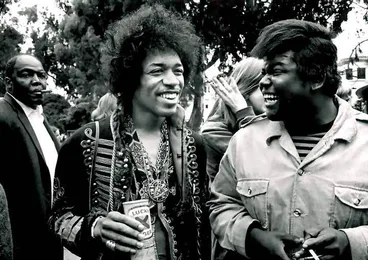
Kruno: The Uni-Vibe's sound has haunted me ever since I first heard it on Jimi Hendrix's Band of Gypsys and Woodstock albums as a teenager. I had to find out what effect was responsible for that sound. I first got my hands on this type of effect when I bought a Dunlop Rotovibe in 1998. It was the only one I could find, and I used it extensively both live and in the studio for years. Although it was good, I was never completely satisfied with that version. It didn't quite match what I had heard on those records, so the hunt was still on. The problem was that the original Shin-Ei was unobtainable and most of the reissues were really big and too expensive for me, especially when trying to import them to Croatia from the USA. That's why I asked my friend Zvonch to make me a real photocell vibe pedal that would easily fit on my pedalboard. And in the end, after a LOT of effort, we succeeded.
Since I had often thought about starting to produce pedals under the name DryBell, it was an ideal opportunity and motivation to develop the first DryBell pedal. Suddenly, I had two jobs, KONĈAR during the day, and DryBell in the evening. The next few years were quite intense for me and my family, especially since my wife and I had just welcomed a daughter at the end of 2009. Every day, I would take the 5 A.M. train to Zagreb for work, come back home at 5 P.M., spending time with my family, then work on DryBell, often until the late hours of the night. I continued with this routine for almost two years. 2010 was the most intense year of development. DryBell launched the Vibe Machine V-1 on November 1, 2011 and I spent almost every weekend in 2012 building pedals. It was insane.
I was fortunate to receive tremendous support from my late father-in-law, Ivica, who was Ivana and Martina's father.
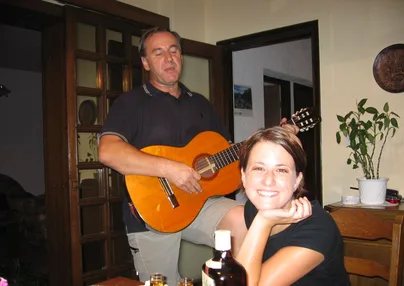
He firmly believed in my vision and provided financial support, legal advice, and his own experience as a business owner to help me establish the company. That's how the Vibe Machine started. In 2013, I left KONĈAR and DryBell became my full-time job. Martina joined DryBell early in 2012 and worked two jobs until 2017, when she then became full-time.
The beginnings were challenging. I clearly remember the day when Brett Kingman released the Vibe Machine V-1 demo. There was a small timeline misunderstanding and the demo went live earlier than we had planned. Our official website wasn't even finished yet. In half an hour, I made a short info page, we opened a waiting list and got to work. Customer inquiries started pouring in from all over the world immediately, but we were still working on producing the first small batch.
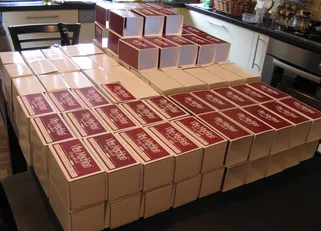
It was quite an experience working on the weekends, assembling the first Vibe Machine batches with my family members, and packing them for worldwide shipping. It felt like everything happened overnight—the word about the Vibe Machine spread rapidly in music circles, especially in the USA, but also in other countries around the world. In the first ten V-1 pedals we sold, one went to Steve Stevens (Billy Idol), the world-famous artist. This was a huge boost for us, along with all the fantastic discussions on world forums about the Vibe Machine. People were raving about how it was the most authentic Uni-Vibe-style pedal they had ever tried. At the time, it was also the smallest of its kind in the world, which only added to its appeal. Soon in 2012, we had many stores around the world inquiring about dealerships, but we decided to take things slow and grow gradually. For the first few years, Martina and I focused on developing and improving our business and production processes. All sales were made directly to customers through our website. This approach allowed us to build an amazing base of loyal customers who continue to support us today. We're incredibly grateful to them for that.
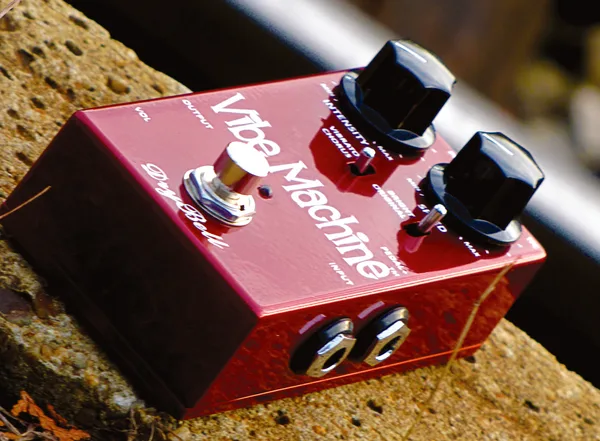
My first workshop was in my family home. In 2014 we hired Marko, our first additional person in production and supply management. That was also the point when we had to move to larger premises where we are still located today, in its expanded version. 2014 was a turning point for us. Before that, we worked on a waiting list basis. From then until now, DryBell always has an available stock of all pedals, and this has given us an additional reputation among customers and stores worldwide that we work with today.
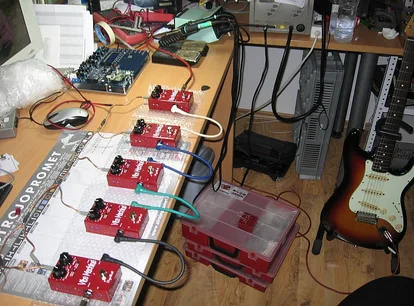
The following year, in 2015, a new employee Luka joined us in production and assembly work.
A year later, Kruno came on board full-time to help with new product design, gear demos and marketing. In 2017, Martina, my partner in business, joined us full-time to manage the company, finances, sales, marketing, and customer correspondence. Martina provides a great balance in DryBell's masculine energy. Kristijan (Kiki), an experienced engineer, joined our small team in 2021 and he is currently working on new product development. We're all musicians with various gigging experience, also friends from the days before DryBell. I'm really proud of my team of people that share love for music and have the many talents needed for keeping DryBell's magic alive.
DryBell's current workshop is located in Krapina, Croatia (EU), and that's where all our pedals are designed, produced, tested, and shipped from. Today, we are a compact small company with six full-time employees, and we have many local production cooperatives with whom we have been collaborating all these years. As the seventh member of our team, I must mention Tom Cundall, our friend from London. In 2012, his wife bought him a Vibe Machine V-1 as an engagement present, he wrote a passionate review. After a great chat, we knew that we had a special connection from that moment on. Since then, Tom has become an integral part of our team as an external associate. He works periodically as a creative editor of our content, serves as DryBell's presenter on exhibits, and appears as a guitar player in some of our latest demos.
After the Vibe Machine V-1 became popular and successful, we continued to improve this product (V-2 and V-3) and launched several new unique designs, including Unit67, The Engine, and Module 4 over the years. I have to say that the journey has been truly incredible. If someone had told me in the past that my passion for electronics and music would grow into what DryBell is today, I'm not sure if I would have believed them.
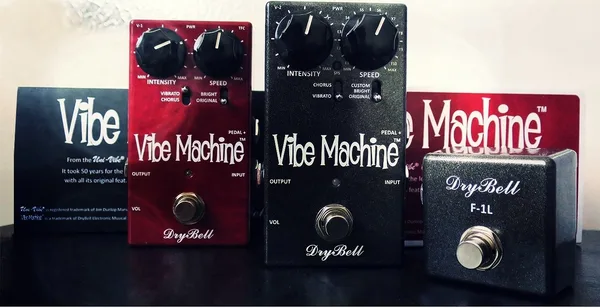
TQR: What can you tell us about the Vibe Machine V-3 pedal? There have been a couple previous versions? What was the process, and did you have access to original Uni-Vibes for prototyping your vision?
The Vibe Machine V-3 is the third version of our Vibe Machine series, which was released in 2021 when we were celebrating DryBell's 10th official anniversary.
Our Uni-Vibe journey started with the V-1 model. The main goal was to achieve a great Uni-Vibe tone, but in a small Hammond 1590B enclosure. At the very start, we realized that each vibe pedal has a distinct sound, but I had no idea what production challenges lay ahead of this development. I find that the characteristics and tolerances of photocells have not only a significant impact on the fundamental vibe sound, but also on consistency of the tonal character of each pedal. The original design, invented by the great Fumio Mieda, is basically a phaser circuit with photocells that act as control elements.
At the beginning of this multi-year development, we did not have an original Uni-Vibe yet. During the process we acquired and tested various brands that existed on the market at the time. However, they all sounded different to us. I would certainly single out the Mojo Vibe as an example that sounded the most musical to us, but we also had another unit of the same pedal that sounded quite flat. It was immediately evident that each photocell-based vibe of the same manufacturer could also sound significantly different from each other. Experienced players and vibe enthusiasts know that through various A/B tests.
Kruno: Creating the first version of the Vibe Machine was very interesting because it revealed to me the pros and cons of the effect. I've had that sound and its nuances engraved in my mind, but somehow it had to be shared with Zvonch's mind in order to get the final result.
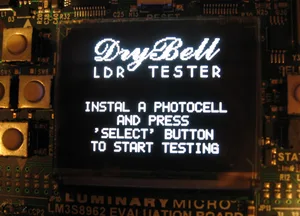
In those early stages of V-1 sound development, I would bring each new prototype version to Kruno as soon as I finished it, so he could listen to and analyze it. We repeated this process until he was satisfied with the sound. I learned alongside him about the character of Uni-Vibe modulation and spent months at home trying to figure out what affected the throb character. During this period, I had to develop the first version of our very own photocell tester. There were many experiments around the voicing of the V-1 model until we were perfectly satisfied. After recognizing the differences of all the tested vibe models, we decided primarily to rely on our ears, to implement a Uni-Vibe character that was as similar as possible to the old recordings. Also, it had to be musical and inspiring when played through an overdriven amp, which is how the vibe should be played. During the later phase of development, we received an original and well-preserved Shin-Ei unit for testing. It was only slightly different, which further confirmed that we were on the right track. We set the V-1's modulation a little more into the mid frequencies, while taking care to preserve its original watery character. The low-end was good. For the first year of V-1 sales, most customers were thrilled.
However, the first production batches of the V-1 model were sonically not so consistent from unit to unit, but most of them still work great today. I was constantly trying to make improvements and that became my life for the next few years. An important improvement in the V-1's sound consistency and production speed was when I arranged to send my new testing equipment to the photocell factory in late 2012. I developed new, improved methods and devices, specialized for measuring, customizing, selecting, and checking the characteristics of photocells.
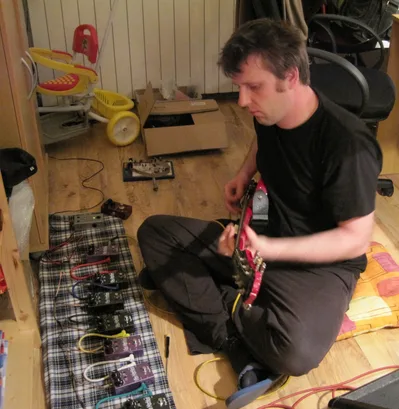
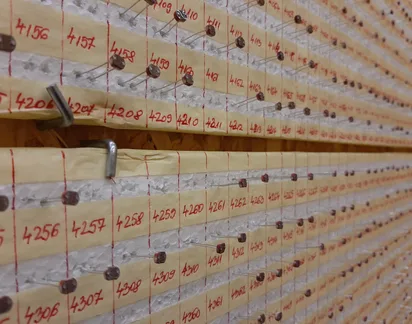
The factory used to send me digital measurement data of samples of the produced photocells before every purchase. That way, I knew what I was buying. During the first few years of Vibe Machine production, I noticed that the sound of a newly produced batch of photocells always differed at least a little from the previous one. That's just how things work with photocells and lamps, they are high tolerance components. Sometimes it feels like they have their own consciousness. That's exactly why many guitarists search high and low to find a Uni-Vibe-style pedal they are ultimately satisfied with. The greatest compliment we can receive, and have received from our customers, is that their search for the perfect vibe has ended with our Vibe Machine.
When thinking about the Uni-Vibe pedal market, there is no global Uni-Vibe standard for vibe pedal development. There is no exact sound reference in the form of a pedal or electronic circuit that manufacturers can one hundred percent rely on. There are numerous, but still different vibe models, including original units, and they can all actually sound excellent, average, or even bad or unmusical, depending on the countless factors I have already mentioned. Both manufacturers and vibe players mostly rely on old, familiar recordings or their own original Uni-Vibes they have acquired.
Another interesting fact is that, due to the nature of its EQ modulation, the SAME Uni-Vibe can sound quite different using different amps or speakers. What the player hears can certainly be pretty subjective. Because of all the reasons mentioned, the debate about whether one vibe is better or worse than the other will never end. People will continue to compare vibes and look for their real Uni-Vibe, and most manufacturers will still say in their marketing that their vibe sounds like the original. And indeed, there are great vibe pedal manufacturers, and they should be congratulated.
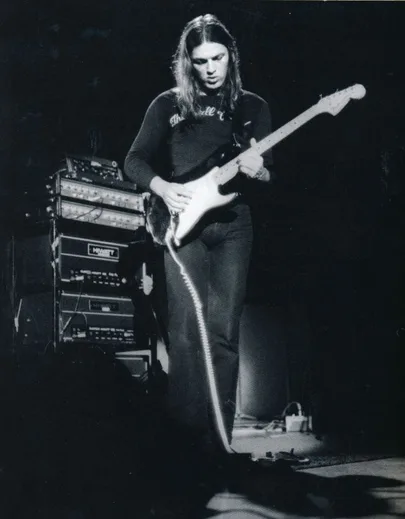
In 2016, inspired by a five-year communication with V-1 customers, we released the version V-2. Basically, the same V-1 fundamental voicing is retained, but I added new tone controls (side trimmers), which made it a more versatile Uni-Vibe-style pedal. These controls give users the ability to adjust the tone to their rig if needed. I gave the user the possibility to adjust the darkness/brightness of the effect with Grit and Custom impedance trimmers while the Chorus trimmer is essentially a blend between modulated vibrato and clean signal. The Vibe Machine side trimmers are generally set and forget options for the vast majority of customers, and all these controls come with our initial factory settings. Even during the development of the V-1, I decided to use side incandescent lamp bias (Symmetry and Range) and Volume trimmers. That made it easier for me to set the vibe sound during production. Also, if the lamp ages or if the customer wants a different character, they can always adjust the bias themselves.

The V-2 became an instant hit. With the V-2, the sound consistency was taken to the next level and the technology for selecting photocells was further improved. One of the biggest technical improvements in the V-2 and V-3 is that it has a separate optical module with photocells and bulb. This has allowed me to test the sound before the optical module is installed in the pedal during production. Another important benefit is that, if a pedal does not pass the very final sound test, that photocell module can be easily replaced with a new one.
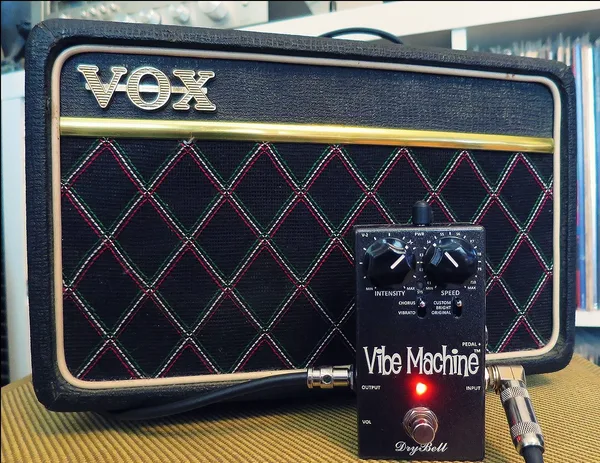
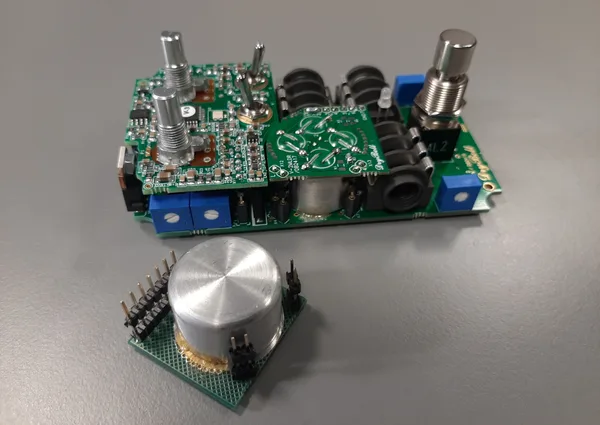
Also, the incandescent bulbs in vibe pedals can burn out over the years. That is an inevitable chemical-physical process of evaporating the filament. In such rare cases, I wanted to give the customer the option to buy a new one from us and replace it in the form of this separate calibrated optical module. So, the customers can replace the bulb in the Vibe Machine V-2 or V-3 themselves. The process is simple and requires no soldering.
The V-2 is a version that offers countless useful options that one might wish the V-1 had. It has a Cancel function, Tap tempo feature, Fast/Slow with adjustable Leslie ramp delay, several expression pedal and footswitch modes, and many other hidden features. We also created an extensive options manual and instructional videos for it. Two years after releasing the V-2, once we sold all the remaining V-1 units, the V-1 was discontinued.
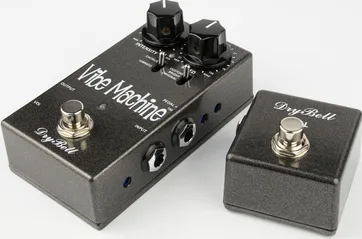
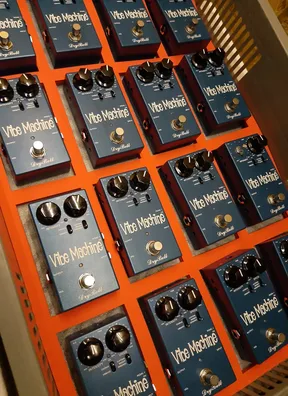
V-3 is a different pedal. It features the same secondary options as the V-2 but the V-3 is voiced differently than the V-2. Over the years, the vibe pedal market has expanded, that's a normal process. Following the market trends and forum discussions, we thought about creating an additional version of the Vibe Machine pedal. During the pandemic, we spent several months working on the V-3's development. Our breadboard experiments resulted in finding a new and pleasant voicing. We loved it and decided to put it in the new version. What's more, I further improved both consistency and quality control.
Kruno: The main sonic difference between the V-2 and V-3 is in the modulation EQ. The V-2 is a bit more mid-heavy. To tell you the truth, our newest version is much more inspiring to me because it blends beautifully with the main tone and modulates it without changing the EQ much. It brings much wider modulation and more depth. Also, the useful Intensity range is changed and it's much wider on the V-3. Everything we love about that pulsating Uni-Vibe sound is in the V-3. It just brings more to the table than our previous versions.
The initial plan was to continue selling both V-2 and V-3 versions simultaneously, but with the release of V-3, we have had less and less demand for the V-2. The V-2 is not yet officially discontinued, but we haven't had a need or reason to produce a new batch. People really love the V-3, feedback is great, so I suppose we did it again, for a third time. I can proudly say that the Vibe Machine V-3 is our best-selling product.
TQR: Is there anything you do differently from your pedals and the originals that inspired them, and if so, why?
Yes, we always try to identify some weak points of the original design and do it differently, primarily using our playing and technical experience. We try to look at the pedal from the user's perspective as much as possible. The goal is to improve practicality, reducing things like pedal dimensions, noise floor, or add a useful feature that was absent in the original design. We also try to offer customers effects that we know from experience sound cool combined, but do not yet exist in the form of a dual pedal or combination, such as The Engine or Unit67. If we think that a particular part of the sound range (settings) of the original design is not musical or sounds bad, we will not incorporate that part in our pedals. It is useful to read the stories about each pedal on our website. If a customer is interested, they can always learn in detail and discover why we did something, or why we designed it in a particular way.
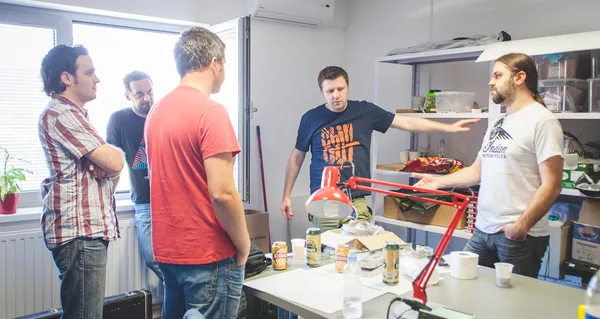
Developing ideas for future pedal designs and how they will be implemented takes several months of communication between all of us at DryBell. Usually, we already have a starting idea for a new pedal by the end of the previous product development. If we can't achieve the energy or a common consensus on the design that motivates and drives us forward during the development process, we modify that idea or create a completely new one. The creation of ideas and technical execution is always a big challenge, but it is also a very fun part of designing a good pedal. Our shared passion to provide customers with a product that is largely unique is one of the biggest motivators of this whole job.
TQR: Is it challenging to source parts, especially after the pandemic? Are you able to find some cool components that aren't elsewhere? Most of the original vintage pedals were all over the map in terms of consistency, each one sounded different. How do you approach quality control?
Unfortunately, the global crisis of procurement and production of electronic components did not bypass us. We started to feel the impact of the crisis in 2019, but when the pandemic hit, the procurement of components became even more challenging and unpredictable. The delivery times for components have increased exponentially. We used to be able to procure components within two weeks, but suddenly, when ordering some components, we were given delivery times of over a year, and in extreme cases, five years. Additionally, component prices have increased significantly. When we realized that we would face serious challenges with supply, we decided to buy larger quantities and keep the components in our own warehouse. Knowing the production batch schedules of our pedals throughout the year, we changed our supply management and ensured that we had components in stock for at least two production runs of each pedal in advance. We had to invest significant financial resources into this, but we managed to organize production in a way that allowed us to avoid having any waiting lists. All of our dealers and stores around the world are used to not having to wait for delivery of DryBell pedals.
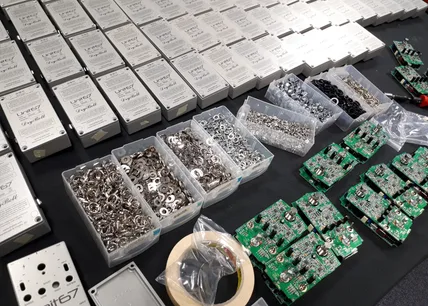
Although it was challenging then and remains so now, we are currently able to produce stock without any production delays. Given these situations, it's important for us to carefully consider which components to use in our pedals. When selecting components, we prioritize these factors: quality and intended purpose in the circuit, long-term availability, and of course, the price. At DryBell, we don't design new pedals with exotic or new old stock components. Since many other companies already do that, we simply decided to stay out of that area. If we want a certain circuit to sound identical to a circuit with an old original component on a blind test, it's often more fun for us to do it with a newer or existing component that has long-term availability, rather than struggling to find new old stock components. This is also because we think of our pedals as being available long-term—that's not to say that other companies are doing it wrong. However, our pedal development process is long and requires a lot of investment, both in terms of time and money. Therefore, we cannot afford to suddenly be unable to produce or sell a pedal due to shortages. That's why we have found enjoyment in exploring how to create a circuit that sounds great in a modern and repeatable way. Of course, we don't mean to say that we will always follow this approach, but it's currently how we operate. We invent and implement quality control procedures simultaneously with each pedal development. The operation and consistency of circuits is checked right after producing each individual electronic module. Once the complete electronics are assembled, we perform a final test. This mainly includes automated or semi-automated hardware testing procedures, using modern technology and programmable measuring instruments. Of course, after each pedal is assembled, it undergoes a final sound listening test and visual inspection to ensure that it meets our high standards of quality.
TQR: What are some of your favorite effects from the vintage days?
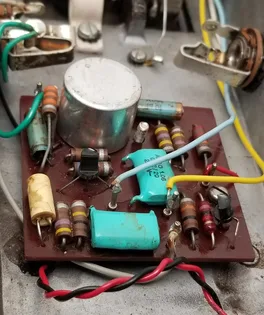
Some of our favorite vintage pedals are Shin-Ei Uni-Vibe of course, ProCo Rat, '69 Vox Wah with the ICAR pot and trashcan inductor, Japan-made Boss stuff, early MXR effects, especially the MX-117 Flanger, and Phase 45.
TQR: Have you worked with some major artists on designs and/or gotten feedback from them?
We haven't had the opportunity to collaborate with major artists on signature pedal designs yet, but I'm sure it would be an exciting experience. Who knows what the future holds for DryBell in that area. Over the years, our pedals have attracted the attention of many famous and influential artists who have given us excellent reviews and feedback.
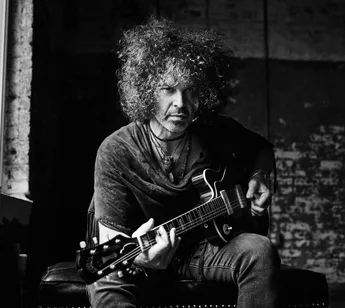
We are very proud to see our products on the pedalboards of artists like Michael Landau, Steve Stevens (Billy Idol), Doyle Bramhall II (Eric Clapton, Roger Waters), Jon Carin (David Gilmour, Roger Waters), John Mayer, Joe Perry and Brad Whitford (Aerosmith), Richard Fortus (Guns N' Roses), Joe Satriani, Pete Thorn, Charlie Starr (Blackberry Smoke), Corey Congilio, and more.
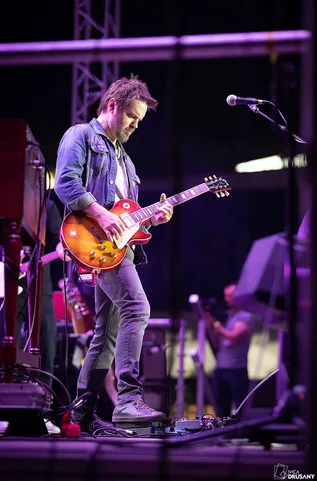
Our team member, Kruno Domacinovic, is a lifelong guitar gear enthusiast who has dedicated his life to exploring the history and guitar sounds of rock and roll. He is also the lead guitarist of one of the most popular Croatian rock bands, Majke, which has been active in the music scene since 1984. Additionally, he won the Status award for the best rock guitarist from the Croatian Music Union in 2019. I can say that the development of our pedals naturally starts with his ideas, which are then developed and refined by the entire team, and this formula has worked out great. So, in a way, I can proudly say that all of our pedals are made in collaboration with a highly respected guitarist and artist in our region.
TQR: What can you tell us about the other pedals you make?
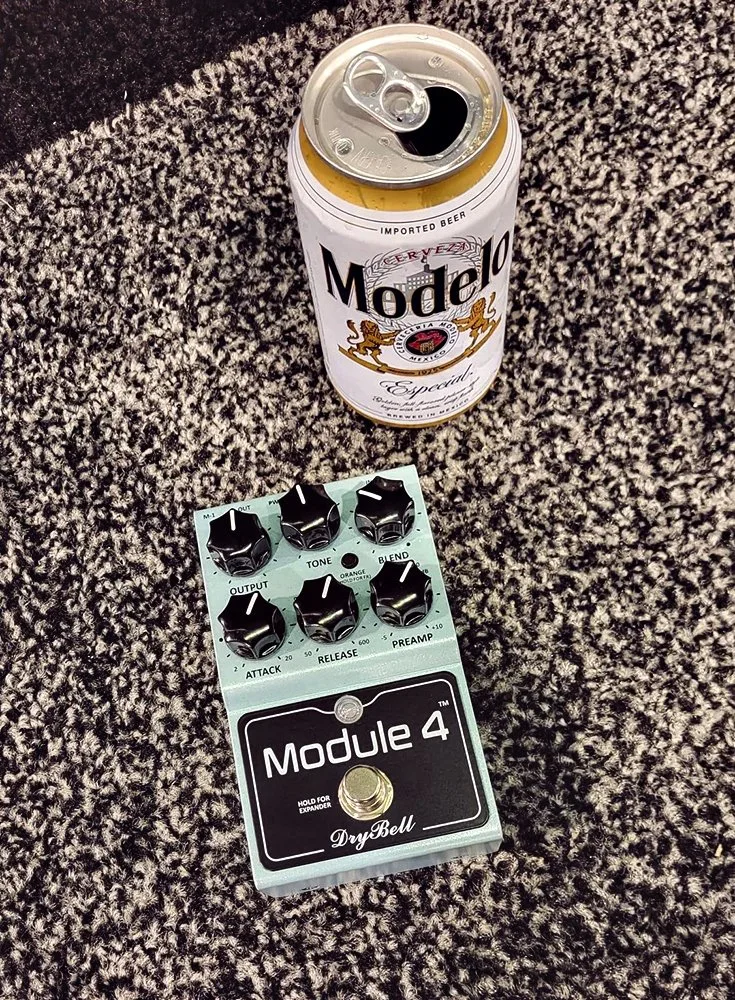
After the Vibe Machine V-2 (2016), we released an excellent mastering tool called Unit67 (2018). The Engine followed, which is a powerful British-style preamp in a box that includes a versatile Rangemaster-style boost (2020). Most recently we released the Module 4 (2022), our first fully-featured compressor, inspired by the old Orange Squeezer. So far, we've drawn inspiration from various records from the sixties and seventies and aimed to make those pleasant sounds a reality in the form of easy-to-use pedals.
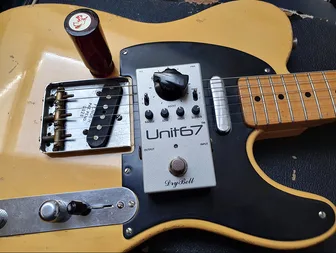
The Unit67 has earned its reputation as an always-on pedal that makes everything sound better. If you put it in front of a clean amp, you get the dynamic response of an overdriven amp, the tone is more pleasant, clean tones sustain much more and shine more brightly. It's much easier to play. You can get an awesome sound by combining the Unit67's 1176 type of compressor with a little bit of Rangemaster control and boost it until your amp starts to sing. When placed in front of an overdrive pedal or an overdriven amp, it can become an extremely versatile booster with EQ shaping options that are perfect for playing lead. It just works great with any amp, anywhere in the pedalboard chain, with acoustic and bass guitars. Many people forget it even has an OFF option. This compact pedal accommodates four effects and I'd say it's remarkably useful for musicians of any genre.
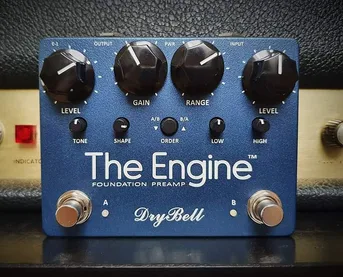
The Engine is our first dual pedal designed as a go-to foundation/drive, with the ability to shape EQ on both pedal channels. It can be used in front of any amp, whether clean or dirty, at any level of playing volume.
Kruno: I use The Engine's foundation tone with my vintage Marshalls set clean when I'm playing live, and it sounds great that way. In my opinion, the real magic happens when you engage the Range control from the B side into the A amp-like side. This seriously enhances musical harmonics along with beautiful blooming feedback. In addition to other controls, the Shape control is really helpful for adjusting the overall character and level of the mid frequencies. If you're looking for a do-it-all dirt pedal, The Engine may be the right choice. Many people seem to love it.
The Module 4 is our take on Dan Armstrong's Orange Squeezer from the seventies. While this is a unique vintage compressor, with Module 4 we wanted to give the user two easily distinguishable compression flavors. ORANGE brings a warm, vintage sound and feel of the original circuit, while with the push of a button, FULL FREQUENCY RANGE brings a more modern, brighter, clearer FET compressor tone. We have made it possible to use that type of vintage compressor on any guitar or output level of pickup, which is a significant upgrade from the original fixed gain design that lacked attack, release, and blend controls. However, thanks to its unique tone, created by a combination of pick-attack controlled EQ and spongy organic compression, the Orange Squeezer has become an iconic pedal among guitarists, and we've integrated that feel and tone into our Module 4. The pedal comes equipped with a variety of options, such as expander or true/buffered bypass, all housed in a new enclosure. Additionally, we've developed a brand-new silent switching system for the Module 4. As with the Unit67, most users rarely turn it off once they start playing with it.
TQR: Do you have any new designs you are working on, and what is ahead on the path for DryBell?
We usually talk about ongoing projects only when they are in the advanced stages, as there may still be some changes. However, I can share that we are currently working on something related to fuzz. We began working on this project at the beginning of this year and have been testing various modifications in the last few months. The current results are very promising, and we are very excited. Our whole R&D team is working on the project, and we are about to enter the live testing phase of the pedal. Kruno is excited to put the prototype on his pedalboard and start playing gigs with it. We can only share more details and pedal configurations further down the road. Measure twice and cut once.
DryBell's vision is to grow gradually and not too quickly. We want to maintain the atmosphere of a family business. Our goal is not to become a company that produces a huge quantity of pedals annually. Although most things in the pedal effects world have already been invented, we still come up with new ideas. We simply want to maintain and further improve the great balance that we have here at DryBell and continue to enjoy creating exceptional pedals. Our customers recognize our passion for creating pedals, and we are grateful for the unwavering support they have given us over the years. Thank you very much for this interview, it was a great pleasure to finally be in ToneQuest! Quest forth… TQ—Riverhorse