
DryBell have come light years along since the days of Croatian corn harvesting parties where they all sang folk songs in the living room. Can those of us here in the United States even imagine? How fortunate we are to have access to the treasure troves of tones we have here at home, for our brothers and sisters around the world who live in various countries have had to go the distance to both find what they love, as well as make their own home-brews. DryBell are ever humble and not about the flavor of the day hype machines. Yes, they have some major players using them, which is always something to pay attention to. We found them through our TQR Advisory Board member extraordinaire Corey Congilio, who let us know his Vibe Machine V-2 was his go to on a pedal board that only uses the best out there. The story that followed was as heartwarming a tale as they get. When the pedals they shipped were cranked up, through endless vintage amps and a few newer ones to boot, we understood what the fuss was all about. These are seriously stellar pedals built to specs we rarely see anymore. They shine like no tomorrow.
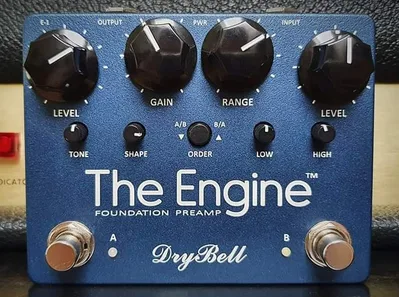
The Engine is an analog preamp with Side A delivering British style tones that can be additionally pushed with a Range control tipping its hat to an actual Rangemaster. Side B offers EQ and Boosting for a bigger louder in your face punch. In a perfect world we could dime all of our 100-watt vintage plexis at home, but this world ain't. Still, it is a beautiful life, especially with this kind of grit being thrown down. The usual Level and Gain knobs as well as the Range are here, but the Shape knob allowed us to push the mids, as well as the overall feel and sparkle of the chords. We had a few Who songs nailed with The Engine, and once we lit up the Side B boosts, were able to back off on the Goldtop volume just a bit and out poured endless early AC/DC rhythms, on to early Van Halen even. Sheesh. We even ran it through the 1959 Tweed Gibson GA-40 amp with a Celestion G12H-30 and it just gushed out the brown sugar goodness. Basically, this pedal wants to give you the feel and whollop of a non-master Marshall, but we felt there was so much Hi-Watt amp flavor and even heaps of Vox AC-30 rumbles in it. Both sides are stackable and variable in the A/B or B/A order you choose, which is fascinating. And all rock and roll wildness aside, we did back the pedal down quite a way in gain just to mine the lovely clean boosts. Separate or together in whichever order, you are in for some heady adventures with The Engine.
The Vibe Machine V-3
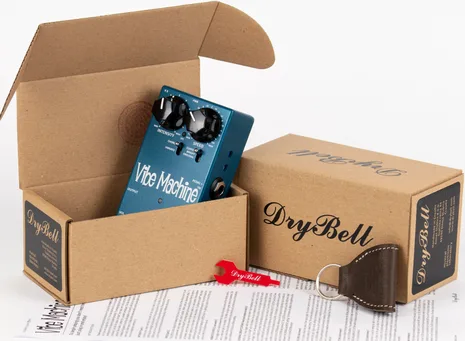
As far as Vibe Pedals, we might as well share that we had some six other brands of pedals besides the ones you are reading about here, and they were all moved on, sent packing. We chose not to write a word about them. They just didn't have what it takes to rise to the top of the tone mountain. But like the Electronic Orange offerings, these DryBell pedals walk the walk in every way. Of the three versions, there are still players who seek out all of them, and even today we saw an early red V-1 recently get scooped up for over half a grand. The V-2 perhaps has a bit more mids, and the V-3 a little more transparent bandwidth, but we all know every single pedal has its own soul, no matter the iteration. Same as guitars and amps, that's just the truth of the matter.
The Vibe Machine V-3 is a killer pedal. Corey is right, as usual. Here's what he had to say about his V-2.
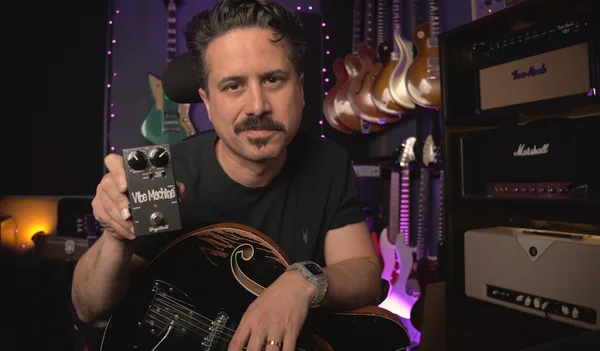
"Out of all the pedals and circuits that have been recreated and reintroduced over the years, it seems like the one so many builders are chasing is the Uni-Vibe. In a world of Klones that's saying a lot! For me a pedal has to have three things. The first is practical, size. Sounds silly I know but, after years of touring and having to have a lot of sounds on my board, real estate matters. If the pedal can deliver the goods in a small package even better. The other two are more esoteric so, forgive me. Feel and inspiration are my other two requirements. How does the pedal 'feel' and respond to my playing? It has to become ONE with my tone and not feel like it's 'along for the ride.' I also want to be inspired to play something I haven't because the effect is influencing me. My Vibe Machine V-2 accomplishes all of those things while faithfully recreating the historical circuit that came before it."
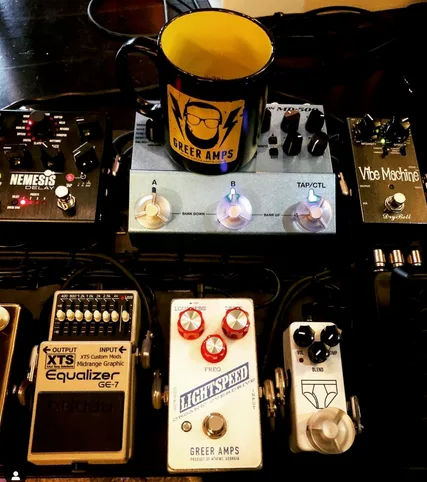
Our compact V-3 is sized perfectly to fit on our board when compared to the other bulky brick-sized offerings out there. The fact that they were able to achieve this shows how deep a dive they've made. The separate optical module with the photocells and bulb dropped in during production are unique, indeed. What a way to go about it. It even has a small separate F-IL3 pedal for tap tempos, Leslie style slow/fast speed modes, and cancellation. You can use this with an expression pedal, of course. The side of it has 6 different trim settings which allow endless tweaking, so much so you could lose your mind, but we found the factory settings perfect. We did listen to all of them at differing points because we couldn't resist. The pots are CHORUS, GRIT, SYM, CUSTOM, RANGE, and VOLUME. The DryBell website walks you through all the ways you can shape things, with clear and concise descriptions.
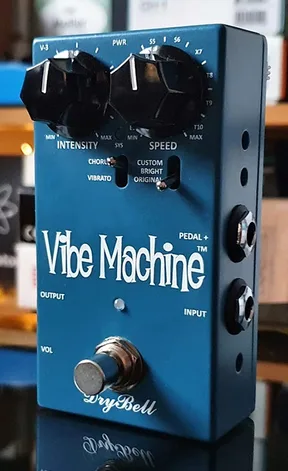
This Vibe is so damn STUDIO HiFi, so richly and crisply detailed and alive, and quiet as can be without the strange hiss many have. Perhaps part of this is that they prefer to use new and currently available components and not dried out second-hand passed around NOS that may not make the grade anymore. And the rest is thanks to how heavily invested they've studied the why and what of sound. All of the gorgeous chewy swirl is there, and everything holds together impressively. With the sunburst Strat and the old early Slider 59 pickups, the vintage harness, through the Super Reverb, we kept steady rolling for the day with the amp firing away. If you dig supreme fidelity, as we mentioned, this is absurdly splendid.
The Unit67
The Unit67 and the Module 4 are both compressors, yet they offer differing ranges of magic that inspire and tailor your signal. They are similar, but different, when you dig into the details.
The fully analog 67 takes its name from the hallowed 1167 compressor and offers the DryBell Range, Sustain, and Boost you can blend in the desired capacities of how deeply you want to both squeeze, hold, and enunciate.
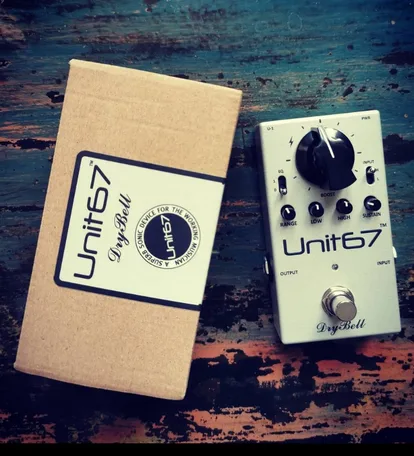
What so many players still don't know, is that this is how Knopfler got those legendary Sultans Strat tones. Even the early Steely Dan songs and so many other hits all had compression. It gets a bad rap, and when not used properly, we understand, but the Unit67 is such a potentially always-on pedal thanks to the chunky big legged cleans it can create from single coils. It is not something you want to live without once you learn to dial it in. We definitely used the Range control to let things sparkle and breathe sweetly while pushed power tubes started to fold when played at major volumes, and it freed up the notes and chords to not lose dynamics and feel, which happens too much with cheaper or poorly designed compressors. Not with the 67. At low volume levels, the Unit67 allows you get everything you would from a major stage pushing air from 4x12 cabinets, without the concern of tinnitus inducing headaches.
The Module 4
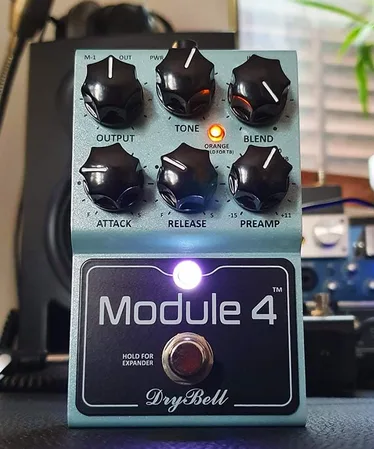
The Module 4 is DryBell's version of the famous Dan Armstrong Orange Squeezer, which was a small 1970s plug-in box that went right into your guitar jack. Think Knopfler again, along with Cooder working his magic for unreal greasy slide. DryBell shared this about the Squeezer relative to the Module 4 birth.
"On the surface, the original Squeezer design is very simple, but its impact on the guitar's tone is far from it, especially with passive guitar pickups connected directly to the circuit. Depending on the signal level of the pickups being used, it brings you a wide range of compression, from subtle to extremely squishy while adding sustain and quite a bit of grit to your tone. The OS attack and release settings were fixed internally. One great feature of the OS is its ability to stack with different drive pedals. If used in moderate drive settings, the long sustain and multiple harmonics would evolve into note bloom resulting in beautiful feedback.
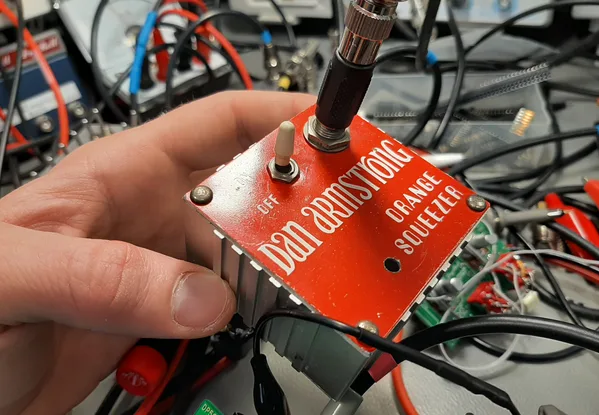
The original OS circuit varies in terms of sound from unit to unit and could be quite noisy at certain bias settings. When bypassed, the unit still changed some tonal characteristics and the (make-up) volume varied, all depending on the unit's temperature, how it was adjusted internally, and the pickups used. The usage of those little boxes was also limited, for example, they couldn't be used with a Stratocaster because of the recessed output jack, unless modded. Also, later reissues weren't very close to the original in terms of build and tone. But in essence, the Orange Squeezer's tonal uniqueness in terms of pick-attack controlled EQ combined with a spongy organic compression, most noticeable with the single coils, is the key reason for the iconic status gained among many artists throughout guitar history."
Which all makes sense to us when wailing away with the Module 4. Quite simply, after all the exploration with it, we found it to deliver note separations and a sustaining bloom that was so funky and mesmerizing, as well as harmonically beautiful. DryBell again delivered their ultra quiet (10dB noise floor lower than a vintage Orange) and clear magic we heard in the V-3, which raises the bar far beyond what the original Orange Squeezer could. The Orange mode is our favorite, so full and warm, and the Full Frequency Range JFET mode delivered Nashville modernity in spades. The game over addition is the Blend knob, which allows us to mix the wet/dry signals to the exact parameters we prefer for each guitar, amp, and use. There are tone cuts, a three-level color compression meter for gauging shaping, a buffered bypass option, a true bypass option, and even an EXPANDER option you can switch in and tweak that offers attenuation automatically to background noise when you stop playing or mute the strings, and so much more. It's mind boggling what they've done. DryBell are throwing aces here, and with every single pedal they are building, big time. Remarkable. Quest forth… TQ—Riverhorse
drybell.com