
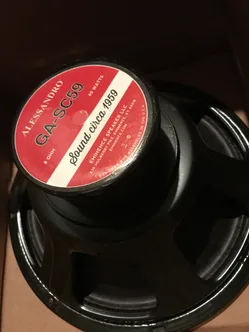
TQR: Hey now George, thanks for making time for us. Chris Rose at Eminence was kind enough to ship us the GA-SC59 Alnico 12 you guys collaborated on now that they are finally in again. We dropped into a few different amps and really dig it. It is definitely like a Celestion met a Jensen, great mids and bottom with a sweet top end.
You bet. There had been some issues with getting materials in, which is still all a result of the recent pandemic era. We worked on these just a few years ago, with the ceramic GA-SC64 you have reviewed there being the first, and this 59 after. These three years have been a blur.
TQR: When you told us this speaker is in some facets a marriage of the best of an Alnico Blue and a Jensen P12N, we know you are talking about the vintage versions. The modern versions of an Alnico Blue sound bright to us. We've had them in hand-wired AC30 Voxes and preferred Celestions in them.
The Alnico Blues in AC30s from 1958 all the way to 1964 or so, and the original Marshall 4x12 cabinets and combos, had Silver Alnicos in them, which were basically the same speaker without the bells and silver in color. There is a particular sound from that generation, that early sixties era, that is just magical. They have an extension on the top end that has the most beautiful shimmer and high-end sparkle, which made them pair well with the AC30s and EL84 tubes. And when in the early JTM45s, which were kind of dark and buttery, that speaker gave them a sound.

That speaker has a character that is unique to itself, and no other speaker has achieved that level of magic that the originals did. When I was designing this Alnico GA-SC59 with Eminence, that was one of my two go-tos, with the other being the Jensen P12N. The P12N, which was historically in the Fender tweed Twin, to me, Jensen was very bright. If you AB a vintage Alnico Blue with a vintage P12N, the latter has a lot more upper mids and high frequency push to it, which is an articulation in certain frequencies that to me are not as smooth and magical as the Alnico Blue. The modern versions of the Alnico Blue and the P12N are not my thing.
TQR: The GA-SC64 we wrote about when run head-to-head with our favorite and cherished 1959 P12N had some serious strengths in the low end and mids that our vintage Jensen did not. The Jensen is jaw-droppingly gorgeous with single coils and harmonically complex, yet the 64 has such stout beefy spine, shoulders, low end, mids, and a very smooth delivery. We love them both. When we melt down the Deluxe Reverb with your 64 design in it, and hit it with echoplexes and fuzzes, we are so grateful to have it in there, it just holds its own for days on end. Plus, we can run the treble up a bit, whereas with the vintage Jensen in a black panel amp we keep it dialed down. Well done. There is a reason why both James Pennebaker and Todd Sharp from our ToneQuest Advisory Board told us recently it is their favorite modern go-to speaker in a Deluxe Reverb. Those guys have gigged all over the world with big names, and they know what's what.

It has been a very well-received speaker. I think that people hear the effort we put into it and the fact it really does pull from so many historic places. It was designed to be a speaker that we would go back in time to the sixties and look to modern times to build it today. I've learned a lot from my days of building amps and truly listening to these speakers, all while hearing all of the other speakers through the decades, which allowed me to develop this by taking the most positive aspects of those vintage speakers and also eliminating the negative attributes of them. Old speakers start to get delicate and grumpy, and don't like to be pushed. They get buzzy, start to tear, cones rip, and you can start frying voice coils. When I developed these new speakers, we used knowledge to build a more robust speaker today which still utilizes the sonic signature of yesteryear.
TQR: The wattage strength signal of the new GA-SC64 compared to our original P12N is so much more powerful and full. The Jensen folds much earlier, which can be wonderful, but as we go through the volumes with anything more than single coils, it collapses compared to the GA-SC64. Did you guys underrate the wattage capacities of the 64?
Believe it or not, and this could be a long conversation if we wanted it to, but the way that you rate a speaker has no definitive calculation. With amplifier power we run it into a load which gives us the voltage to be measured, meaning the wattage at that load. With a speaker there is no absolute calculation. If the GA-SC64 was being measured back in the day, it would be rated at 15-watts. It might be rated around 20 or more, but that speaker uses the same parameters that Celestion would have rated the first generation G12M, which was 20-watts, or the Alnico Blue, which was around 15-watts too.
TQR: Well, that's both fascinating and frightening, because now we are wondering how the heck everyone else is rating their speakers today…
That's the thing. We've also found that the math calculations they used then were not accurate. Because no Alnico Blue back then had problems handling an AC30, which was pushing close to 50-watts when into distortion volumes. That speaker proved itself to easily be a 25-watt speaker, and when they were paired, could handle it. It's the same as a Greenback Celestion when paired with a 100-watt Marshall — it could be 50 to 100 percent more capable than the actual wattage. Any more than that they'd heat up and you'd fry the voice coil, of course. Same with vintage Jensens, two of them went into an 80-watt Tweed Twin and did fine, wouldn't blow up often, and they were rated around 14-watts. That's the way we rate speakers today, meaning what is a realistic usable wattage in applications. Since there is no absolute math or calculation, I rate the speaker at what I know it is going to handle. I know a pair of GA-SC64s can go in a Twin Reverb or Tweed Twin and you could play them to your heart's content, and they will easily handle those amps. We call them 40-watts because a pair of them can easily handle those 80-watts. Another company might call them 60-watts. Jensen or Celestion back in the day would have called these 64s as in the teens. Absolute ratings are a difficult place to be. I do it from experience, and what they can handle easily. I developed that speaker with my Alessandro Working Dog amp and never had any failures.
TQR: Can you tell us about the Eminence Alessandro GA-SC59 here? The process you went through and what you were ultimately going for as it evolved in design? What you tweaked as far as lows, mids, high end, etc.
Absolutely. The GA-SC59 is exactly what its namesake is, Sound Circa (SC) 1959. When I was voicing that speaker, I was really thinking about Tweed Twins, Tweed Deluxes, early AC30s, and what Jim Marshall was building. That speaker is meant to have what the best of the Alnicos had back then, which was the heyday of the Alnicos, in my opinion. The early Jensens and Alnico Blues we have mentioned. Unlike the ceramic speakers of that period, the Alnico has a bit more upper mid push and a bit less of a percussive low end, so not quite as deep on the low frequencies, and definitely having more of that sparkle on the top end that Alnicos are known for having. The SC64 has such a great voice; the Alnico 59 lets us take the best attributes of that 64 and add the best aspect of what Alnicos had. It's kind of a blend of the two. I didn't want to give up the beautiful low end of the 64 but I did want it to sound more like an Alnico, so we did lighten up the bass response and opened up the 59 in the upper mids and trebles. When listening to a ceramic and an Alnico that are similar, there are two things that are going to happen. Because of the way their flux densities act under compression when you push a heavy signal into it, there is a slight difference between the two — Alnico does compress a bit. And that's a good thing if you build the speaker around that. When I designed the Alnico 59, I wanted it to have the compression that was what a vintage Alnico should have. The other thing to know when you compare ceramic to Alnico: the ceramic is two to three times heavier, so when you mount a ceramic to the bell frame, it has more mass and will dampen the bell, because when you hang a heavier weight on a bell it will ring out less. By having Alnico be a lighter weight, you get a little more actual ring out of the bell frame, and you will hear that. That's part of the upper mid and upper frequency sparkle and chime, especially with a vintage P12N, that is magical. It translates. I tried to make sure that I utilized those characteristics in the overall voice of the speaker.
TQR: Looking at the inside of the GA-SC64 ceramic on the farthest outer edges of the cone, ours here has an adhesive layer that is still the slightest bit tacky to touch. This must affect the sound. Does it give it strength, too?
That's called the edge treatment. It looks like black rubber paint right by the edge of the gasket. There are a few different forms of that treatment. I have a special process with Eminence, and it went through a lot of different R&D of edge treatment, to use as a tool for voicing. With or without the treatment, why the treatment, how much the treatment, how does it change, etc. There are a lot of variables. With the SC64 the voice I was going for was achieved with the edge treatment you are seeing. With the SC59, the voice was achieved sans edge treatment. We've been working on edge treatments for new designs lately, too, for sounds they got across the pond in England.
TQR: Then you have some more speakers in the works?

Oh, I haven't stopped. If we can start getting raw materials as quickly as we can build speakers we'll start coming out with more models, but unfortunately, we are having difficulty keeping up with demand, as speakers are getting sold quickly. It's not fun to be in that position, but so be it. We'll make it happen.
TQR: Did any artists work with you on the 59 design? We know you have a serious number of major players like Derek Trucks and others you help create tones for, to let them shine as the best versions of themselves.
All of the SC models are all one hundred percent me. Because of my affiliation with major artists, everything has been shared with as many of them I send them to, to put them through real world testing on stages and studios, but they are all my voicings. Originally, I had done a speaker with Eminence, that is the Eric Johnson speaker. The EJ Alnico model. That one was me doing the design and translating what he was specifically voicing to us into ways the engineers would understand to get the initial prototypes made, and then he and I would listen to them and go from there. Eric had the absolute decision on the voicing of the speaker. He would let us know each change as we went, and we'd make adjustments to dial the speaker in. In that project it was his ears with my mind, and Eminence's hands. But with all these SC speakers, they are me.
TQR: That's quite an endeavor. We have four of the Dunlop Eric Johnson fuzzes he did with Jeorge Tripps, and we know they went through around sixty-eight iterations of it before Eric signed off on them. It is such a musical fuzz, deeply resonant and composed, magical creamy tones. It doesn't have that ragged glory splat on the edges at all, which can be fun, too. This fuzz sounds like him. We found a pulled EJ Fuzz board from a guy in Denmark and are having Jeff Bolin at Analog Pedals build a housing around it for us but added a special knob to it. Eric Johnson has some ears, let alone his knowledge of tones. He's such a kind and peaceful human, too. We conversed with him in the mountains of Colorado once, before he borrowed a bicycle and took off for an afternoon ride.
At the time we designed his speaker, he was playing vintage Tweed Twin both from around 1958 and 1959. I had worked on them for him. I was really into them at the same time, too. Of course, this was before they reached astronomical prices. They were relatively reasonable when we did that project. I knew what he was looking for because I had dialed in those amps for him and could tell what he was seeking from the new speaker design. It was a good learning curve for me because when I went into working with Eminence on the SC line, I knew I wanted to make speakers that were not one trick ponies, but that had an immense range to them for musicians. The SC64 has completely proven itself to everybody. I haven't met anybody who didn't love what it does, and that's from a broad spectrum of artists who use them on a regular basis with all genres of music. It has proven that the right tool for the job doesn't have a genre. Similar to a great pair of PAF humbuckers, which can play everything from Wes Montgomery to Eddie Van Halen and everything in between.
TQR: We agree. We've used the SC64 in the 1964 Deluxe Reverb with an old Telecaster for honky tonk, with Strats and tube Echoplexes for glassy blues and ethereal outer space dreamy Pink Floyd realms, and with the Gibson R7 goldtop for Allman Brothers grooves. It covers the bases, and we have no fear of it melting down or blowing up at major volumes. It is really different from the vintage 1959 P12N we have in the other Deluxe Reverb. As we keep saying, that early P12N has the most jaw-dropping clarity, sparkle, and chime, with an early breakup, but the SC64 has this humungous low-end and chunky mids in it, with a truly smooth top end that lets us actually raise the treble up on our black panel amps instead of dropping them down to 5. We love the heck out of both of them. Such tools. That 64 is a stellar speaker. Such a workhorse.
You'd be surprised at how your vintage P12N can hang as long as it has 6V6s going through it. But if you are using 6L6s, it will hit the wall really quickly, and you know what happens then, it gets gnarly. The moment you start pushing that speaker beyond its abilities, it's going to all fall apart soon thereafter, lookout. The SC64, when hit with a 40-watt amp gets a musical speaker breakup that can be wonderful. It can handle it and still retain such a musicality. You are going to have fun with our GA-SC59. It is such a bridge between the two speakers. It's a little more open and you will have the accentuated top end treble but it's still going to have that magic musicality you seek. There is a harmonic layering with a shimmer and chime in the treble that most speakers don't accentuate. You might even want to grab an old Rickenbacker to play with it. The SC59 still has a lot of what you love about the SC64, such as the composure beyond where you think it would. The SC59 will tell you when it is going to break up and you will know. The magic of that Alnico is just when the amp is starting to break up and the amp and speaker are melding together, for everything to blend beautifully. That's where things are the most synergistic and harmonic. It's a fine line when you start pairing things, but when you get it right, it's amazing.
TQR: Yes indeed. When you find that sweet spot it is exhilarating. The feel in your hands is indescribably glorious and everything pours out of your heart and soul. That's why we dig this SC59 speaker.
That's right! When you have two things that are magnificent, just like the 1959 P12N you have and one of these modern SC designs, neither is better, they are just both special flavors. Both of them inspire, and each one tells you what they can do, as a player, and you will get absorbed in them, the realms they offer. As a designer, that's my job. To create the tones that make the music, and to help guitarists play better than they ever have before. This is the way it should be, and unfortunately, that can be a rarity anymore with a lot of what is out there for current players, but after decades of doing this, I know what I am here to do. Back in the fifties and sixties, everything was great, that's why we chase those tones, but not so much today. You must be selective, and that pays off in special ways. These speakers are the tools to create modern magic. It's just a matter of us putting the right ingredients together. There is no reason why we can't exceed what was done back in the day.
The Eminence Alessandro GA-SC59 Review
Everything George said he did was true. We put this in a vintage 1964 Deluxe Reverb and nailed it for three months straight. Compared to the GA-SC64 we previously reviewed, the 59 Alnico has such a beautiful and warm pleasing but clearer, more chimey top end, along with keeping some of the magical and chunky lows and mids. It held strong with various fuzzes and Uni-Vibes, and really enjoyed every guitar we put through it, allowing them to shine as true versions of themselves. The old see-through blonde Big Tex Telecaster sounded absurdly good, with the fattest twang and attitude one could imagine. When we dial it in with the Les Pauls loaded with low wind Ambers from Germany, both the goldtop and burst, that speaker sang like no tomorrow. Compared side by side with the Jupiter 12, which we really love, the Alessandro has a more prominent, round, killer wide-glide richness, thanks to the stronger mids and lows. This is an absolutely fantastic speaker to throw in a Tweed or black panel style amp. Worth every greenback you have to shell out for it. Congrats George and Eminence, you guys are truly at the top of your game. Quest forth... TQ—Riverhorse
eminence.comalessandro-products.com