
We've had the same Lyric HG Guitar Cables for almost twenty years. As much as we have been open to finding other cables that sounded better, to our ears and hands, there just isn't anything even remotely in the ballpark. Same with the Siren Speaker Cables, which we even have in our vintage amps as replacements. As for the Source AC Power Cable, we ordered one up and used it with a few amps, like a Marshall Plexi and the Milkman HT-15. Tony Farinella had told us to get out a stopwatch and time the sustain, and we thought he was joking. He wasn't. The overall balance and tone of chords was definitively clearer, and bizarre enough to us, the chords and single notes did last a few seconds longer compared to the usual cheap power cable most amps ship with. The difference between all these is much the same as using modern tubes instead of a good set of NOS Vintage. Most modern tubes have a powerful and woofy, bassy whomp, and are missing so much clarity and bloom, harmonic complexity. We got the lowdown from Tony.
TQR: Tell us about the AC Source Power Cable and the Siren, from both a technical and musical standpoint.

Both the Siren and Source Power Cable stick to the basic design priorities I've practiced from the beginning. The three largest sources of distortion in cables comes from 1) The negative effects of strand interaction 2) The geometry of the conductors and 3) The use of inferior materials for both the conductors and insulator. The solution to these three issues? You can solve the electromagnetic modulation of the signal in neighboring strands by getting rid of them. Use one strand. One? Well sure, for an instrument cable, but you'd need a really big one to handle the current for a speaker or power cable. However, thanks to the phenomenon of skin effect, things get a little weird if the conductor is over 18 awg. To increase the cross-sectional area of the cable to handle the current moving between an amplifier and loadbox, the trick is to use multiples of an 18 or 20 awg conductor. Keeping in mind the negative effects of strand interaction, each conductor needs to be individually insulated and isolated from the other.
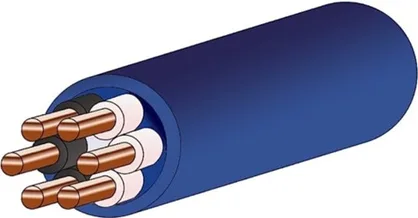
As for geometry, a twisted pair offers a nice balance of inductance and capacitance and if you lay the conductors in a helical arrangement with a filler down the center of the cable, you can emulate the geometry of a twisted pair and further reduce the magnetic modulation between the poles. Finally the copper I use is something most companies wouldn't pay to give a listen to, but all things equal the purity and grain alignment offer a sweet spot where it doesn't get much better than this without the use of certain silver materials — but that's a 0.1x improvement at a 10x cost, where the copper I'm using is a 2x improvement over "Oxygen Free" copper at a 2x cost.
What does this expense and attention end up doing when it hits the ear drum? To use a visual analogy, getting rid of strand interaction is going to bring things into focus. At the low-end, transients are cleaned up. They hit faster. Decay faster. Become articulate and tight. You feel the bottom a little bit more and hear it slightly less. This is often a good time to revisit cabinet position and the tone controls and adjust for the change. In the midrange, chords clean up and you find it easier to hear the notes that make up the chord at the same time that you hear the chord. Geometry plays its hand mostly in dynamics and feel. You get more of a 3D hologram quality to the sound coming off a driver than a 2D painting. And finally, material quality pays off the higher in frequency you go. Inferior copper, or god forbid even worse, adds a distortion that's gritty and irritating. It fires up the inner ear real fast. There's a place for that in our art for sure. Musicians have a cornucopia of pedals available to step on and bend and shape all manners of noise, but if you have to use the same cable on an acoustic 12-string there's no place for that happening in the cable. You can't dial it out. Garbage in garbage out. Simple as that. Open, transparent sweet harmonic integrity going in? You'll get open, transparent sweet harmonic integrity coming out.
TQR: That's equal parts interesting and revealing. We understand. Makes perfect sense to us, let alone what we hear having played these EA cables for more than eighteen years. How things are going after the pandemic for you, and what is ahead for EA these days?
Post-pandemic things are going pretty much the same as they were during the height of the chaos. As a one-man garage shop, social distancing and working from home were lovingly familiar. I will say getting materials got tricky for a while, and production times bounced from one month to around eight, and back down again. But that's just an inventory management issue. As long as I can build stuff the way I want to build it, the rest is logistics. What's ahead for me is the great unknown as with everyone else. I did finish up some tooling on a new plug that will sound great. But it's been a four-year process so by the time this runs you may seem to catch me lying about it. It's always a month away. Has been for years! Quest forth... TQ—Riverhorse
evidenceaudio.com