
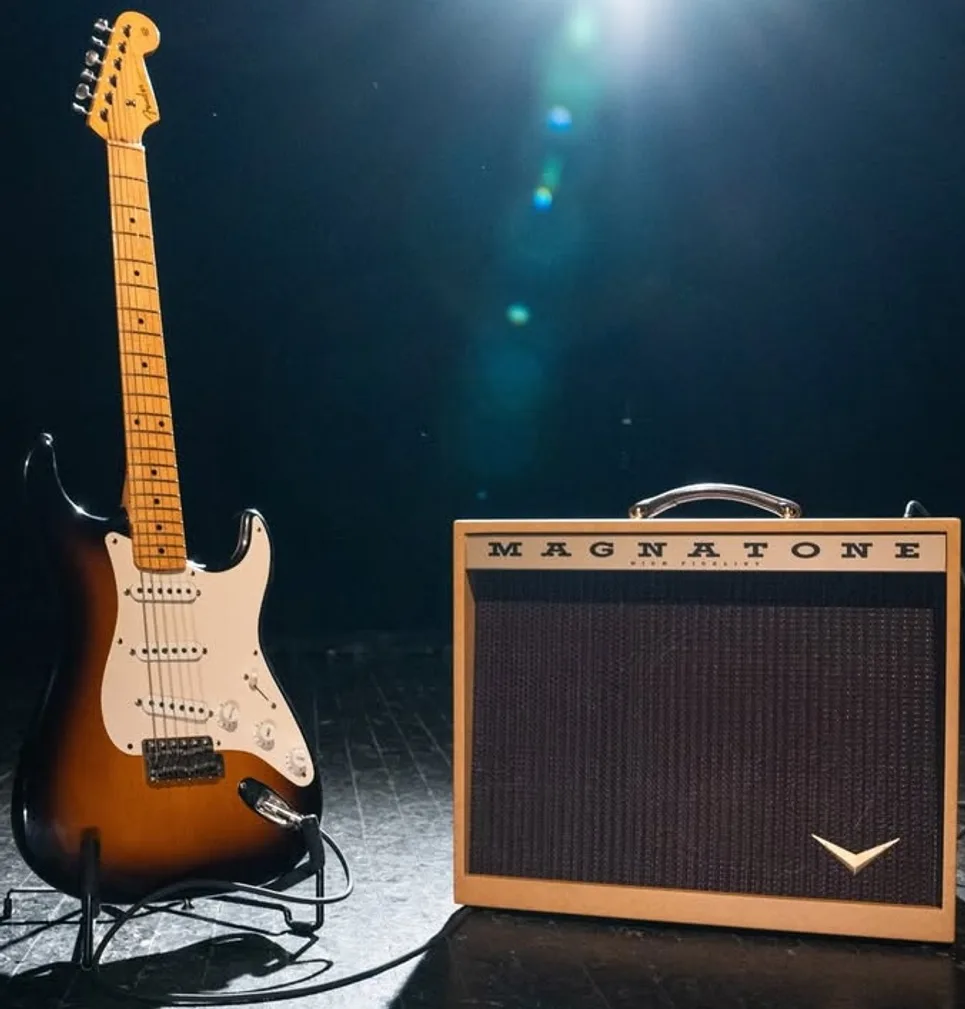
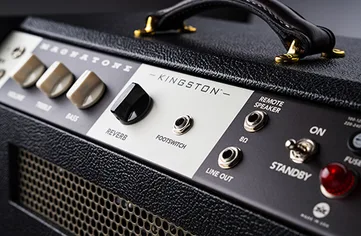
David Wilson simply loved Magnatone, and discussions of the company and their amplifiers have graced these pages over the last 25+ years. When we heard about the release of the Kingston, a 12-watt combo, designed by longtime amplifier designer and beautiful player Obeid Khan and voiced together with Larry Cragg, who at this point needs no introduction, we knew the amp would kill. It does. We sat down with Obeid, Larry, and the Magnatone Company CEO and reviver of the classic brand, Ted Kornblum, for a conversation on all things Kingston.

TQ: The last three to four weeks of playing the Kingston almost every day have been special, and we will miss this one immensely. We understand why Magnatone bills it as a Princeton killer, but to our ears that may sell it short because it sounds like a Magnatone and really much different than a Princeton Reverb. We compared it to the newish Fender reissue Princeton Reverbs, and it was not even close.
Larry: I'm a huge fan of the Kingston. I came home after the NAMM show this year and sold three in the first week.
TQ: Not surprising. Ted, in general, how has the tube amp business been going since you resurrected the brand?
Ted: Oh, gosh. I have quite a bit I could say about that, but in short, it's been a much larger responsibility than I had anticipated. It's not just about building the brand; it's a management process with focus on the day-to-day running of the company.
TQ: What have been the big surprises along the way?
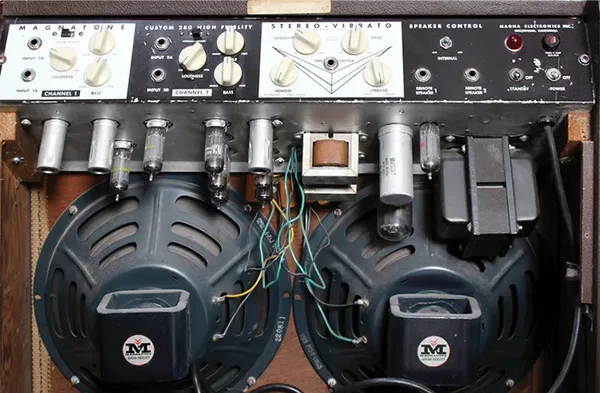
Ted: The consistency in keeping the momentum going. And that's based upon proof in the pudding so to speak as to how the products are performing and perceived by the consumer and the retailer. To keep that constantly going, it doesn't need to be new product all the time. It takes fresh energy combined with not taking things personally if feedback from the internet is all over the place. We've chosen to be an American-made product and brand, and that can be limiting as to how many different price points you can meet. The natural place in the market for Magnatone, which has always been the case, is the high end. I recently found an issue of a magazine from 1958 with a press release that Magnatone was introducing the 280A stereo, high-fidelity vibrato amp. It was listed at $385, which was an incredibly high price point for that year. [Ed. Note: $385 in 1958 translates to approximately $4,136 in today's money.] That same piece also mentioned that Magnatone had recently purchased 7,500 acres in the heart of downtown Los Angeles in order to build factories for the manufacture of their products, which included guitars, amplifiers and organs. That re-energized me when I came upon that article.
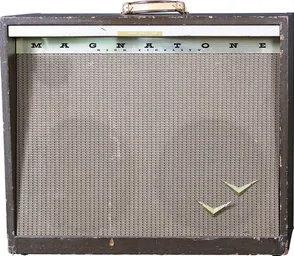
TQ: I hope they held onto that land.
Ted: We could go much deeper on that topic.
TQ: Magnatone got some really good exposure when Phil X was doing those Fretted Americana demos through his Magnatone Troubador 213. Did you consider reprising that amp at any point because the market went nuts for those about 15 years ago.

Ted: I'll let Obeid and Larry talk about that.
Larry: I have quite a bit to say. [Laughs.] My beginnings with Magnatone began with being on the road with Neil Young for 35 years and part of his rig is a Magnatone 280, so I got to know that amp really well, especially trying to keep it going and alive. Ted came to me and said, "If you were king, what amplifier would you design?" and that was easy for me to answer. My favorite amp is a Tweed Pro with 2x12s, and I also have one with 4x10s. So, I would have a Tweed Pro with pitch-shift vibrato and reverb. The 280 was a challenge, and I never liked the core tones. Magnatone came out with the Single V. It sounded killer, but it was too big, loud, and expensive. I made my way to St. Louis [Magnatone's headquarters], and they were working on the Twilighter, a single 12" combo, inspired by the original. I turned it up and it was trashy, awful, terrible, in my opinion. I said, how about we make the best-sounding black-panel Deluxe Reverb ever. So, Obeid, with his brilliance, came up with one, and after a few back and forths with multiple prototypes and in comparison to my black-panel Deluxe Reverb, we got one that just killed. At that point I said, don't change anything. That then became what is now the Twilighter, which has pitch shift vibrato and tremolo. It's got this big, rich tone. You hear it right away, and even though it was the target, this is no Deluxe Reverb. It's what a Deluxe Reverb wishes it would be but never will. There's also a stereo 2x12 Twilighter combo, which is amazing, but it weighs a lot. In the last few years, I had been pushing for a baby Twilighter, and at first it didn't go over very well, but over time it gained traction because the market wants Princeton Reverbs right now. Thus, the Kingston was born. It's got two 6V6 tubes, and the first prototype only had a 10" speaker. I really prefer a 12", so they came out with a Starlight 10, which formerly had an 8" speaker and is now configured with a 10" covered in the product line, and it took the pressure off so the Kingston could be a 12". It's the same WGS speaker, which is a huge contributor to the big and rich tone. The Twilighter is a fantastic amp, and those 22 watts are big watts. It can get really loud, so the Kingston, with its 12 watts and smaller footprint sits in a beautiful spot. I have two mid-'60s black-panel Princeton Reverbs, and I'll A/B those with the Kingston, and while I always thought the PRs sounded good, they really do pale in comparison. It killed 'em. It's like two PRs coming out of the same amp, but bigger and not as flat. The Kingston is more 3-D, which is difficult to explain. You have to be in the room, and one listen is worth a thousand words.
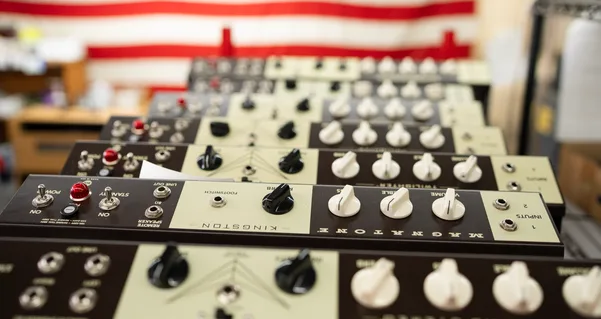
Obeid: We started with the Kingston idea about three years ago, and then it sat for a while until it made sense, and the market timing was right. To your point about the Kingston sounding like a Magnatone, yes, it does in that it's much fuller, with more body, more richness, and more clarity and detail. That's basically it. We built it with digital reverb instead of a tank with a spring.
Digital reverbs can be plate, spring, hall and all of these various studio things which are typically pretty far back in the mix. A spring reverb is more an element that works with the guitar as a sound and based upon early reflections. A digital guy will say the spring is really crappy because you hear all of these flutters and such, but yes, that's what you want to hear.
Larry: Right. That's the beauty.
Obeid: We worked on producing what an actual spring does. We did a good job of replicating that flutter-like sound, and you'll either like it or not within 10 seconds of plugging in. A lot of devices are evaluated by players and customers in this way, where they'll form an immediate opinion as to whether they like it. Everything and everyone has a unique personality. Amps have personality. A Marshall is a Marshall, and no matter where you set the knobs, it's a Marshall. A Twin is the same way: a big, loud, clean, powerful amp, and if you try to play it on 3 or 3½, it's a tough sound to digest. You have to get that amp up around 6 or 7 before it really starts speaking. That's all it does. The concept of one amp that does everything doesn't resonate with me. I believe that these things are like appliances. A washing machine washes your clothes. A guitar amp can sound like this or like that. With the Kingston, we spent a good amount of time prototyping, tweaking, and refining, and in the end, yeah, it's a pretty good-sounding amp.
TQ: It's a great-sounding amp, and by the way, Obeid, we caught a YouTube video of you playing Frank Zappa's "Black Napkins," which is not simple guitar playing. You got chops and your Strat looks like something that Philip Sayce would dig.
Obeid: I've owned that Strat since 1985, and it was a pretty clean sunburst when I got it. I think the previous owner had hit it with a pickaxe and then threw it in his closet. I forced him to sell it to me and couldn't talk him down from $400, which I tried to do once I saw it.
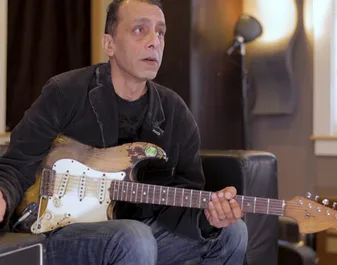
The rest of that wear has been done over the last 40 years or so. I wouldn't let anyone else put their hands on it at this point. No Philip Sayce or Joe Bonamassa. I have instructions to my wife that when I pass, it's not allowed to be sold to any other guitar player. They can all just F off. [Laughs.] It's a nice Strat, which I play all the time.
TQ: Let's talk about some design and component considerations you made with the Kingston. How many different output transformers did you audition? You use a Heyboer, yes?
Obeid: Yes, Heyboer.
Larry: And that's important.
Obeid: Very important. We use their version of a Princeton output transformer, and we didn't do a whole lot of tweaking in that arena because it sounded good. I'll say this about transformers, because there's a whole lot of misinformation out there: Before the internet, you had to mine that knowledge, so there were a limited number of people who were willing to do the hard work, go to the university library, find the books, read them, understand them, go to engineering school, learn about op-amps, transistors, and whatnot. Since the internet has been around, it's been great, because people can learn, but at the same time there's a fair amount of misunderstanding. One guy will say, "Oh, I'm going to put a 'flavor of the day' transformer in my amp because it will make it better." Is it really going to make it better? Do you know why you're doing it? I'm not a firm believer in a lot of that hype.
Larry: I heard a Twilighter with another brand of transformer in it, and compared to the Heyboer it wasn't even close. The Heyboer is one of the reasons that amp sounds and feels like it does. With the other transformer, it sounded crashy. You can't really tell how obvious it is until you A/B it, and then it's like "Oh no, that's all wrong."
Obeid: From an engineering standpoint, it comes down to this. The improvement in the transformer doesn't necessarily equate to a tone improvement. It may be an improvement on paper, with for example, better low-end response and less distortion at lower frequencies. What Larry heard was a harsh overload because the lows were cleaner. It comes down to the core material. It's better when it's linear, but not necessarily better when you clip the thing. When you get that sudden clip, it will be harsh. If you use some type of mid-grade M-19 it can be more pleasing. There's something really good about the way an old Fender breaks up when you turn up the bass a little too much, crank the volume, put the guitar on the neck pickup, and start playing those blubbery, flubby riffs. If you were to improve that transformer with better core steel, take the tube rectifier out, and put in a solid-state one with less sag, it becomes harsh when it breaks up. That pleasing quality is no longer there. There are some things that are inefficient in guitar amps that lead to better sound and feel. If you buy into the marketing hype, where the specs are touted as better, it's often the case that those improved specs lead to lesser-sounding amps. For hi-fi and recording devices, sure, it's different because you don't want them to clip. They're never pushed to overload, but guitar amps are a totally different thing.
Larry: It's all about the tone. What does it sound like? You can have all these theories one way or the other way, but in the end, what does it sound like? That's all that matters.
TQ: Along with what it feels like.
Obeid: Yes, 100%.
TQ: How much experimentation did you all do with different capacitors and resistors, and where did you land?
Obeid: We landed at using carbon-film resistors, and that decision was made early on—one that is consistent across the brand. I tend not to go too far in that esoteric world. I have friends who go there and really experiment with things like that. I build things with functionality and tone first with pretty common parts. When he first started doing them, I went to a Loni Specter amp show. He would put these shows on in hotels that would showcase boutique amps back in the early 2000s. The discussions that I would hear repeatedly were often centered around what capacitors and components were used, and the reality is that you could go to Radio Shack if they were still around, and buy parts that you could use in an amp build that would sound just fine. We auditioned some stuff early on but settled on yellow Mallory 150s and carbon-film resistors. We use 1 watts throughout the whole amp, just to overrate them, and it's been a good formula for us in terms of sound and reliability. Of course, you have to keep price in mind, too. You can't be buying Solen caps out there for like $4 apiece. Some do take on that expense, and I've seen the use of polypropylene film in the power supply, too. It's really impressive and those amps sound excellent, but I think if you took those polypropes out and put in some electrolytics in there, it wouldn't kill the sound of those amplifiers. The sound of great amps is based more upon circuit design choices and how they're laid out. I believe that it's far less about the components themselves. Having said that, in some cases, yes, mica versus ceramic treble and bright capacitors can change the way the top end comes out of the speaker. We use mica for that reason. Larry has ears that can tell the difference between those two components. The end result and what comes out of the speaker is again what matters more than how you got there. In those days of those amp shows, I was a frustrated amp designer guy among many internet amateurs. At that time, I'd already been doing it for 15 or 20 years and felt like "What do these newbs know?" I could go to Radio Shack and build something that would sound and feel just as good.
TQ: It's more about knowing how to dial in a sound based upon all of the considerations, components just being one of them.
Obeid: Right. It's less about whether I have to use this SoZo cap or this Dale resistor. Look at MESA/Boogie. They use Dale resistors and Orange Drop caps in their builds, and it's still a very dull, hard-to-dial-in kind of an amp.
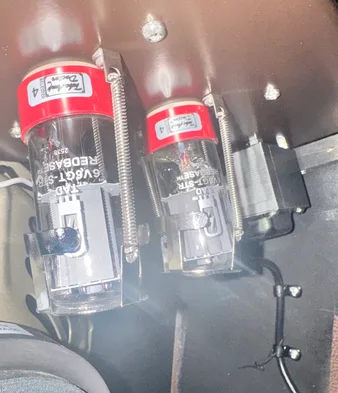
TQ: How'd you come to the TAD 6V6 Redbase tubes?
Obeid: They sound good. The 6V6 is a pretty tricky tube to get right nowadays because the JJ 6V6 is not really a 6V6. It doesn't sound like one. A lot of the JJ stuff is more forward, more aggressive, more midrangey sounding. And that's fine. If you swap those out for older RCAs, it's night and day and you can hear it right off the bat. The TADs are made in a factory in China and although the supply chain is not the greatest and can be variable, TAD does a good job of testing and weeding out those that don't meet their requirements. These tubes are balanced and smooth. Sonics can vary a good amount with power tubes. That said, if you pull EL-34s out of a Marshall and install 6L6s or KT-66s or 6550s, it's still going to fundamentally sound like a Marshall.
TQ: We had a friend back in the late '90s who owned great amps. He had Alessandros, Two-Rocks, Trainwrecks, and Komets, and he'd have me play a Two-Rock with 6L6s, and the distortion was beautiful and creamy, and the crunch tones were so far beyond what I perceived that those tubes would do. We had always read and heard that 6L6s produced big, round, cleanish types of tones. It's more about the circuit than the tubes.
Obeid: Yes, exactly and that's not to say that tubes won't make some difference. You can take a circuit, and if you want to sweeten it up a little bit, there are things you can do, but we're talking about sitting down with a whole stash of stuff for two or three hours and going through it stage by stage, tube by tube, all the while A/B'ing and this kind of thing. We're only talking about the last 5% or 6%. Some guys are willing to do that, and if you're in a studio trying to capture something, sure it can make sense to have the amp super tuned like that, but for the most part the circuit dictates what it feels like and the type of breakup quality you'll get. You can bend it a little bit with preamp tubes, too. A Russian Sovtek 12AX7WA or WB sounds different than a Chinese tube or an EH long plate. Subtle differences, but if it's got too much bass in the front end of the circuit, it's still gonna flub and there's nothing a preamp tube swap is going to do to fix that. You've got to open it up and change that coupling cap value to really make a difference. Preferably go Radio Shack, buy one and stick it in there. It will prove all of the cork sniffers wrong.
TQ: To our ears, the amp leans darker than brighter, which we love because we find too often that we're trying to dial brightness out of an amp. The EQ voicing is perfect for both single-coils and humbuckers.
Obeid: Yes, to both, but I do like top end. I'm the guy who had to listen to Ted and Larry to take some of that out with this amp. I love that glassy top, but you know if it had a bright switch, that would be nice. Plug in an SG, throw the bright switch on, put it on 5 or so, and you might get a little of the Gretschy top end. One of my big pet peeves is when guys clip the bright cap on a Marshall. It kills the amp altogether. What's the point? The Marshall sounds great on 7 because most of that cap is no longer in the circuit, just enough to preserve the perfection in the attack of the note. When on 2, sure it's too much and a bit harsh, but on 7 without the cap, it's not the same. Getting the balance of the Kingston was a bit of a challenge and management of opinions, because you just can't please everyone. The voicing of the EQ is parked in the center, where most players can dial it up and get a good sound. Then go on and play your guitar.
TQ: The amp starts to really work the power section and break up early, like at 9 o'clock, but it's not that preamp-gainy distortion.
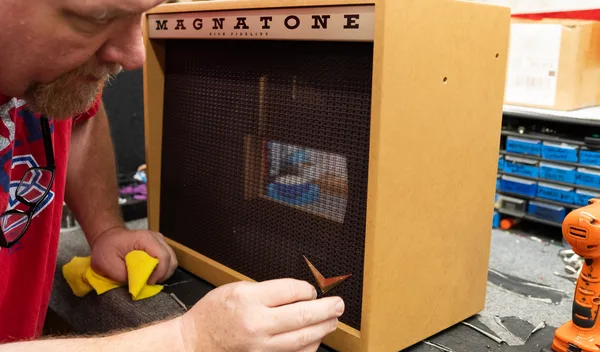
Larry: Right, no master volume, please. You know about me and master volumes. I hate 'em. I was actually Randy Smith's partner at Prune Music back in the day, and he was the guy who invented it. [Laughs.] The first thing guys with master volume amps do is turn the master way down and the volume up, and now you have a buzzy 12AX7 into a cool, idling power section, which sounds terrible. In my opinion, you gotta have output tube saturation to get the bloom. With Neil, he has no master, and he kills it with 6L6s in his Tweed Deluxe. I audition Chinese 12AX7s to find specific ones to be used. They vary so much.
Obeid: I'll agree with Larry on that and say it in a different way. You have to pick the right-size amplifier for the gig.
Larry: Right, if you have to turn down the master, then your amp is too big and non-master volume amps are what we all should have.
Obeid: [Laughs.] Because then you have to choose the right amp so that you're playing into that power. When you take a powerful amp, turn it up only to 2 or 3 and hit it with some gain or boost pedals, it can hurt people. I was just in Dallas yesterday fixing amps for Dave Hinson [Killer Vintage Specialty Guitars owner], and we went to a jam session. There were two Deluxe Reverbs up there in a pretty small room, and that shit was loud. It gets to be kind of piercing when you start pushing things with gain pedals, with a Strat in the bridge pickup position. The next day, a guy brought a Princeton to the same room. It was a much better fit, because he could dial it up a little hotter and push it, and it didn't hit the audience and club owner in the same way. Two Deluxes on a small stage in a shotgun room, you know…forget it. It gets annoying quick.
TQ: We really appreciate the layout of the chassis, and the accessibility of the V1 and Phase Inverter tubes. We were able to quickly and easily experiment with 12AY7s, AU7s and 5751s, with fantastic results. You want a little change to the headroom on the volume and take a little gain out, it's easy to do.
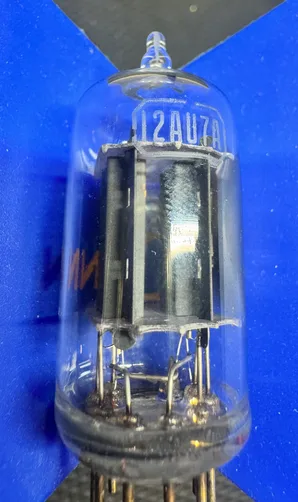
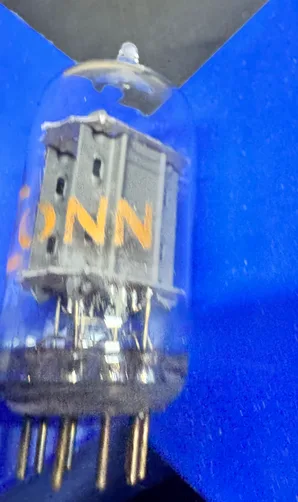
Obeid: Yes, you were in effect fine-tuning the amplifier for headroom, and different guitars may excel with those adjustments. We went to show that amp to Jason Isbell. His tech plugged into it and played it for a while, and then he turned everything on 10, except the bass, which he had on 0, and it was killing. It sounded like Neil.
TQ: And it will chirp with your attack when cranked. "Dance The Night Away" Van Halen is right there.
Larry: Right, don't be afraid to crank that thing all the way up, and when you do, it gets really close to Neil's Tweed Deluxe.
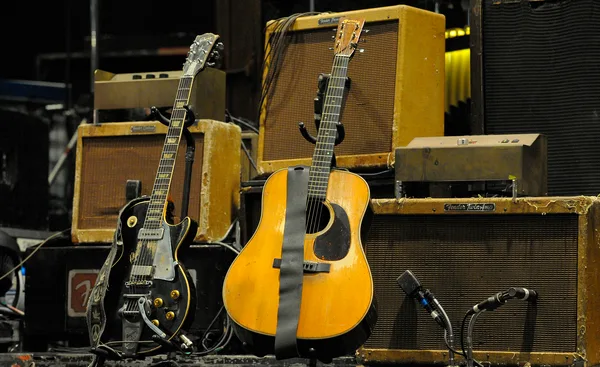
TQ: We did and loved it. It's got great range and holds together. Les Pauls at volume 5 up to 10, back down and up again into the cranked Kingston, is magic.
Obeid: Like you said, plug in an '80s Charvel, and you can play Eddie licks all day long. Volume on 10, Treble on 10, Bass on 0.
TQ: Let's talk about the custom WGS [Warehouse Guitar Speakers] ceramic speaker. How long did it take to get there, and what was the process?
Obeid: That decision happened early on, as well, wasn't it Larry? We listened to a whole batch of different speakers and did so much speaker testing. Celestions, Webers. Dean Birdsong [WGS] makes a really good speaker.
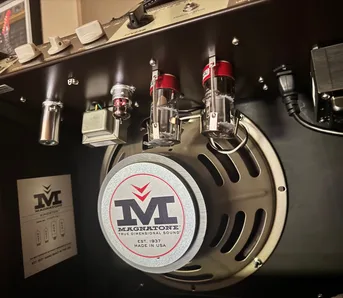
Larry: I came to St. Louis and listened to WGS versus a gold Celestion, which Magnatone offered as an upgrade in the Single V and Twilighter. We went between the two using the same amplifier, and to our ears it wasn't even close. The WGS killed the gold Celestion. I'm so damn happy about it, and I simply love that speaker.
TQ: We experimented with a number of different speakers, which is always fun because the amplifier's personality still comes through, but the speaker's does, as well. Pivoting to the digital reverb, it sounds great and introduces far less mechanical failure risk.
Obeid: Without a doubt, far less.
Larry: The number of times I've had one spring break with Neil. All the miles in trucks. When they break, there's no fixing it. You have to replace it.
Ted: One of the things about the digital reverb that I really like is that we were able to hit a better price point for players to potentially afford to get into the amp. The cost to put spring reverb in along with the associated tube(s) and need for a transformer makes the amp more expensive.
Larry: $2,350 [MAP] for the Kingston is an amazing price for the amp you're getting. I'm astounded by the value.
TQ: And you don't miss having a tube rectifier, because the feel is there as though there is one. It's another tube you don't have to worry about failing.
Obeid: Yes, and it's game over when one of those goes out. The fuse goes and a potentially a whole host of other issues may arise. To your comment about sag and the amp feeling as though there is a tube rectifier: if you put a stiff power transformer in there, it sucks. If you don't have a tube rectifier, you can select the appropriate power transformer with a little bit of sag regulation built into it, and you will get a similar feel. There are multiple ways to get to the end result.
TQ: The PCB board is really solid and bomber looking and checks all of the boxes for what constitutes a good PCB design versus not.
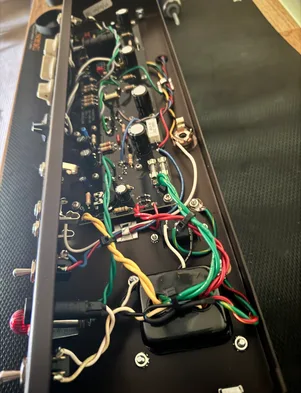
Obeid: I was building amps on PCBs [printed circuit boards] since the early days of SLM [St. Louis Music which owned amplifier brands Ampeg and Crate], and I am well aware of the drawbacks associated with those. Flimsy traces, cheap board material, breaks in traces, etc. We are currently using a thick .090, perhaps a 1/8"-thick board. We don't try to run filament wires in there. You'll see partial filament stuff on the Kingston, but some of it is done in the air in twisted pair. A lot of time, there's a fair amount of current and heat, where you'll need space and clearance. It's double sided, with plated-through holes. I don't have a problem building the amps on PC boards. I get it that some guys feel as though point to point or turret board wiring is preferred for a number of reasons.
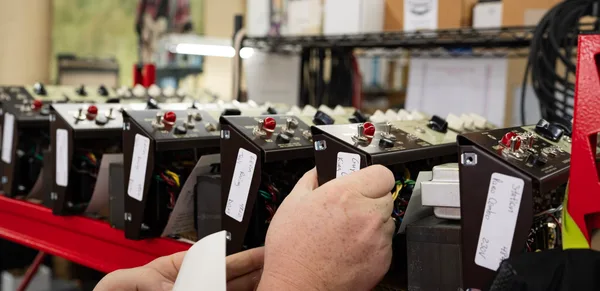
Ted: What I didn't realize, just to tie in here, is that every part has its own home on a board, and that resonated with me and made sense. Because we build the pitch-shifting vibrato on a board, it fits much better and requires far less space. All of the boards are hand-populated, as well. They're not done with machines. We solder by hand.
Obeid: You can tell that the builders have their hands on it. It's not an automated assembly line type thing. They're built one by one by people who care and that's a really nice difference.
TQ: And whoever at Magnatone originally came up with the idea to hold the chassis in place with wood, where it slides into the cabinet on an angle, was a genius. Unlike a Fender, where you have to hold the chassis with one hand, while loosening the last couple of screws with the other, before carefully lowering it down.
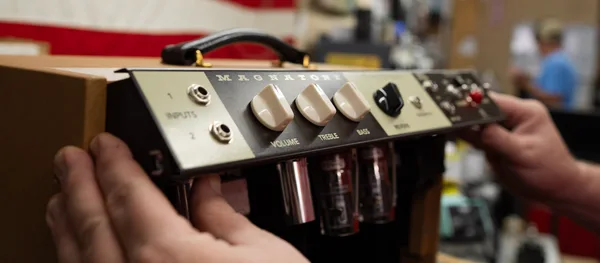
Obeid: Right. It sits on those little cleats, and you can leave everything connected, slide it halfway out, and still work on it. Everything has its pros and cons, but yes, a good design.
Ted: In the beginning with Magnatone—and still to this day—we use what I'll call the "horse sense" of a guy named Bob Dixon at The Amp Hole in Los Angeles. He's a great repair guy, and we have him assess all of our products before they go to market, to ensure that they're easily repairable if there's a problem.
Obeid: Yeah, Bob and Larry are the final gatekeepers.
Larry: I don't take it apart. Rather, I just go by what it sounds like. I listen carefully and have customers plug in with different guitars and unique styles. I'm turning knobs while they're playing to experience what's going on.
TQ: We appreciate that we didn't have to chase any sympathetic resonant buzzes or rattles with the Kingston, which can plague so many cranked combos. It can become a nightmare chasing these things. Is the cabinet made of pine?
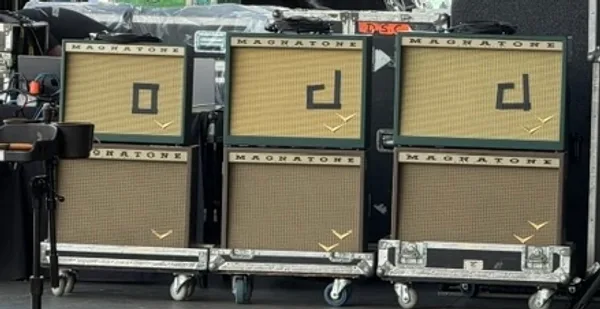
Ted: The sides are ply, as it helps with durability, and with the design of the cabinet, those corners, or "wings," as best described, are vulnerable. The ply adds some rigidity.
Obeid: I learned about rattles in the '90s, listening to like 300 amps down the line, so occasionally you'll find a little pad of Tolex underneath an output transformer because the little fingers of the channel ring mount are metal and they can vibrate and make clicking noises. We've had a fair amount of experience with that situation, so there are design considerations that we make in order to minimize it. We have an amazing person who is last in line in the final assembly, who has exceptional ears, is in tune to the finest of details, and he listens for things like that. When the customer gets their amp, it will be 100% right.
Ted: There was an interesting sympathetic sound that we had to chase down and eliminate. In the beginning, we wanted to make really great leather handles, much better than the originals, and so I had the Amish make them, and they still make them. Originally there was a small piece of steel that ran through the center for reinforcement, but we found that it would resonate. In order to fix the issue, we now encase the steel in a rubber sheath inside the leather and that took care of it. I'll give you one more little detail that may not be a sonic thing, but we wanted to make the covering of the amplifiers legitimate to the way they were done in 1958, which is that they were covered in 100% cotton bookbinding material. Early Vox speaker cabinets were also covered with 100% cotton, so we still use that original material, which is made in Knoxville, Tennessee. We know they will scar when they get dinged, but it's actually more durable than Tolex, because Tolex is reinforced plastic. Fabric looks cooler as it ages and gets beat up. I think our amps are beautiful, aesthetically speaking.
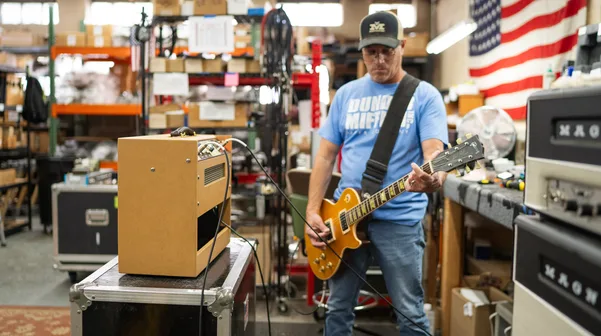
TQ: Chris Benson would agree on the fabric front. The pots, from the material to the sweep, have a high-quality feel to them. Really smooth.
Obeid: Yes, good-quality components. Ted has those knobs tooled up.
Ted: Sometimes manufacturers silkscreen the lines on the knobs and then they fade so that you can't tell where the knob is.
Obeid: Geoff Daking [recording engineer] told me one time that the knobs are very important because that's where the player is most often touching the amp. If you're going to expect that someone is going to spend some money on an amp, things like that are important, as it's an object.
Ted: When I went to Larry initially, it was backstage at a Neil Young show in Chicago, and he simply said, make them better than they were. Make the future Magnatones better.
Larry: The thing about Neil's 280 is that it had a beautiful pitch-shift vibrato, but I hate the core tone of the amplifier, so I wanted a big Fendery sound with the pitch-shift vibrato. Turn off the vibrato on the Twilighter, and you still have a killer amplifier.
Ted: That's what Obeid did. In layman's terms, the vibrato requires a signal to always be going through and because we use silicon carbide varistors, it was making the vintage Magnatones not sound that great. The varistors were hindering the tone.
Obeid: There's a lot going on with the vibrato circuit behind the scenes. I'll start by saying that with the early ones, as Larry described, if you pulled the vibrato out of the circuit, it still didn't sound good. The amp design fell a bit short. Once we started to develop a better circuit with Larry's Tweed Pro in mind, we got it sounding really good, and then added in the vibrato—and it lost something. So, we had to figure out what the vibrato circuit was doing and where in the circuit should we put it, along with how to best bias the varistors, because the circuit itself is like a phase-shift LFO [low-frequency oscillator]. How do we find the center frequency? All of these things affected the sound regarding how it travels through that block. Without giving up all of the secrets, we figured out how to optimize headroom and clip points, biasing of the tube stages, and where in the circuit it should go, which is closer to the back, for noise considerations. It was kinda tricky, but now that we figured it out, it's repeatable across the line.
TQ: What was the process to dial in the voice of the Kingston? Was there a lot of sitting in a room together, a funneling of different players offering feedback in addition to yourselves?
Obeid: Not really. We go short and to the point. We get it dialed in. It's pretty much me along with a couple guys in the shop. They listen a little bit and comment. We get it to a point and then send it to Larry, and he'll either give the thumbs up or down. With most guitar players, you gotta hit 'em within the first 10 seconds. I keep going back to that.
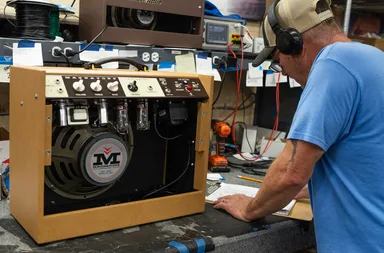
Larry: I agree with that. It either speaks right away for itself or it doesn't. The Kingston and the Twilighter you hear right away. There it is.
TQ: As we've had it here, it's opened up and gotten better as the new components get some signal flowing through them and the speaker breaks in. It's noticeable.
Obeid: There's something to that with instruments. It's a mojo factor. Like with my guitar, it takes 40 years to get there. You can build a dead-nuts exact Marshall clone and put it up next to an old Marshall, and it's like, "Man, what's up here? Why does the old one sound so much better?" It's time. All the metal, electronics, and insulators get a memory to them, where they're all working together. It's like a habit, where you can do certain things with your eyes closed. You play notes on a guitar long enough, it will reach a point of resonance, where it almost plays itself. There's a whole slew of people who will say, "Oh, no. The new stuff sounds just as good." Ok, fine; that's great if you don't hear it, but if you can hear it and feel it, yeah, there's something there. Like an old '50s Junior, most of those just have it.
Larry: With Nils Lofgren, I use my '57 Junior, and I have a number of great guitars, but that's the one I choose. Also, it just sounds so different from a Stratocaster. It roars. I get the coil on that P-90 right up to the strings.
TQ: And it cleans up in the most beautiful way.
Obeid: Yes, and a lot of that is in the magnetics. It's like the steel in the transformers or it's in the bar magnet slugs. They're just not the same anymore. There are pickup builders who send their screws to China and claim that the formulas have been replicated. No, they haven't. It's different. Capacitors, pots, resistors, you can get pretty close. The magnetics is where the difference lies. We're talkin' mojo and voodoo now.

TQ: Anything on the bench or new that's coming and you'd like to talk about?
Obeid: We're doing an outboard reverb/vibrato and chorus unit, called the Vortex. It will be a spring reverb going into a serial-input dual-stage vibrato. You can combine dry signal and get a Univibe-y, phasey sound. It can do vibrato only or you will be able to have tremolo with vibrato. It will be about the size of the old Fender reverb units. Isolated transformers, so no ground loop with a two-amp setup, and it has a remote footswitch that controls and can slow or speed up the effects.
Larry: Yeah, I know all about that. [Laughs.] Don't get me started. With Neil, I'll get things just right in Cleveland and then we'll go on to Syracuse, and the electricity is different. The formula to get the hum to go away has now changed. Who gets grounded now? All electricity is not the same.
Ted: Next year will be the 90th Anniversary of Magnatone, and the release of the Vortex will be in celebration of Magnatone's invention of the pitch-shifting vibrato effect. I'd also like to say how important Larry and Obeid have been since day one and also how important David Wilson and ToneQuest have been, because David was the first person I told about Magnatone coming back to the market back in 2013. He had the full scoop behind the scenes prior to the announcement, and I gave it to him more than any other magazine. It was all ToneQuest, and he did me such a solid. TQ—Scott Ulrichs
magnatoneusa.com
IG: @magnatoneusa