
If you approach the NF53 as a Telecaster, you'll probably be disappointed because, simply, it's not. Like many of the Maryland builder's instruments, it evokes rather than copies, freely blending ideas from both the Fender and Gibson schools. On one side, you get a bolt-on solidbody with a 25.5" neck scale, while also coming with two humbuckers and a wider-nut fingerboard.
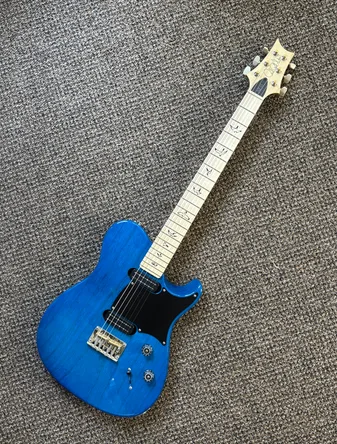
Perhaps it's more like a 1970s Telecaster Deluxe (with Seth Lover-designed Wide Range humbuckers) or Jeff Beck's "Tele-Gib" which had two zebra 'buckers wound by Seymour Duncan. The proverbial best of both worlds. Here, we'll look at a U.S.-built model from the PRS headquarters and factory in Stevensville, Maryland. Its name, NF53, is derived from the PRS Narrowfield pickups and the year of Paul's beloved Tele.
The American version of the NF53 has a three-piece swamp ash body, which makes sense, since swamp ash is hard to source as single pieces. Why that specific tonewood? Because swamp ash (ash trees whose roots grew in damp soil near water) is light and highly resonant, delivering a larger-than-life tone. It's a terrific material that suggests the vibrant persona of aged tonewood, without requiring decades of playing time. It also has contours in the back for playing comfort. Add to that a four-bolt neck joint with contoured heel, a scarfed maple neck with maple fingerboard, medium frets, bird inlays, double-acting truss rod, and a bone nut.

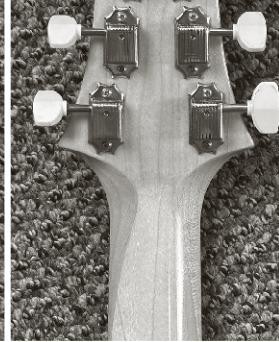
Instead of the large bridge plate and strings-through-body design on Leo's Telecaster, PRS designed a dedicated NF53 bridge, with detents in the body that hold the ball ends and creates an important break angle for intonation. There are also two adjustable brass saddles. On the headstock, look for PRS' light and highly accurate tuners in a 3+3 configuration, as well as their angled headstock, which precludes the need for Fender-style string trees.
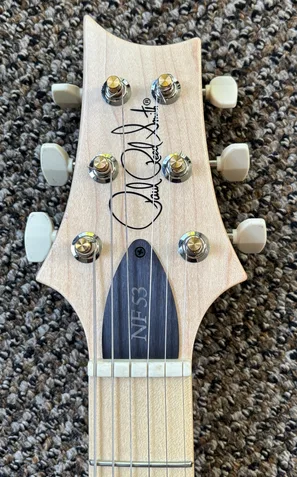
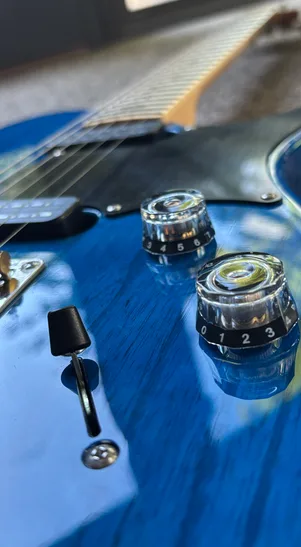
Its pickups are Narrowfield DD, which stands for "deep dish," and have extra-tall bobbins. These narrower humbuckers (vaguely reminiscent of Gibson's mini humbuckers) are screwed into the body, again generating maximum resonance. The electronics are topped with a 3-way switch and master volume and tone controls; the volume is in the perfect location for pinky swells. Best of all, this test NF53 weighed in around 6 lbs. 13 oz., a perfect gigging weight. Lastly, the NF53 I tested came in a potent Blue Matteo hue that pops under bright lights.
The NF53's neck carve is generating lots of conversation, both pro and con. Paul Smith's '53 Telecaster has a hand-sanded, "U"-shaped contour, which is deep, with ample shoulders. These days, U-shaped Tele necks are held in high regard, both for their in-the-mitt feel and for conjuring the "big neck, big tone" aesthetic for transmitting vibration throughout the instrument. (In the distant past, folks often thought that tone came solely from pickups, but today's savvy guitarists know the value of good tonewood, not just in the body, but also the all-important neck.)


As the owner of a 1962 Gibson Les Paul/SG Junior (and having tested endless modern Epiphones), I know all too well what a fat neck feels like, and certainly this one has girth. But where the Junior is almost laughably obese, the PRS' neck is a U that's deeper than wider, which is a huge difference. It's big with a beautiful carve, and once I started playing, I didn't notice its dimensions. One reason is that the PRS setup is so spot-on, I spent my time enjoying the playability of the fingerboard rather than thinking about the carve in the back or the wider string spacing. It's a sweet slab of maple, with a satin, rather than glossy, finish. You can feel the wood.
For another perspective, watch the excellent Ask Zac videos from Nashville guitarist Zac Childs, a vintage Telecaster specialist. In one YouTube clip, he gives the NF53 a thorough testing and notes that aside from the wider nut and larger neck carve, there's not much to complain about. It sports PRS' famous build quality, tone, and perfect nitro finish, though as a musician who prefers a narrower-nut old Tele, it's not his particular taste, which is fair. Again, the NF53 isn't a Telecaster — and Zac points that out clearly.
I've written in The ToneQuest Report before about the PRS Silver Sky [July–August 2024], which also takes advantage of swamp ash to create a vast tone palette. The NF53 has a 3-way switch, so perhaps fewer choices, but the advantages of the tonewood are clear and obvious. The axe has a brash, punchy persona, fusing the body/neck materials with the Narrowfield DD pickups. While the PRS can certainly deliver funky, twang tones galore, what you won't hear is the trebly "clank" of some Telecasters, which can be a plus or minus, depending on your taste. I don't care for it, so the warm but punchy tone of the NF53 suits me well. Also consider the noise-free dimension of the humbuckers, which are an asset at louder volumes. (If you are a traditionalist who prefers single-coils, that's fine. But always remember: iconic Tele wizard Danny Gatton used Barden blade humbuckers in his Fenders.)
As for a price, a new U.S.-made NF53 costs between $2,699 and $2,899, but there's already a brisk used market online, and you can shave it down significantly. The SE version from Korea is priced under a grand, but they have different specs and vibe. (While import PRS SE models are quite good, my preference is for Maryland-built planks all the way.) Another NF53 variation is the PRS Myles Kennedy Signature, which adds a 5-way switch for coil tapping, different pickup voicing, and a fatter neck carve.

Final thoughts? If you want a Fender Telecaster or T-style clone, get a Tele — an easy decision. But that's not the NF53. This is a brave, new guitar for players who want Leo influences, but also other innovations. Even more interesting: the NF53, SE version, and Myles Kennedy are among the company's most popular guitars, next to the hot-selling Silver Sky models. All the more reason to check one out. TQ—Pete Prown
prsguitars.com